A household notebook can hold a grocery decision, a pickup detail, or the place you put a spare part. A reflection notebook can hold thoughts you are still working through, and those pages do not become shared information simply because both books live in the same home.
Begin by deciding who each record is for and what its readers need to know. Clear boundaries can be ordinary and practical: separate books, an agreed storage place, and a conversation about what may be read or shared.
This is an original household organization exercise, not a guarantee of privacy or a substitute for a difficult relationship conversation. Use it to make the intended audience of your notes easier to recognize.

Name the audience before choosing the notebook
Write down who needs to use the household record. A shared list for two adults has a different audience from a visiting helper’s instructions or a child’s reminder about what to bring tomorrow.
Then describe the information that audience actually needs. Someone arranging a ride may need the time and location, but not a private explanation of everything you felt about the conversation that led to it.
Keep personal reflection in a place intended for that purpose. You do not have to make every thought concise, fair to an imagined audience, or ready for discussion simply because you are using a notebook to explore it.
If you want to share part of your reflection later, choose that part deliberately. Copying a practical decision into a shared record can be enough; you do not need to hand over the pages that helped you reach it.
Choose a separation you can recognize easily
Two clearly different notebooks can be simpler than one book with an easily missed dividing page. Choose a distinction you and the other people involved can identify without opening the private section to check.
You might use different covers, a plain label, or separate storage locations. The useful feature is that the arrangement means something you have actually discussed, rather than a color code only you know.
A label is an instruction about intended use, not a physical security device. If you need stronger protection than an agreed boundary provides, choose an appropriate arrangement rather than assuming a different cover settles the issue.
Do not put sensitive details on the outside just to identify the book. A simple description such as household notes or personal writing can distinguish the purpose without displaying the contents to everyone passing by.
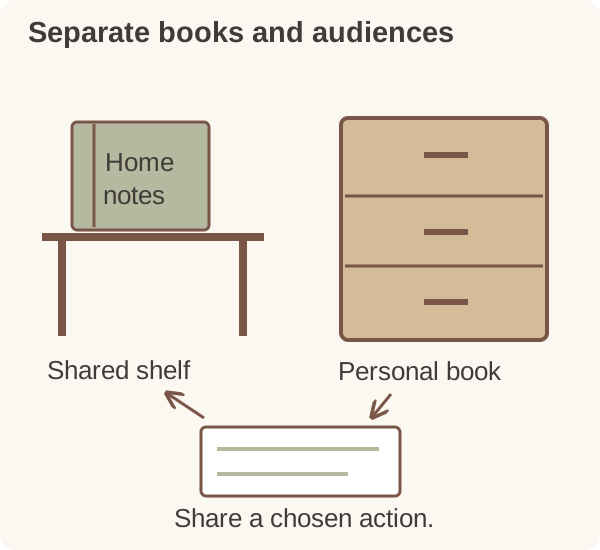
Keep the shared record focused on action
Give a shared entry enough context to be usable: what was decided, who will take the next step, and what remains uncertain. That is different from recording every part of the disagreement or private conversation behind it.
For example, you can write that a visitor’s arrival time still needs confirmation and identify who will ask. You do not need to add an interpretation of the visitor’s motives or preserve a private message word for word.
If an entry concerns another person’s preferences, ask what they want recorded and who should be able to see it. A useful household note does not need to become a permanent record of everything somebody once told you.
Separate a fact from an assumption when you write. Waiting for confirmation means something different from a final arrangement, and the shared record should not make another person’s responsibility look more settled than it is.
Talk about reading and sharing plainly
Tell the people who use the space which notebook is shared and which is personal. Ask them to check before opening, photographing, quoting, or passing along material that is not intended for them.
Offer the same respect in return. A notebook left on a chair, an unfinished letter on a desk, or an open page nearby is not an invitation to review another person’s private writing.
Keep the conversation specific enough to guide ordinary behavior. We can both use the household list, but please ask before reading my reflection journal is clearer than assuming everyone attaches the same meaning to the word personal.
If someone wants to discuss a page, let the writer decide what to share and when. A home organization system cannot resolve every disagreement about boundaries, but it can prevent the storage arrangement itself from being ambiguous.
Use the same audience question for digital notes
If your household record is digital, check the actual sharing settings rather than relying on its title. A file called private can still be available to other people through its own permissions or the folder that contains it.
For example, Google Drive’s official sharing guidance distinguishes viewer, commenter, and editor access and explains that folder access is inherited. Read the current instructions for the service you use instead of transferring those rules to every app.
Keep private reflection out of the shared location unless you intentionally want that audience to have access. Separating files can make the intended audiences easier to manage, but it is not a promise that a digital service eliminates every privacy risk.
Also check the practical copies your household creates, such as printed pages, exported files, screenshots, and message attachments. Changing one file’s settings does not turn those separate copies into the same controlled record.
Give each record a workable home
Place the shared record where its intended readers can reasonably use it. A notebook buried under private work papers is hard to consult and can encourage people to sort through material they did not need to see.
Put personal writing somewhere that fits your own boundary and the realities of your space. You can keep a portable book with your belongings or choose a separate place without creating a decorative display of something you want left alone.
If you move between rooms, check what you leave behind when the session ends. Gathering the notebook, loose pages, and any identifying papers is part of putting away that particular writing activity.
For a shared home, decide how a misplaced book should be handled. Another person can tell you where they found it or return it to an agreed place without inspecting the pages to decide where it belongs.
Consider what a future handoff would look like before leaving a shared notebook for somebody new. Remove irrelevant loose pages and explain the entries they actually need, rather than expecting them to sort a long history of private context from today’s practical instructions.
You can also keep a short contents note for the shared record so people know where to look for ordinary information. Keep that note about the shared book’s purpose, without using it to catalog or describe the contents of your personal journal.
Review the arrangement when its audience changes
A guest, a new roommate, or a helper visiting regularly may change who uses a common surface. Revisit which notes they need and move the rest out of the shared handoff rather than expecting them to infer an old arrangement.
When a practical task is finished, decide whether its entry still belongs in the working record. You can keep useful household history separately without leaving every outdated detail in the list people consult today.
If you want to preserve personal writing, make that a deliberate choice about its future audience and storage. The fact that a notebook is full does not by itself decide whether it should be displayed, circulated, digitized, or discarded.
Keep returning to the same small question: who needs this information for what purpose? That gives both shared coordination and private reflection a clearer place in the home without asking either notebook to do every job.
