A reading corner can look finished before it feels useful at the time you actually sit down. The chair, throw, and book may all be where you want them, while the light lands on the armrest, shines into your face, or changes when someone else uses the room.
Begin with your real seat and an ordinary reading page rather than choosing a lamp from a room photograph. Observe where the page rests, what blocks the light, and what you can adjust without turning a shared space into a display that only works from one angle.
Start from the seat you really use
Sit where you normally read, with the kind of book you intend to open. A tall hardback held in your hands occupies a different position from a notebook resting on your lap, so use the actual arrangement before deciding that the light needs to be higher or closer.
Notice how you settle after the first few minutes instead of holding a pose for the experiment. If you usually turn toward the window, put your feet up, or lean against an armrest, include that movement rather than arranging the lamp around a posture you will not keep.
Try the location at the time you expect to read, especially if your original impression came from a bright afternoon. A window that makes the corner inviting during daylight does not tell you how the same page will look once the room relies on its existing lamps.
Write down the specific problem you see before shopping. You may need light on the lower part of the page, a different angle, or an easier way to reach the switch, and each of those observations points toward a different adjustment rather than automatically requiring a brighter bulb.

Follow the light to the page
With the book open, move only the adjustable parts the lamp is designed to move. Watch whether the light reaches both pages and whether your hand, the book cover, or the chair back casts a shadow across the place you are trying to read.
You can compare a couple of ordinary positions without treating the exercise as a technical measurement. Mark what changed in plain language, such as less reflection on the right page or the lower lines remaining darker, instead of assigning an invented brightness score to the result.
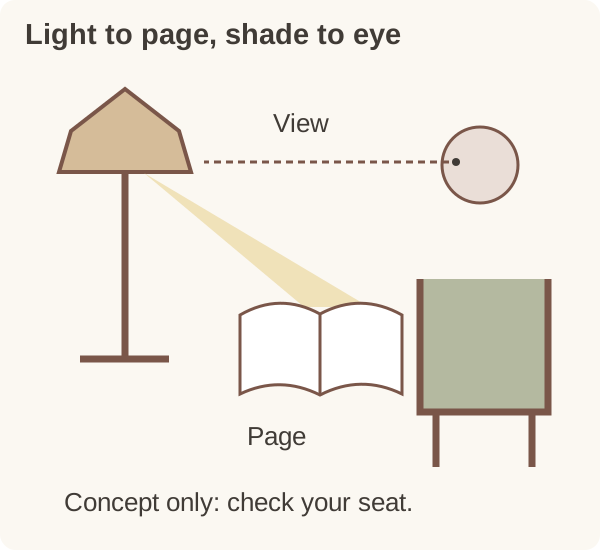
A shaded lamp beside the seat may offer a different angle from a ceiling light above it. That does not make either option universally better, but it gives you a useful question: can the existing fixture direct light toward the task while keeping the source out of your usual view?
OSHA’s workstation environment guidance discusses supplemental task lighting and shades that direct light away from your line of sight. Its context is office workstations, so use that placement idea without borrowing office illumination numbers as a prescription for your home reading chair.
Check reflection from your usual angle
Use a page with the finish you actually read, whether that is a matte paperback, a glossy magazine, or a screen. A position that works for one surface may create a distracting reflection on another, so avoid assuming that every reading material behaves like your first example.
Move your head as you ordinarily would while turning a page and notice whether a bright patch follows the change in angle. Adjust the lamp within its intended range, or shift the reading material, then compare again without holding either one in an awkward position just to make the reflection disappear.
If you read on a screen, inspect it from the actual seated position while nearby lights are on. The same OSHA page specifically addresses reflections on monitors; that supports checking the relationship between source and screen, rather than claiming that a particular household lamp prevents eyestrain.
Keep lighting adjustments separate from diagnosing discomfort or a change in vision. You can describe what you see on the page and improve the arrangement, while leaving persistent symptoms or new difficulty seeing to an appropriate eye-care professional rather than treating the room exercise as a medical answer.
Include the other person in the room
A reading corner may share a room with conversation, a television, or another person trying to rest. Ask how the proposed position looks from their usual place before deciding that your own view settles the question, particularly when the lamp points across the room.
Try the lowest practical adjustment range that works for the activity using the fixture’s actual controls and compatible equipment. If you need a different bulb or dimmer arrangement, follow the specific fixture and bulb instructions rather than assuming that every product can be combined because the socket appears familiar.
Agree on a simple way to change the room when activities overlap. You might use the reading light at one seat while leaving the rest of the room as it is, or choose a different location for a short session when the shared space serves another purpose.
Do not build the plan around everyone remaining still. Include ordinary movement past the chair, opening a nearby drawer, and sitting down at the other end of the sofa, so the final arrangement fits a lived-in room instead of a temporarily cleared path.
Consider the switch, base, and return path
Reach for the switch from your usual seat and then from the standing position you use when entering the corner. A lamp that is easy to photograph may be inconvenient if you must stretch behind a chair every time you want to begin or finish a quiet reading session.
Check the footprint of the base before adding it to a small side table. The book, a necessary everyday item, and the lamp all need their intended place, and a crowded tabletop can mean that a different fixture layout makes more sense than squeezing another object onto the same surface.
Look at the cord route as part of the arrangement, not as something to hide after you have chosen the location. Keep the manufacturer’s installation and use instructions in charge of the setup, and choose a different location if the only attractive placement depends on an unsuitable connection.
For a clip-on reading light, check where the clip is intended to attach and whether that matches your actual book or surface. A product designed around a book cover is not automatically a substitute for a fixed fixture, and its apparent convenience does not answer the compatibility question.
Keep the useful observation, not a perfect diagram
After trying a workable position, write a brief note about the conditions that made it useful. Mention the seat, the time of day, the reading material, and the adjustment that helped, so you can recreate the arrangement without restarting the whole conversation next week.
If the result still requires a purchase, turn the unresolved problem into a shopping requirement. You might need a reachable control, a different base footprint, or a defined adjustable direction, which is more informative than searching for a lamp described only as cozy or suitable for every room.
Return to the arrangement when the furniture or activity changes rather than following an arbitrary adjustment schedule. Your aim is a place where you can open the actual book comfortably within the room’s ordinary life, with clear observations that guide the next choice if something still needs work.
A useful note might say that the glossy magazine reflects the side lamp when it rests flat, while the paperback works at the usual angle. That distinction helps you make the next adjustment without changing everything in the corner at once.
