A textile can matter to you for reasons that have little to do with matching a room. You might have a quilt from a relative, a runner you made during an ordinary winter, or a piece of fabric that brings back a place you no longer visit.
Before deciding where it belongs, separate the story from the job you want it to do. A cloth that can handle everyday meals fills a different role from a fragile keepsake, and your home can make room for both without asking one piece to do everything.
Begin with the story and the ordinary task
Write down what you know about the piece without filling gaps with guesses. You may know who gave it to you and when you received it, while the maker, fiber, or earlier history remains uncertain; that is still enough information to begin a useful household note.
Then name the task you are considering in plain language. Covering a sofa during daily reading, sitting beneath a serving bowl, and being admired on an occasional afternoon involve different kinds of handling, even if each possibility starts with the same folded textile in your closet.
Ask whether you want to see the piece often, use it physically, or keep its story accessible. Those goals can lead to different arrangements, and you may discover that a photograph and a short note meet your immediate need while you consider appropriate care for the original.
A meaningful textile does not have to occupy the largest surface in the room. A small cloth used intentionally can feel more connected to your life than a large display you keep rearranging because it blocks the chair, collects everyday spills, or makes you anxious whenever someone visits.
Choose a role that respects its condition
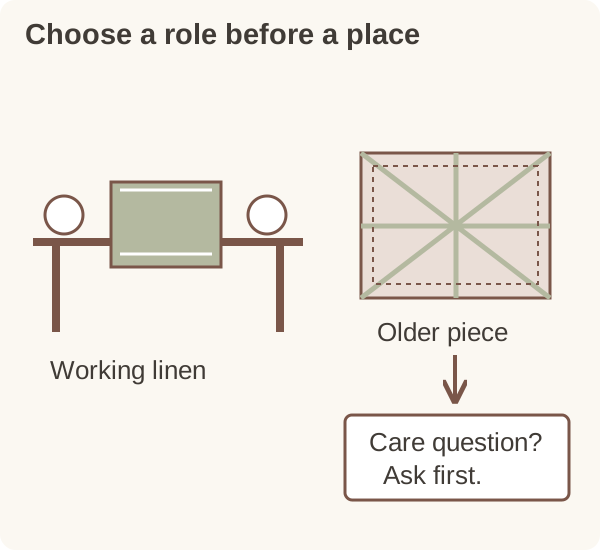
Lay out the choice before you commit to a display: everyday use, occasional use, or keeping the piece protected while you seek advice. You are deciding what you will ask of it, rather than awarding the object a rank based on how sentimental you feel.
For a current household product with a readable care label, keep those instructions with your practical decision. For an older or historically significant textile, avoid treating a familiar laundry routine as proof that the same method is appropriate just because another blanket looks similar.
The Textile Museum’s care guidance distinguishes everyday linens from historical textiles and advises consulting a textile conservator before cleaning historical pieces. That is a useful boundary when you are tempted to wash an inherited item first and ask questions only after it comes out differently.
If you see weakened areas, loose decoration, or changes you do not understand, pause the proposed use instead of improvising a repair for the sake of finishing the room. You can make the room comfortable with another cloth while deciding whom to ask about the piece that matters.
Try the placement without forcing the piece
Start with the daily movement around the proposed location. A runner that falls into the path of a pulled-out chair, a throw that drags where feet pass, or a cloth that must be removed for every ordinary task may turn an appealing idea into repeated handling.
Use a different, ordinary cloth to test the size and placement when you are uncertain. Mark the approximate footprint on your table or chair with that stand-in, then carry out your usual activity before asking the meaningful piece to occupy the same position.
You might find that a shorter runner leaves room for plates, or that a throw belongs beside the reading chair rather than across its entire back. These are layout observations about your space, not judgments about the textile’s quality or a promise that the arrangement protects a delicate object.
For an inherited piece you only want to view, consider getting advice about its support before hanging it. A convenient hook or a clip that works on a current kitchen towel does not establish that an older textile can carry its own weight in the same way.
Notice the room beyond the matching colors
A location can look right in a photograph and still need a closer look during the day. Watch where sunlight falls, where people set drinks, and which surfaces are handled whenever a door opens or a chair moves, then include those observations in your placement decision.
The Textile Museum notes that light can fade dyes and make textile fibers brittle. Its collection-care discussion is a reason to reconsider a treasured piece in a bright display location, rather than assuming that a beautiful sunny spot is automatically the best place for it.
You do not need to redesign the entire room to respond to that observation. You might choose another piece for the bright everyday position and keep the meaningful textile elsewhere while you work out a suitable way to enjoy it, especially if its condition or materials remain uncertain.
Keep your decision specific to the object and setting instead of announcing a universal rotation schedule. A modern machine-made tablecloth and an older embroidered panel have different questions attached to them, so a number borrowed from a museum example is not an automatic household timetable.
Keep the story close without attaching it blindly
A separate story card can preserve useful context without making you handle the textile every time you want to remember it. Include the giver, the occasion, what you know directly, and any questions still open, using clear dates when you actually have them.
Keep family recollection distinct from documentation. You can write that someone remembered the piece in a particular home without declaring that the memory establishes its age, maker, or origin, and you can update the note later if another relative offers a different account.
Do not pin, tape, or write on a textile simply because the note feels important. Keeping the record separately lets you make a useful start without choosing a labeling method that may be unsuitable for the actual fabric, stitching, or condition in front of you.
If the story includes faith or family traditions, describe the connection in your own terms rather than presenting it as the only correct use. You might remember the cloth at a holiday meal while choosing a different setting for it now, without treating that change as a loss of meaning.
Make the everyday arrangement easy to live with
Once you choose a working textile, decide what happens before and after the activity it supports. A table runner might have a specific place to go when you need the full surface, while a reading throw might return to the same nearby shelf after use.
Choose that return place before adding more decorative layers. If moving one meaningful cloth requires rearranging three other objects every evening, simplify the surrounding display so that the piece remains part of the room you actually use rather than an installation everyone avoids disturbing.
When the piece is not in use, keep its care information with your household notes so another person does not have to guess. Record only the instructions you have actually established, and leave an explicit question where the material, cleaning method, or storage arrangement still needs qualified advice.
You are allowed to choose a current, replaceable textile for the busiest task and enjoy an older piece differently. Meaning comes from the connection you recognize and the care you choose, not from proving that every treasured object can survive the most demanding part of daily home life.
Keep a simple photograph of the arrangement with your notes if it helps you remember the decision. That record can explain where the piece belongs without requiring another person to recreate your reasoning.
