Best Surfacing Router Bits for Slab Flattening and Planing
Precision in surface flattening is essential for producing flat, stable workpieces and achieving consistent finishes in woodworking. The right surfacing router bit can turn rough slabs into smooth, planed panels, making spoilboard resurfacing faster and more reliable. The following article reviews five top-rated carbide-tipped CNC spoilboard and slab-flattening bits available on Amazon. They vary in shank sizes (1/4″ and 1/2″), cutting diameters (1″ to 2″), and wing configurations, offering durable cutting edges and anti-kickback designs. This overview highlights each tool’s key strengths, material compatibility, and practical applications to help you choose the best fit for your shop.
| Product | Brand | Shank | Diameter | Notes |
|---|---|---|---|---|
| BINSTAK CNC Spoilboard Surfacing Bit (2″ Dia, 1/2″ Shank) | BINSTAK | 1/2″ | 2″ | Carbide-tipped, anti-kickback, heat-resistant coating |
| POWERTEC Slab Flattening Bit (2″ Dia, 1/4″ Shank) | POWERTEC | 1/4″ | 2″ | Hardened steel body, tungsten carbide edges, anti-kickback |
| SICWOOD Slab Flattening Bit (2″ Dia, 1/2″ Shank) | SICWOOD | 1/2″ | 2″ | 6-wing design with replaceable carbide inserts |
| BINSTAK Extra Large Slab Bit (1-1/2″ Dia, 1/4″ Shank) | BINSTAK | 1/4″ | 1-1/2″ | Carbide inserts; replaceable 4-sided edges |
| SpeTool Slab Bit (1-1/4″ Dia, 1/4″ Shank) | SpeTool | 1/4″ | 1-1/4″ | 2+2 carbide inserts; ATS coating for longevity |
BINSTAK 2-Inch Surfacing Bit, 1/2″ Shank

This carbide-tipped bit is designed for heavy-duty spoilboard surfacing and slab flattening. It uses a 1/2″ shank and a 2″ cutting diameter with a 1/2″ cutting length, delivering solid material removal while maintaining edge integrity. A heat-resistant Teflon coating helps minimize resin buildup, making cleanup easier in workshop environments. The bit’s anti-kickback design supports smoother operation when feeding material through a router, reducing tool deflection during heavy stock removal.
- 3-wing carbide bit for efficient material removal
- Shank: 1/2″; Cut Diameter: 2″; Cut Length: 1/2″
- Anti-kickback design and heat-resistant coating
- Ideal for wood slab flattening, spoilboard resurfacing, and planing
POWERTEC Slab Flattening Bit, 2″ Diameter

POWERTEC’s slab flattening bit is built for precision and longevity. With a solid hardened steel body and tungsten carbide-tipped edges, it remains sharp through multiple passes for high-quality finishes. The anti-kickback design promotes controlled, uniform cuts, minimizing chatter in varied grain directions. The 2″ cutting diameter and 1/2″ cutting depth enable flattening large surfaces, suitable for spoiling boards, dado slots, and grooves, providing a versatile tool for professional workshops and hobbyists alike.
- Solid hardened steel body with tungsten carbide edges
- 2″ cutting diameter; 1/4″ shank; 1/2″ cutting depth
- Anti-kickback design for smooth, controlled operation
- Good for flattening large surfaces, trimming, and slotting
SICWOOD Slab Flattening Bit, 2″ Dia, 1/2″ Shank
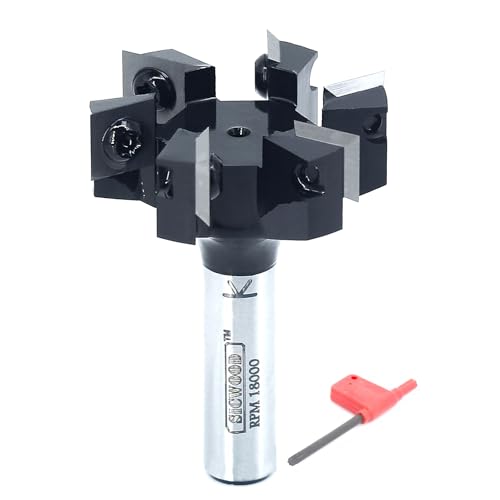
SICWOOD offers a 2″ diameter slab-flattening bit with a 1/2″ shank and a 6-wing carbide design. Its replaceable carbide inserts (12x12x1.5 mm) provide extended life and resharpening options, allowing multiple edge uses before replacement. The bit is engineered for smoother cuts and higher RPM performance, making it a solid option for flattening large spoilboards and planing top surfaces. The insert system reduces overall tooling costs by enabling edge reuse rather than discarding the entire bit when dull.
- 2″ cutting diameter; 1/2″ shank; 6-wing design
- Replaceable carbide inserts with long life and sharpness
- High RPM capability (up to 18,000) for smooth results
- Efficient and economical for spoilboard resurfacing
BINSTAK 1/4″ Shank, 1-1/2″ Dia Slab Bit

This extra-large cutter from BINSTAK features a 1/4″ shank with a generous 1-1/2″ cutting diameter. The design leverages four carbide-edged inserts to deliver robust removal with consistent finishes. Anti-kickback construction helps maintain control when working across wide spoilboard surfaces. The tool is well-suited for flattening, planing, and creating flat reference faces on large panels or slabs, making it a reliable choice for production shops and custom woodworking projects alike.
- Shank: 1/4″; Cut Diameter: 1-1/2″
- Carbide insert edges (4-sided) for extended life
- Anti-kickback design supports stable cuts
- Planing and leveling of large surfaces
SpeTool 2+2 Flute Slab Flattening Bit, 1/4″ Shank

SpeTool’s 2+2 flute design combines precision and longevity. With a 1/4″ shank and a 1-1/4″ cutting diameter, this bit uses 10x10x2.2 carbide inserts and an ATS coating to extend life in mixed hardwoods, softwoods, and MDF. The replaceable carbide inserts enable quick edge rotation or replacement without discarding the entire bit, delivering cost savings over time. This configuration is particularly effective for heavy-duty slab flattening tasks and spoilboard resurfacing where longer tool life is critical.
- 2+2 carbide inserts; 10x10x2.2 size
- 1/4″ shank; 1-1/4″ cutting diameter
- ATS coating for longer life; replaceable inserts
- Suitable for softwood, hardwood, and MDF
Buying Guide
Key Purchase Considerations
- Shank size: Most home routers accept 1/4″ or 1/2″ shanks. Choose a bit that matches your machine’s collet size and power capacity. Larger shanks are stiffer and can handle heavier stock removal, but require compatible routers.
- Diameter and cutting depth: Larger diameters remove material faster but require more precise setup and flatter stock. Consider your spoilboard or slab size and your router’s horsepower when selecting diameter and cutting depth.
- Wing count and insert design: Bits with more wings or replaceable carbide inserts tend to run smoother and last longer, especially on aggressive passes. Inserts reduce overall cost since only the worn edge needs replacement.
- Carbide quality and coatings: Carbide inserts with coatings (e.g., ATS, Teflon) help resist resin buildup, extend edge life, and ease cleaning. High-quality carbide tolerances also contribute to more consistent finishes.
- Anti-kickback design: Features that reduce kickback improve control and safety, particularly when resurfacing large spoilboards or heavy slabs.
- Application scope: Some bits are optimized for spoilboard resurfacing, others for plain slab flattening, dadoing, or grooves. Ensure the tool matches your primary tasks.
- Maintenance and replacements: Look for readily available replacement inserts or blades. A tool designed for easy insert replacement reduces downtime and cost over the life of the bit.
- Machine compatibility and RPM: Verify your router’s RPM range supports the bit’s operating speeds. Avoid forcing a bit beyond its rated RPM as this can wear the edge quickly or cause chatter.
Comparison At A Glance
| Product | Shank | Diameter | Inserts / Wings | |
|---|---|---|---|---|
| BINSTAK 2-Inch Surfacing Bit | 1/2″ | 2″ | 3 wings; carbide | Anti-kickback; heat coating |
| POWERTEC Slab Flattening Bit | 1/4″ | 2″ | Solid carbide edges | Anti-kickback; durable |
| SICWOOD Slab Flattening Bit | 1/2″ | 2″ | 6 wings; replaceable inserts | High lifespan; economical |
| BINSTAK 1-1/2″ Dia Bit | 1/4″ | 1-1/2″ | 4-sided carbide inserts | Extra-large diameter; inserts replaceable |
| SpeTool Slab Bit | 1/4″ | 1-1/4″ | 2+2 inserts | ATS coating; replaceable inserts |
When selecting a surface-finishing bit, align your choice with typical stock sizes, desired finish quality, and maintenance preferences. For frequent spoilboard resurfacing on large tables, a larger diameter with replaceable inserts can maximize uptime and reduce downtime. If your work involves hardwoods with dense grain, a multi-wing or insert-based design can deliver smoother surfaces with less chatter. Always consult your router’s manual for recommended bit diameters and RPM ranges to ensure safe and effective operation. A well-chosen bit simplifies flattening tasks, delivers consistent planing results, and extends the life of your spoilboard and machinery.