Best Screws for Hardie Board: Durable Cement Board Fasteners for Projects
Choosing the right screws for Hardie board, a popular cement-fiber backer, depends on board type, environment, and installation method. This guide highlights five top cement board screws designed to fasten Hardiebacker and similar boards to wood or metal studs. The selections emphasize self-drilling versus drill-point designs, drive types, and corrosion resistance, with a focus on reliable performance and long-term durability in moisture-prone spaces such as bathrooms and kitchens. The table below provides a quick at-a-glance comparison of key specs to help you choose confidently for your project.
| Product | Brand | Diameter | Length | Drive | Notes |
|---|---|---|---|---|---|
| Hard-to-Find Fastener Cement Board Self-Drilling Screws | Hard-to-Find Fastener | #8 | 1-1/4 in | Self-Drilling | Steel construction |
| Jake Sales Cement Board Screws | Jake Sales | #10 | 1-1/4 in | Torx/Star T-25 | Sharp point; 166 screws per pound |
| Rock On Cement Board Screws, Serrated Head | Rock On | #9 | 1-1/4 in | Star/T-25 | Serrated head; hi-low thread |
| Jake Sales Drill Point Cement Backer Screws | Jake Sales | #10 | 1-1/4 in | Torx/Star | Drill point; 161 screws per pound |
| Lexar Industrial Phillips Wafer Head Cement Board Screws | Lexar Industrial | #8 | 1-1/4 in | Phillips | Hi-Lo coated; 750 pieces |
Hard-to-Find Fastener Cement Board Screws

The Hard-to-Find Fastener cement board screws are designed specifically for cement board installations, with a #8 diameter and 1-1/4 inch length. Made from steel, these self-drilling screws streamline installation by eliminating the need for pilot holes in standard backer boards. The self-drilling capability helps create a clean, secure bite into both the cement board and underlying substrate, which is especially helpful in bathroom and kitchen applications where moisture resistance and long-term hold matter. The combination of size and self-drilling design makes them a practical option for fastening Hardiebacker and similar cement boards to wood framing.
Jake Sales Cement Board Screws With Sharp Point
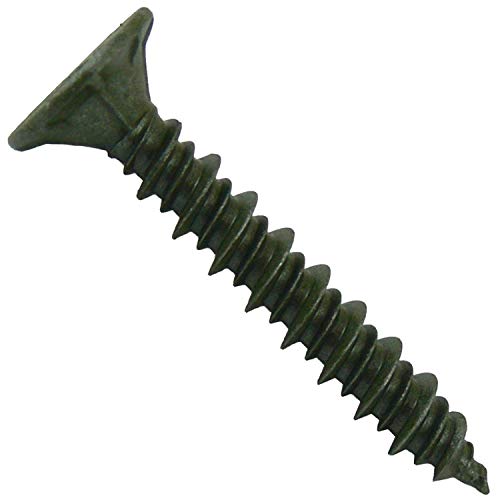
Jake Sales’ #10×1-1/4 inch cement board screws feature a sharp point and Torx/Star T-25 drive, designed for fastening backer boards to wood while maintaining strong holding power. Manufactured from high-quality heat-treated steel and ceramic-coated, these screws offer corrosion resistance across common cement board brands such as Hardiebacker, Wonderboard, and PermaBase. The 1-1/4 inch length is well-suited for typical 1/2 inch to 5/8 inch cement boards when used with standard carpentry framing. The combination of a sharp point and a reliable coating supports quick, confident installation in interior projects like tiling substrates in bathrooms and kitchens.
Rock On Serrated Head Cement Board Screws

Rock On 23301 screws measure 9 by 1-1/4 inches with a serrated head designed for flush seating. The star drive pairs with a T-25 bit for one-handed installation, while the hi-low thread and sharp point provide rapid bite into cement board during fast installation. The serrated thread helps resist loosening in high-friction joints and can improve edge grip along tile backing boards. This set is particularly useful for projects requiring strong initial purchase and a concealed screw head aesthetic on visible countertops or wall-substrates.
Jake Sales Drill Point Cement Board Screws

The Jake Sales 10×1-1/4 drill point screws feature a drill-point tip and a Torx/Star drive suitable for cement backer and tile boards. Designed to fasten cement board to metal studs as well as wood, they are made from high-quality heat-treated steel and ceramic-coated to resist corrosion. The 1-1/4 inch length provides adequate bite for most backer board installations, reducing the need for pre-drilling in many scenarios. This option is well-suited for projects involving metal framing, where the drill-point tip helps prevent wandering during start-up aligns with the stud.
Lexar Industrial Phillips Wafer Head Cement Board Screws

Lexar Industrial offers #8 diameter, 1-1/4 inch long cement board screws with a Phillips wafer head and Hi-Lo drive design. The Hi-Lo coating helps reduce cam-out and improves driving efficiency, especially for long runs across larger backer-board installations. This bundle is positioned for rapid assembly in residential tiling projects, where a clean, flush look is important and where a compact head is desirable to minimize profile against tiled surfaces. The Hi-Lo coated screws are suitable for fiber cement boards and similar substrates frequently used in bathrooms and laundry areas.
Buying Guide
Choosing the right cement board screws for Hardie board involves balancing board thickness, framing material, environment, and tool compatibility. Start by selecting the correct diameter and length. For most cement boards used in residential installations, screws in the #8 to #10 range and lengths from 1-1/4 to 1-5/8 inches provide reliable bite without penetrating too far. If you are using metal studs, drill-point or self-drilling options combined with a tougher drive (Torx/T-25) reduce cam-out and provide cleaner starts. In wood-framed walls, self-drilling or sharp-point screws tend to offer quick installation with less pre-drilling.
Drive type matters for both speed and accuracy. Torx/Star drives (T-25) and Phillips wafer heads are common choices. Torx bits resist cam-out better under high torque, which is beneficial on longer runs or when working with dense cement boards. Phillips heads are widely compatible with standard drill/driver bits but can suffer from cam-out with heavy torque. Coatings such as ceramic, Ruspert, or Hi-Lo finishes enhance corrosion resistance in moisture-prone spaces like bathrooms, kitchens, and basements. When installing in wet areas, prioritize corrosion resistance and consider stainless options if permitted by the project specifications.
Installation method should match board type and substrate. Self-drilling screws work well when fastening to wood and many light-gauge metal studs, but they may require pre-drilling for very hard metal profiles. Drill-point screws offer a clean start on metal studs and are useful when you need precise pilot alignment before seating the screw. Always drive screws to a flush or slightly recessed depth to avoid uneven tile substrates; over-tightening can crack or compress the board’s surface. For large projects, consider screw counts per pack to ensure you have enough fasteners for uniform coverage across all joints.
Brand or packaging considerations can influence performance and value. Look for cement board screws advertised for backer boards such as Hardiebacker, Wonderboard, or PermaBase because these listings often reflect compatibility with common tile substrates. Coating and material composition matter for longevity in damp environments. If you work with both wood and metal framing, you may prefer a mixed set that includes both self-drilling and drill-point options with a star drive. Finally, verify product specs against your board thickness and wet area requirements to ensure a secure, lasting installation.