Best Porcelain Tile Blade for Clean, Precise Cuts on Ceramic and Marble
Choosing the right porcelain tile blade ensures clean edges, minimal chipping, and longer tool life. This guide highlights five top-rated blades designed for porcelain, ceramic, marble and other stone, and explains how to choose based on cutting conditions, material, and equipment. The blades here support wet and dry cutting, come with different arbors, and are suitable for both home projects and professional installations.
The five selected blades below cover common grinders and cutting scenarios.
| Product | Brand | Key Feature |
|---|---|---|
| QEP 7-Inch Premium Diamond Blade | QEP | Continuous rim; wet/dry; 5/8″ arbor; minimizes chipping |
| Casaverde 4.5-Inch Blade | Casaverde | Dry/Wet; X teeth; thin turbo rim; smooth cutting |
| EZARC 4-1/2-Inch Blade | EZARC | Super thin; X-teeth; clean cuts; wet/dry |
| ZORUNNA 5-Piece Diamond Blades | ZORUNNA | Ultra-thin; X-teeth; wet/dry; 4.5″ blades |
| GoYonder 4.5-Inch Tile Blade | GoYonder | 2 arbor options; wet/dry; X-teeth |
QEP 7-Inch Premium Diamond Blade

Designed for both professional tile installers and DIYers, the QEP 7-Inch Continuous Rim Premium Diamond Blade handles ceramic, porcelain, and marble with minimal chipping. The blade uses a continuous rim designed to deliver a smooth edge on hard tiles, while supporting wet or dry cutting to match various job-site needs. With a 0.625-inch arbor, it fits a wide range of angle grinders. This combination of rim design, versatility, and build quality helps deliver straight, clean edges on porcelain tile while maintaining blade life.
In practice, wet cutting is often preferred for porcelain because water cools the blade and reduces heat buildup that can cause micro-chipping. The QEP blade’s design helps minimize chipping and extend edge integrity when cutting across large format tiles or mosaic sheets. For best results, secure the tile, use steady passes, and avoid forcing the blade through material. Regular checks for warping, proper guard clearance, and consistent lubrication when wet cutting will extend blade life and performance.
Limitations include the need for appropriate clearance on some grinders and the potential for wear with aggressive dry cuts on very hard stone. Verify your grinder’s arbor size and ensure the blade is mounted flat to prevent wobble. As a versatile option in mid-priced blades, the QEP is a solid choice for porcelain, tile, and marble projects requiring dependable edge quality.
Casaverde 4.5-Inch Super Thin Diamond Tile Blade

Casaverde’s 4.5-inch blade is designed for flexibility, offering universal compatibility for both dry and wet cutting. The blade features X teeth for fast, smooth cutting and a super-thin turbo mesh rim that lowers kerf and reduces chipping when slicing porcelain and marble. The thin profile helps minimize heat buildup and allows precise control on tight angles, making it a strong option for both kitchen backsplash work and bathroom tile installations.
Users benefit from fast performance and cleaner edges on dense materials. The blade’s thin profile requires careful handling to prevent overheating; use water during cutting to extend blade life, and avoid forcing the blade. The 4.5-inch size fits most handheld grinders, and the universal design reduces changeover time on multi-material projects.
Potential limitations include reduced wear life when used aggressively on extremely hard stone without proper cooling. Always verify arbor compatibility with your grinder; Casaverde blades typically pair with standard arbors and require a secure guard to maintain control during use.
EZARC 4-1/2-Inch Super Thin Diamond Blade
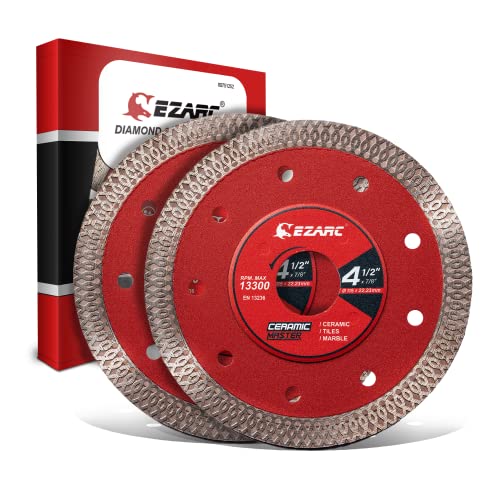
EZARC’s 4-1/2 inch blade emphasizes precision through a super-thin design and X-teeth turbo mesh rim. The thin kerf reduces cutting force, enabling smoother, cleaner cuts in porcelain and ceramic with minimal chipping. The blade supports both dry and wet cutting and is compatible with common 4.5-inch angle grinders, making it a practical choice for detailed tile work on countertops, showers, and floors.
Two blades in the package offer value for repetitive tasks and provide backups for longer projects. The design prioritizes reduced vibration and consistent results across curves and angles. To maximize life, use water during cutting to cool the edge and prolong blade life, and avoid pushing the blade too quickly through tough materials.
While thin blades excel in precision, they can be more prone to edge wear if used on particularly hard stone or with poor mounting. Check your grinder’s arbor (7/8-inch standard or metric equivalents) and ensure a secure, flat mounting surface. Overall, EZARC provides reliable performance for meticulous porcelain and ceramic tiling.
ZORUNNA 5-Piece Diamond Tile Blades

ZORUNNA’s 5-piece set provides a versatile toolkit for porcelain, ceramic, granite, and marble projects. The blades highlight an ultra-thin design with an X-teeth turbo mesh rim for fast, precise cuts with minimal chipping. The 4.5-inch blades are sized for standard handheld grinders, making it easy to tackle both straight runs and tight corners in kitchen and bath tile installations.
Performance is enhanced by a thicker core that reduces vibrations and wobble, contributing to steadier cuts and safer operation. The set supports both wet and dry cutting, with water recommended for deeper cuts and longer blade life. While the blades are designed for versatility, users should match the blade to the task—select the blade with appropriate thickness and tooth configuration for porcelain versus ceramic.
Careful mounting and proper cooling are essential to preserve edge quality. Avoid overheating by using light to moderate pressure and allowing brief pauses to prevent heat buildup. For multi-material projects, this set offers a convenient way to keep a blade on hand for different materials.
GoYonder 4.5-Inch Tile Blade

GoYonder’s 4.5-inch tile blade is designed for versatility and accuracy. The blade features a dual arbor design that accepts both 5/8-inch and 7/8-inch hubs, allowing use with a wider range of grinders. It is suitable for wet or dry cutting and is built to work with porcelain, granite, marble, and ceramic tiles. The flexible product design helps ensure stable cuts across curves and long runs.
GoYonder uses an X-teeth rim semi-turbo mesh for fast cutting and a slim 1.2 mm kerf, which reduces material waste and heat. The blade’s design aims to minimize vibrations and provide smoother, quieter operation. When operating, maintain steady feed and use water to extend life, especially on dense porcelain.
Despite its versatility, this blade may require more careful alignment when switching between dry and wet modes. Be sure to mount with the correct arbor size and verify guard clearance on your grinder. Overall, GoYonder offers a practical option for mixed-material tiling projects needing both precision and flexibility.
Buying Guide
When choosing a porcelain tile blade, consider a few practical factors that influence cut quality and blade longevity.
- Cutting conditions: Wet vs dry cutting affects heat, edge quality, and blade life. Wet cutting generally extends blade life and reduces chipping on porcelain and marble.
- Arbor compatibility: Common arbors include 5/8″, 7/8″, and metric sizes. Confirm your grinder’s arbor and thread pitch before purchase.
- Kerf and blade thickness: Ultra-thin blades offer cleaner edges and reduced waste but may be more brittle. Choose blade thickness to balance precision and durability for your project material.
- Material compatibility: Porcelain vs ceramic vs marble; some blades are optimized for dense porcelain while others target natural stone or ceramic.
- Size and reach: 4.5″ blades fit compact grinders; 7″ blades require larger tools and more clearance. Consider guard clearance and work area.
- Safety and maintenance: Use protective gear, clamp workpieces, and replace dull blades promptly to avoid kickback.
- Cost vs lifespan: Higher-quality blades may cost more upfront but deliver longer life and better edges on porcelain.
Comparative Considerations
- Porcelain-specific blades often feature continuous rims, X-teeth, or turbo rims to minimize chipping and provide clean edges.
- For intricate work, thin blades with precise tooth patterns help achieve fine lines and crisp corners.
- For mixed-material projects, keep a small set of blades with different tooth geometry to optimize results across porcelain, ceramic, and stone.