Best Belt Sanders for Woodworking: Top Picks for 2025
Woodworking projects demand smooth finishes, precise stock removal, and reliable power. Belt sanders deliver aggressive material removal while enabling fine finishing when paired with the right belt choice and dust management. This guide spotlights five top belt sanders from trusted brands, focusing on performance, versatility, and value for American workshops. Each model is evaluated on belt size, power, dust control, and ease of use to help you pick the best sander for your needs.
| Product | Brand | Belt Size | Type | Notable Feature |
|---|---|---|---|---|
| WEN 6321 | WEN | 3 in x 21 in | Corded | 7-amp motor, belt speed over 13 ft/s, detachable dust bag |
| WEN 6502T | WEN | 4 in x 36 in belt / 6 in disc | Benchtop Belt & Disc | Two-in-one machine, belt tilts 0–90°, cast-iron base |
| Makita 9403 | Makita | 4 in x 24 in | Corded | Low noise, fast material removal, labyrinth seals |
| DEWALT 20V Max | DEWALT | 3 in x 18 in | Cordless | Brushless motor, up to 22% more power, high-efficiency dust system |
| Bucktool Direct Drive | Bucktool | 4 in x 36 in belt / 8 in disc | Benchtop | Direct-drive 3/4 HP, 0–45° tilting table, sturdy disc |
WEN 6321 Belt Sander 3×21
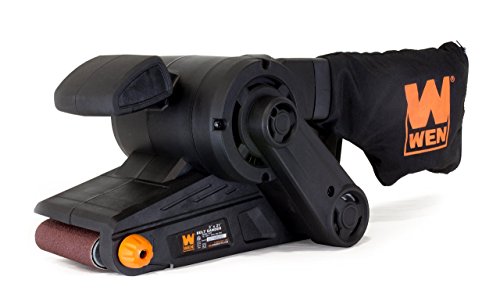
The WEN 6321 delivers a robust 7-amp motor that drives the belt to over 13 feet per second, enabling efficient stock removal on hardwoods and softwoods. Its compact six-pound frame reduces operator fatigue during long sessions, and a detachable dust bag helps keep the workspace cleaner. The combination of power, portability, and a straightforward dust-collection option makes it well suited for general carpentry and small shop projects.
WEN 6502T Benchtop Belt & Disc Sander
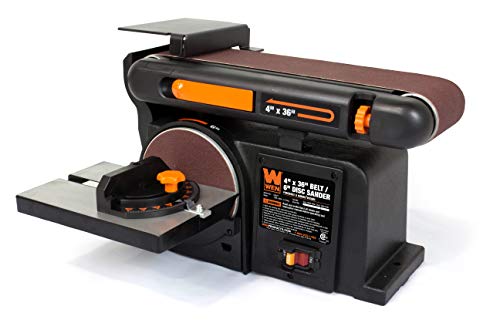
The WEN 6502T combines a 4-by-36 inch belt with a 6-inch disc for versatile stock removal and finishing. The belt tilts from 0 to 90 degrees, enabling precise edge work or flush stock removal on tall panels. A sturdy cast-iron base minimizes vibration for smoother operation and better accuracy, making it a practical choice for larger shop projects where stability matters.
Makita 9403 4×24 Belt Sander

The Makita 9403 prioritizes a quieter operating experience with a measured 84 dB noise level and a belt speed of 1,640 feet per minute for rapid material removal. Its labyrinth construction seals and protects the motor and bearings from dust and debris, extending tool life. The 4-by-24 inch belt provides a balance between aggressive removal and manageable control for larger panels and furniture components.
DEWALT 20V Max Belt Sander DCW220B

DEWALT’s cordless belt sander relies on a brushless motor for efficient performance and longer runtime within a 20V Max system. It offers mobility for boundary-free work areas and features a tool-free, compatible dust collection solution that can reach high dust-collection efficiency when paired with the appropriate vacuum system. This model is well-suited for site work or projects where corded power isn’t practical.
Bucktool Direct Drive Bench Belt Sander

The Bucktool Direct Drive model uses a 3/4 HP motor with a 4×36 inch belt and an 8 inch disc, delivering stable performance for woodworkers who need reliable mixed-mode sanding. The table can tilt 0–45 degrees, and the belt can be oriented horizontally or vertically, offering flexibility for beveling, flattening, and edge work. Its direct-drive design contributes to steady operation and consistent results across varied projects.
Buying Guide
Choosing the right belt sander depends on how you work and what you build. Consider these purchase factors to find the best fit for your shop and projects:
- Belt size and versatility — Smaller belts (3×21) are great for detail and curved edges, while larger belts (4×36, 4×24) remove material quickly on panels and tabletops. Benchtop models often combine belt and disc options for added flexibility.
- Corded vs cordless — Corded sanders provide constant power for long sessions, whereas cordless models offer mobility for remote jobs or shops without easy outlet access. A battery system compatibility check is wise if you already own brand batteries.
- Dust management — Dust bags are convenient but limited; built-in vacuum adapters and dust collection efficiency matter for cleaner air and easier cleanup. Consider whether you’ll vacuum or use a dust-collection system.
- Vibration, weight, and stability — Cast-iron bases and heavier frames reduce vibration, improving finish quality and control. Lighter models are easier to maneuver but may feel unstable on large pieces.
- Belt speed and grit compatibility — Higher belt speeds remove stock faster but can gouge soft wood if not controlled. Ensure you have a range of belts (grits) compatible with the sander to handle shaping, flattening, and finishing.
- Table tilt and alignment — A tilting belt or adjustable table expands capabilities for beveling, edge work, and curved surfaces. Check the maximum tilt angle and ease of adjusting.
- Ergonomics and ease of use — Comfortable handles, low-resistance dust paths, and simple belt tracking reduce fatigue and improve accuracy on long projects.
- Maintenance and belt availability — Availability of replacement belts and accessories, along with the ease of changing belts, affects long-term value and uptime.
- Output and project fit — For frequent large projects, prioritize models with larger belts and robust dust control. For detail work and small pieces, compact corded units may suffice.
When selecting among the five highlighted options, think about how often you sand large panels versus finishing edges, your tolerance for cords or batteries, and how much dust control matters in your workspace. The WEN and Makita models suit steady workshop use, the DEWALT offers mobility with ample dust handling, and the Bucktool provides a versatile benchtop setup for mixed sanding tasks. Each has its strengths depending on your workflow and project mix.