A shared evening reset works best when another person can understand what you mean without following you around the house. Start with a small, visible result, such as clearing the table for breakfast or returning reading materials to one basket.
You are not trying to make every room look finished before bed. You are deciding which few changes would make the next part of home life easier, then giving those changes names that everyone involved understands.
The method below is an original household planning exercise you can adapt. It is useful whether you share your home with a partner, relatives, roommates, or someone whose schedule rarely lines up with yours.

Name the next use of the room
Ask what you will need the space to do next. A table that becomes a work surface in the morning needs a different reset from a table you will use for another craft session after breakfast.
Write that next use in ordinary language: a place to eat, a clear chair for reading, or enough counter space to pack lunch. The phrase should describe a useful result rather than an ideal photograph.
If two people expect different uses, settle that before you move things. You may discover that one person is clearing a project the other person planned to finish, which is a coordination issue rather than a tidiness issue.
For an ongoing project, agree on a temporary home and an identifying note. That lets the room serve more than one purpose without making someone guess whether a pile is abandoned or intentionally waiting.
Choose a stopping point you can both recognize
Replace a broad instruction like clean the living room with a few observable actions. Return the books to their basket, put personal items in their owners’ agreed places, and clear the seat you plan to use tomorrow.
Then decide what counts as finished for this particular reset. Straightening every shelf, washing a window, or sorting a drawer can wait unless that task is part of the result you actually chose.
You can write the stopping point on a small card near the room’s shared supplies. Keep the card brief enough that someone can read it while standing there, without opening a household manual.
Leave room for different preferences about appearance. If the agreed result is a clear tabletop, a particular arrangement of coasters does not need to become an extra requirement that only one person knows.
Give the objects a real return path
Walk through the reset once and notice where objects get stuck. A book cannot return to an overflowing basket, and a jacket cannot return to a hook hidden behind another person’s bag.
Fix the smallest obstacle that prevents the handoff. You might move the basket within reach, clear one hook, or decide which objects belong in a temporary holding place until their owner can sort them.
A holding place needs an owner and a next step. Otherwise you have created a new pile with a more attractive container, and the same unresolved decisions will still be there tomorrow.
Keep private papers, unfinished writing, and someone else’s personal belongings out of a general sorting session. You can ask where an item should wait without opening, reading, or discarding it.
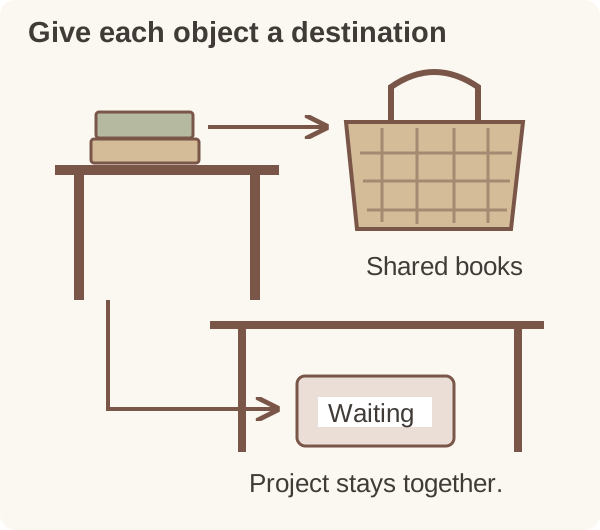
Hand over the whole small task
Agree on who notices the task, gathers what is needed, carries it out, and says when it is finished. A handoff is incomplete if one person must still explain every step while trying to do something else.
For example, the person handling the table can check the agreed stopping point and put the reset supplies away afterward. They should not need a new instruction for each book or cup.
That does not mean assigning every household member the same work. Discuss what each person can reasonably do, what requires assistance, and which tasks should stay with an adult or someone familiar with the equipment.
If an arrangement keeps failing, look at the assignment and the available time before treating it as a character judgment. You may need a smaller result, a different destination, or a different person for that evening.
Leave a short note when schedules differ
When you do not see the other person before they start, leave only the information that changes their task. A useful note might say that the books are returned but the labeled project box is staying on the shelf.
Separate a completed action from an unresolved request. Table ready is a status; please decide where these receipts belong is a request that still needs an answer.
Choose one place for this kind of note so it does not have to compete with messages on several apps and scraps of paper. Use a shared channel everyone has actually agreed to check.
Avoid turning the note into a scorecard of who did more. It should help the next person understand the room, not require them to defend the rest of their day.
Write a smaller version for crowded evenings
Choose a fallback before the evening becomes difficult. Perhaps you only clear the eating area, put supplies where they will not be disturbed, and leave the rest for the next agreed opportunity.
State what the fallback leaves unfinished, so nobody mistakes it for the usual full reset. You can say that the room is usable but the personal-item basket still needs its owners’ attention.
This is also a place to protect a meaningful pause in your household. If you want time for prayer, quiet reading, or conversation, decide what limited reset is enough to make that pause possible.
You do not need to make the practice public or require everyone to participate in the same way. Keep the shared task concrete, then let each person use the available quiet according to their own needs and beliefs.
Try a handoff on one ordinary evening
Imagine you finish dinner before another household member arrives home. You clear the table, return the shared books, and put an unfinished sewing project in its labeled box, leaving its contents exactly as its owner arranged them.
Your note says that the breakfast space is ready and the project box is on the shelf. The next person can understand the state of the room without reopening decisions you already settled together.
On a later evening, a different person can complete the same small result. If they cannot find the basket or do not know which box is private, that reveals a missing instruction worth fixing.
Penn State’s Thrive guidance encourages involving family members in routines and revisiting a plan when commitments change. That supports keeping the conversation open; it does not independently validate this particular reset exercise.
It can help to practice the handoff while both people are available once, using the actual basket, shelf, and note location. Let the next person try the task in their own order, then ask which detail they had to infer rather than giving a running commentary on their choices.
If you discover that an object has no agreed home, leave that decision for a separate conversation with its owner. Moving an unresolved pile from one person’s chair to another person’s workspace makes the room look different without completing the shared task you chose.
Change one confusing part at a time
After you have tried the handoff, ask which instruction was unclear and which action did not help. You can remove an unnecessary step just as readily as you can add a missing destination.
Keep the result small enough that you can explain it in one sentence. When the room can pass from one use to the next without a fresh round of guessing, your shared reset is doing its job.
