Your week doesn’t need a perfect schedule to have a recognizable rhythm. You need a few decisions you can return to when the calendar changes, the laundry piles up, or dinner happens later than you expected.
Start with one sheet of paper and the week you actually have. This guide walks you through a small household planning ritual that leaves room for work, care, prayer or reflection, and ordinary interruptions.
Begin with what the week already holds
Open the calendar before you write a cleaning list. Mark work shifts, appointments, school events, shared transportation, and anything else that sets the boundaries of your days.
Include the invisible edges around those events. A late meeting might also mean an earlier dinner decision, a different pickup arrangement, and less time for the evening kitchen reset.
Choose a planning moment that fits your household rather than assuming Sunday evening is available. You might use Friday lunch, the morning after your shift rotation arrives, or a short conversation while the children finish a snack.
Keep the first version deliberately small. You’re trying to make the next seven days easier to see, so you don’t need to solve every unfinished project before you can begin.

Choose three anchors, then stop
Pick one anchor for food, one for keeping the house usable, and one for connection. An anchor is a recognizable action, such as checking tomorrow’s dinner ingredients, clearing the table, or sitting together for a brief check-in.
Make each action visible enough that another person could understand when it’s done. “Get organized” leaves too many decisions open, while “put tomorrow’s school papers in the bag” gives you a clear stopping point.
You can connect an anchor to something that already happens without attaching it to an exact minute. “After breakfast” may fit your life better than “at seven,” especially when different people start their days at different times.
Leave deeper cleaning and optional projects off this first layer. If your basic rhythm takes an entire free afternoon, it will be difficult to use during the weeks when you most need a simple version.
Give the plan more than one voice
If you share your home, ask what other people need before you assign tasks. Someone may know about an early departure, an empty supply, or a difficult day that hasn’t reached the household calendar yet.
Keep the conversation concrete and brief. You might ask, “Which day looks hardest?” and “What would make dinner or the morning departure easier on that day?”
The University of Minnesota Extension’s guidance on family traditions emphasizes discussing expectations and values, explaining plans in ways children can understand, and inviting questions. Apply that communication principle here without treating a household rhythm as a rule everyone must enjoy in the same way.
Choose responsibilities together where possible, including how a task will be handed off. “Please handle the dishes” may need a quick conversation about whether that includes unloading, wiping the counter, or making room for breakfast.
Build a day that has an ending
A useful evening reset should have a finish line. You might put food away, leave the sink usable, and move the next day’s essentials to one known spot.
Decide what can wait before you begin. Sorting the mail, reorganizing a drawer, and matching every stray sock can turn a short reset into an open-ended project.
Use a small written list if it helps you stop at the agreed boundary. When the three actions are finished, you can close the notebook rather than scanning the room for another reason to keep working.
Your morning anchor can be equally modest. Check the calendar, choose the most time-sensitive household action, and confirm one practical detail such as a pickup time or a packed meal.
Try the same sequence for several days before adding more. If it keeps falling apart, change the location, timing, or size of the task instead of assuming you need a more elaborate planner.
Leave a place for what matters to you
Household planning can hold more than chores. Add a small space for a person you want to encourage, something you’re grateful for, or a question you want to bring into prayer or reflection.
Use language that belongs to your household’s own faith and traditions. You don’t need to copy someone else’s devotional schedule or turn a private practice into a performance for the rest of the family.
If you want a shared moment, offer a clear and gentle invitation. Reading a short passage you already use, saying a familiar prayer, or asking one thoughtful question can be enough for that particular evening.
Keep participation and privacy in mind when you write. A shared calendar is a useful place for logistics, while a personal notebook may be a better home for another person’s sensitive needs or your own unfinished thoughts.
Write the hard-week version in advance
Picture a day when someone is sick, you get home late, or the car needs unexpected attention. Decide which household actions still matter and which ones can safely move to another day.
Your fallback might be a simple meal, necessary clothing, and a clear walking path. That is an example to adapt, not a universal list of what every household should be able to do.
Keep a couple of familiar meal options in the plan without prescribing a particular diet or shopping budget. Choose foods your household already uses, and check what you have before adding more to the grocery list.
Make the fallback easy for someone else to understand. A short note beside the calendar can be more useful than a detailed system that only one person knows how to interpret.
When the week changes, cross out a task rather than carrying every missed action forward. An overloaded catch-up list can hide the decisions you actually need to make today.
Review the rhythm without grading your home
At your next planning moment, look for one action that worked and one that caused friction. You might notice that lunch packing went smoothly near the refrigerator but kept getting forgotten on the dining table.
Change one detail at a time so you can tell whether it helps. Move the list, reduce the number of steps, or choose a different handoff before you replace the entire routine.
Ask whether the plan fits the people who live with it. Different work hours, energy levels, mobility needs, and seasons of caregiving can call for different ways to share the same household goal.
Keep the older page if you want a record, but begin the next week with a clean view. Your notebook can show how your home changes without becoming a permanent inventory of unfinished work.
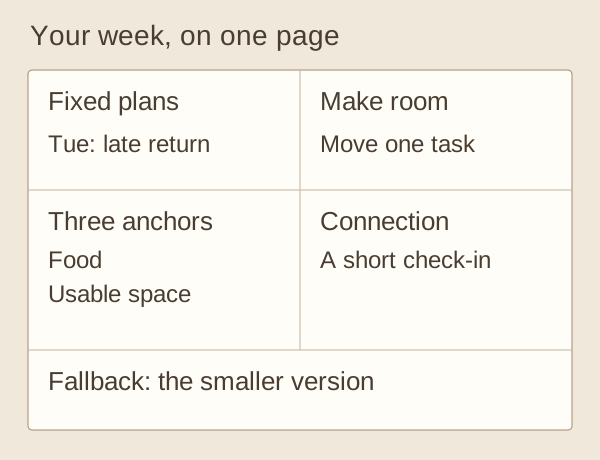
For your first week, write only the fixed commitments, three anchors, and one fallback. Put the page where you’ll see it during an ordinary day, and let the next review tell you what deserves a little more space.
Try a week with one crowded evening
Imagine that Tuesday includes an appointment and a late return home. You might choose dinner before Tuesday arrives, move the optional bathroom clean to Thursday, and ask someone else to check the next morning’s bags.
On the planning page, write those actual decisions beside Tuesday instead of adding “be more prepared” to a general list. The point is to connect a small action with the day when it will make a difference.
Now imagine the appointment moves to Wednesday. You can shift that day’s supporting actions together, keeping the rest of the week intact rather than rebuilding the whole schedule from scratch.
If you live alone, use the same method without creating a pretend household meeting. Ask what your future self will need after a long day, then leave a clear note or an ingredient where it belongs.
If your work shifts change often, plan the next few known days and mark the rest as undecided. A partial plan based on reliable information is easier to use than a filled page built around guesses.
