Best Swivel Utensils for Parkinson’s: Stabilized Eating Aids for Independent Meals
For individuals managing Parkinson’s, arthritis, or hand tremors, swivel and weighted utensils can restore confidence during meals. This guide highlights five top swivel utensils designed to reduce spills, ease grip, and support independent eating. Each option combines bendable angles, weighted balance, and non-slip handles to accommodate alternates in strength and dexterity.
The following table summarizes the featured products to help you compare at a glance:
| Product | Brand | Angle / Weight Features | Key Benefit |
|---|---|---|---|
| Weighted & Swivel Adaptive Utensils | Forzaddik | Weighted 4.2 oz per piece; bendable neck; 360° swivel | Enhanced stability for tremors; ambidextrous grip |
| Adaptive Utensils, Weighted Set | GREENANTS | 180° with 6 adjustable angles; 9.25″ length; weighted | Multiple angles for personalized comfort and control |
| KMINA Bilateral Adaptive Spoons | KMINA | Adjustable angle up to 90°; bendable; 2.8 oz weight | Left/right-handed use; easy grip with bendability |
| Nourislif Adaptive Utensils 4Pcs | Nourislif | Built-up handles; non-weighted; rustproof stainless steel | Straightforward grip with added stability |
| EZ Assistive Adaptive Weighted Utensils Set | EZ Assistive | Weighted; ergonomic curved handle; left/right friendly | Independent self-feeding with reduced wrist strain |
Weighted & Swivel Adaptive Utensils by Forzaddik

Designed for tremor management, Parkinson’s, arthritis, or general weakness, these weighted utensils act as a natural stabilizer. Each piece is precision-weighted at 4.2 ounces to promote balance, with a bendable neck that allows custom angling and reduced arm movement. The ambidextrous comfort grip minimizes wrist strain and hand fatigue, enabling independent eating with greater confidence. This set aims to reclaim dignity at mealtimes by combining weight, balance, and ergonomic design in a single tool.
Adaptive Utensils, Weighted Set by GREENANTS

GREENANTS offers an extended adaptive utensil set featuring a 9.25″ overall length with an ergonomic grip and six adjustable angles. The utensils are weighted to support tremor control, and the design emphasizes portability for travel. Occupational therapists helped develop the angled design to help people with physical or cognitive impairments eat independently. The set includes a fork, spoon, and cleaning brush, providing a compact, versatile solution for daily dining and on-the-go meals.
KMINA Bilateral Adaptive Spoons
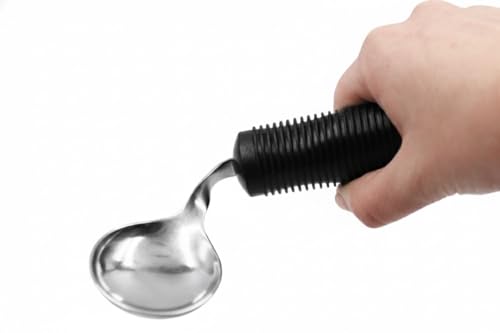
KMINA’s bilateral adaptive spoons are designed for users with limited arm or wrist mobility. The spoon bends up to 90° to fit individual feeding angles, reducing effort and spills. At just 2.8 ounces, the lightweight design suits both right- and left-handed users, with a wide, soft handle that provides a non-slip grip. This combination of bendable flexibility and ergonomic grip supports independent mealtime routines for users with Parkinson’s, arthritis, or tremors.
Nourislif Adaptive Utensils 4Pcs
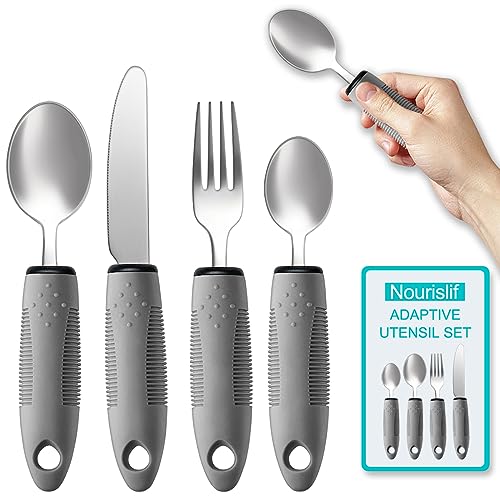
Nourislif’s four-piece set emphasizes an easy grip and durable construction. Built-up handles offer stability and control for users with tremors or dexterity challenges, while rustproof stainless steel provides long-term durability. The design focuses on comfort and reliability, promoting greater independence at meals without adding weight or complexity to daily routines.
EZ Assistive Weighted Utensils Set

EZ Assistive offers a weighted spoon and fork with a curved ergonomic handle designed to reduce wrist strain. The set is appropriate for both left- and right-handed users, promoting independent self-feeding while minimizing spills. The curved design helps guide food to the mouth, making it a practical choice for users with limited mobility or tremors seeking a straightforward, reliable eating aid.
Buying Guide: Key Purchase Considerations
- Weight and balance: Heavier utensils can stabilize tremors, but comfort matters. Look for options with adjustable weights or consistent 4–4.5 ounce weights per piece to balance control with ease of use.
- Angle adjustability: Bendable or swivel designs reduce the need for awkward arm movements. Consider products offering multiple angle settings (e.g., 45°, 90°, or full swivel) to fit individual preferences.
- Grip and ergonomics: Non-slip, larger handles help users with reduced grip strength. Built-up handles and soft textures can improve confidence during meals.
- Left/right-handed compatibility: Some sets support ambidextrous use or offer separate options for each hand. This is important for shared devices or changing dominant hand needs.
- Durability and materials: Stainless steel utensils resist rust and are easy to sanitize, a practical choice for daily use and caregiving settings.
- Maintenance: Removable parts, simple cleaning, and compatibility with dishwashers can influence long-term convenience.
- Portability: Travel-friendly designs or compact sets help with meals away from home, reducing anxiety about eating in unfamiliar environments.
- Therapeutic alignment: Some designs are clinically informed by occupational therapy principles, which may affect effectiveness for tremors or arthritis.
When selecting swivel utensils for Parkinson’s or related conditions, balance personal comfort with functional needs. Testing a few options may help determine which design best fits daily routines, dining etiquette, and caregiver preferences. The listed products provide a range of weights, angles, and grips to support independent eating while reducing fatigue and spills during meals.