Best Jigsaw Blades for Cutting Rubber and Other Soft Materials
For smooth, accurate cuts in rubber, cardboard, leather, and other soft materials, selecting the right jigsaw blade is essential. This guide highlights five blades well-suited to these tasks, explaining what makes them effective and how to choose the best option for your project.
Summary of selected products:
| Product | Brand | Material Focus | Blade Type | Length |
|---|---|---|---|---|
| BOSCH T113A3 3-Pack | Bosch | Soft materials (cardboard, leather, carpeting, polystyrene) | Standard T-shank | 4 in (3 in working) |
| Bosch 2608635187 Jigsaw Blade T313AW | Bosch | General soft materials | HCS blade | Overall 3 in |
| Vearter 16″ Reciprocating Saw Blade | Vearter | Cardboard, rubber, carpet, leather | HCS blade | 16 in |
| eMagTech 3PCS T313AW Jigsaw Blade | eMagTech | Cardboard, leather, carpet | HCS blade | Total 152 mm |
| Bosch T102BF 3 pc. 3-5/8 in. 13 TPI Plexiglas | Bosch | Plexiglas (clear plastic) and similar | T-shank | 3-5/8 in |
Note: This article remains objective and price-free, focusing on blade design, materials, and typical applications to help you choose the right tool for rubber and other soft substrates.
BOSCH T113A3 3-Pack – Ideal for Soft Materials

The BOSCH T113A3 set is designed for cutting soft materials such as cardboard, leather, carpeting, and polystyrene. Its knife-edge shape enables fast cuts through single or multiple layers, reducing drag and heat buildup. With a 4-inch overall length and a 3-inch working length, these blades are well-suited for compact jigsaws and precision work where material resilience is moderate and edge quality matters.
Bosch 2608635187 Jigsaw Blade T313AW – Smooth Cuts

The Bosch T313AW blades feature a high-carbon steel (HCS) composition with a serrated tooth pattern optimized for soft materials. This 3-piece pack focuses on versatility for crafts and DIY tasks where quick, clean cuts through laminates, light fabrics, or foam-backed materials are required. The working length supports delicate curves and precise edges without excessive blade wear.
Vearter 16” Reciprocating Saw Blade – Heavy-Duty Soft Materials

The Vearter blade is a 16-inch HCS (high-carbon steel) blade designed for fast cutting of cardboard, rubber, carpet, leather, foam, and polystyrene. Its long length provides leverage for deep cuts, while the sharp teeth and evenly distributed tooth pitch enable consistent force transmission for smooth results across larger or repeated cuts in soft materials.
eMagTech T313AW Jigsaw Blade – Sharp, Durable

eMagTech’s T313AW blade is crafted from high-carbon steel and features a 152 mm total length, 126 mm working length, and 1 mm thickness. It is designed for soft materials such as cardboard, leather, and carpet, delivering sharp, smooth cuts with a teeth spacing of 1.4 mm. The blade’s construction supports repeated use in DIY projects and home improvements where clean edges matter.
Special Wood T142HB Jigsaw Blades – Precision Wood Cuts
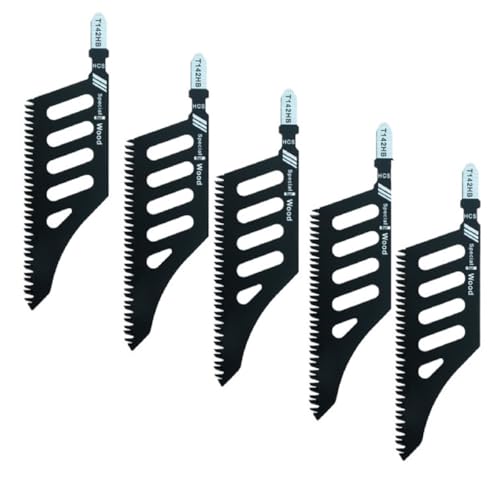
Though primarily aimed at wood, the T142HB blades offer a specialized design with multiple cutting slots that can handle curved cuts with clean results. They provide good control over intricate patterns and can be useful when soft board materials are combined with wood elements in a project. The blades are made from durable steel for extended service life in repetitive cutting tasks.
Bosch T102BF 3-Piece Plexiglas Blades

Designed for Plexiglas and clear plastics, these blades feature a ground and tapered-back tooth design to produce straight, clean cuts in acrylics and similar materials. While not specifically for rubber, they can be a good choice when your project involves a mix of soft polymers and plastics where a smooth edge is essential and tearing must be avoided.
Buying Guide: Key Considerations For Selecting Jigsaw Blades For Rubber and Soft Materials
- Material compatibility: Look for blades explicitly rated for soft materials such as rubber, cardboard, leather, leather-backed fabrics, and foam. High-carbon steel blades with fine-toothed designs offer cleaner cuts with less tearing in these substrates.
- Blade thickness and width: Thinner blades reduce resistance and help prevent material snagging. Narrow bodies improve maneuverability for curves, especially in leather or carpet.
- Tooth design and pitch: A fine-tooth or medium-tooth layout provides smoother edges on soft substrates. For very flexible materials, a blade with a gentle tooth pitch reduces tearing and fuzzing along the cut line.
- Blade length and working length: Longer blades help with deeper cuts or thicker soft materials, while shorter blades offer tighter control for intricate shapes and curves.
- Shank compatibility: Ensure the blade has a compatible shank (T-shank is common on many modern jigsaws) to fit your saw securely and reduce slipping during use.
- Durability and price: Blades built for repeated cuts in soft materials should balance durability with cost. Replacing blades frequently in high-volume work can be more economical with multi-packs.
- Intended project scope: For DIY tasks and occasional remodeling, standard HCS blades in medium tooth counts are typically sufficient. For professional-grade work, consider blades with reinforced edges or specialized shapes for clean edges and long life.
- Safety and technique: Maintain a steady feed rate, avoid forcing the blade, and allow it to do the work. Lubrication is generally not required for rubber but use cutting mats or scrap material to protect the surface beneath.
What To Consider For Your Specific Project
When cutting rubber or soft materials, the goal is clean edges and minimal edge tearing. A blade designed for soft substrates with an appropriate tooth count helps prevent shredding and reduces the need for post-cut finishing. For multi-material projects, having a range of blade styles—soft-material blades, plastic-rated blades, and general-purpose blades—can save time and improve outcomes.