Best Rubber Backing Pads for Angle Grinders: Top 5 Picks
Choosing the right rubber backing pad for an angle grinder is essential for achieving smooth sanding, improved disc life, and consistent results. The following top picks are selected for durability, compatibility, and performance across common grinding and finishing tasks. Each option supports 4-1/2 inch discs or standard 4″ pads and includes a 5/8″-11 arbor for broad compatibility.
| Product | Brand | Main Benefit | Arbor |
|---|---|---|---|
| BHA Angle Grinder Ribbed Backing Pad | BHA | Ribbed design for cooling and resin fiber discs | 5/8″-11 |
| DeWalt DW4945 Steel Reinforced Pad | DEWALT | Durable steel-reinforced rubber construction | 5/8″-11 |
| Mercer Industries 324045 | Mercer Industries | Semi-flexible design for variable surfaces | 5/8″-11 |
| ComeFloor Rubber Backer Pad | ComeFloor | Long lifespan and quick changes with hook-and-loop | 5/8″-11 |
| YPCOO Hook and Loop Backer Pad | YPCOO | Semi-flexible with water hole for wet/dry use | 5/8″-11 |
BHA Angle Grinder Ribbed Backing Pad

The BHA backing pad is designed for resin fiber sanding discs, featuring a 5/8″-11 metal zinc-alloy locking nut and spiral raised ribs to improve cooling during use. The ribbed backing promotes airflow, potentially extending disc life and maintaining consistent performance across grinding tasks. Its construction supports heavy-duty use on angle grinders with compatible discs, making it a solid option for both aggressive material removal and finishing work.
DeWalt DW4945 4-1/2″ Steel Reinforced Pad

DeWalt’s DW4945 backing pad uses a steel-reinforced rubber design for resilience in sanding applications. It includes a 5/8″-11 locking nut to secure attachment and provides a balanced sanding experience with a medium grit feel. This pad is suitable for demanding tasks where durability and consistent performance are key, helping to maintain disc integrity under heavier workloads.
Mercer Industries 324045 Backing Pad
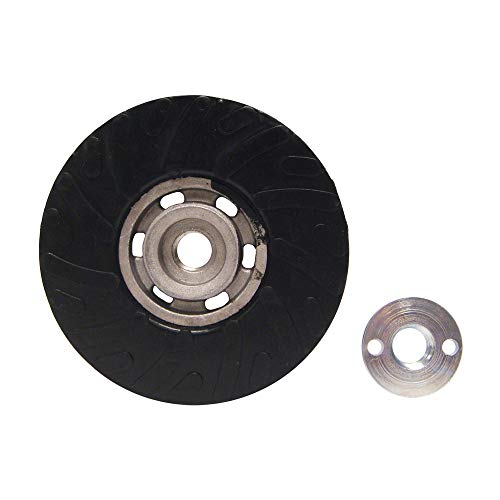
Mercer Industries’ 324045 backing pad is designed to work with semi-flexible discs on angle grinders. It features a strong rubber pad that supports the disc while allowing some flexibility to adapt to uneven surfaces. This combination helps maintain consistent contact and reduces gouging while finishing, especially on curved or contoured workpieces.
ComeFloor Rubber Backer Pad 4″

The ComeFloor 4″ rubber backing pad emphasizes a long lifespan and flexible rubber, paired with a strong hook-and-loop interface to prevent separation. It supports quick changes and reliable rigidity for grinding and polishing tasks. With a brass arbor and 5/8″-11 threading, this pad is designed for frequent use in shop environments where ease of disc changes matters.
YPCOO Hook and Loop Backer Pad

The YPCOO backing pad combines a premium rubber body with a semi-flexible profile, designed for both wet and dry use. It features a brass arbor with 5/8″-11 threading and an internal water hole, making it versatile for applications requiring active cooling or splash-prone environments. The design aims to improve grip and stability during polishing and grinding tasks.
Buying Guide
- Arbor compatibility: Ensure the pad uses a standard 5/8″-11 thread to fit most angle grinders and accessories. Some models may include locking nuts for secure attachment; verify compatibility with your tool’s spindle.
- Pad rigidity and flexibility: Rubber backing pads range from rigid to semi-flexible. Semi-flexible designs better adapt to uneven surfaces, minimizing disc chatter and producing a smoother finish on irregular workpieces.
- Cooling features: Pad ribbing or ventilation improves airflow and disc life. If you frequently use coarse grits or perform extended grinding, cooling-enhanced designs can reduce heat buildup and loading.
- Disc compatibility: Check that the pad is designed for the resin fiber discs or sanding discs you plan to use. Some pads are optimized for resin fiber discs, others for hook-and-loop polishing pads.
- Durability vs. weight: Steel-reinforced or robust rubber constructions offer longer life in demanding tasks but may be heavier. For light to mid-duty work, a flexible rubber pad can provide easier material conformity.
- Wet vs. dry use: Some pads include features like internal water holes for cooling during wet grinding or polishing. Choose a pad that matches the environment and media you work with.
- Maintenance and replacement: Consider pads with reliable locking mechanisms and high-quality adhesives to reduce the chance of disc slippage or pad separation during use.
- Brand and warranty: Reputable brands often provide better consistency and support. Review warranty terms where available to gauge long-term value.
For most hobbyists and professionals seeking reliable performance, prioritizing cooling efficiency, compatibility with common disc sizes, and a robust locking system will yield the best overall results. The selections above balance these factors across varied grinding tasks, from material removal to finish work, across both wet and dry environments.