Some household lessons are easy to forget because you only need them again months later. You remember that a holiday setup was awkward or that a particular storage place worked well, but the detail disappears before the next season gives you a reason to use it.
A small yearly home note can hold the practical observation without turning ordinary life into a report. Keep what would help a future decision, separate facts from preferences, and leave private records and official documents in the systems that already belong to them.
Begin with a question you expect to ask again
Instead of reviewing the whole year, think about one moment when you wished you remembered last time. You might want to know which room held the extra chairs, when you needed the serving pieces, or why a particular afternoon routine stopped fitting the household schedule.
Write the future question at the top of the note so the record has a clear purpose. A heading such as where the guest bedding belongs is more useful than a broad category called memories when your real aim is to find the right items before another visit.
Keep the scope close to the choice you can actually repeat. You do not need to summarize every gathering or describe how everyone felt; a few concrete details about the setup may be enough to prevent the same search or unanswered question next time.
Use an ordinary notebook or file you already know how to find. A beautiful new recording system can create another decision, while the useful part is the small connection between a future question and an observation you have taken the trouble to preserve.

Separate what happened from what you preferred
Start with a factual detail you directly observed, such as where something was stored or which preparation step was still unfinished at a certain point. Then add your own preference as a separate sentence, making clear that it is your proposed adjustment rather than a shared household conclusion.
For example, you might record that the spare table stayed in the hall until the last guest arrived, then note that you would prefer to decide its location earlier next time. That is different from declaring that everyone disliked the arrangement without having asked them.
When another person offers an observation, ask whether they want it included and how they would describe it. A useful shared note should not quietly turn a passing comment into a permanent household verdict, especially when the comment concerns another person’s work or responsibilities.
Leave an open question where your memory is uncertain. Saying that you need to check which container held the cloths is more honest and more useful than filling in a confident answer that may send someone to the wrong place months later.
Use a few fields that support the next choice
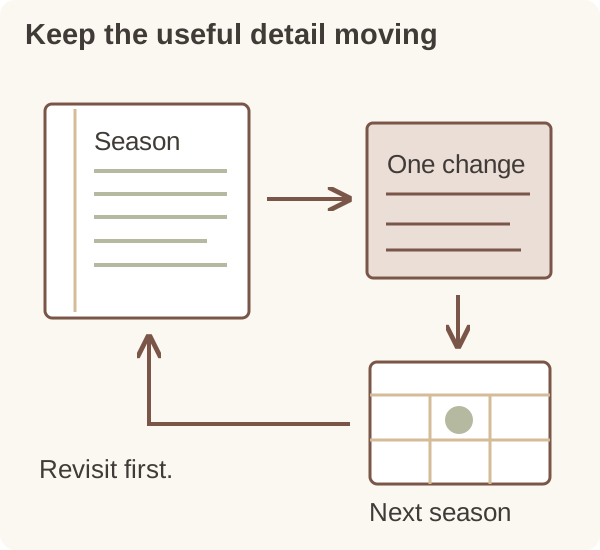
A compact note can include the occasion or season, the setup you used, the observation worth keeping, and one proposed change. Add an actual date if you know it, but do not spend so long perfecting the format that you postpone recording the detail you wanted to save.
Use names for locations that will still make sense to someone else in the household. The left box may be clear today and meaningless after the closet changes, while a defined storage label or a short description of the container gives the note a more durable point of reference.
If a photograph helps show a layout, choose one that records the arrangement without gathering unnecessary personal details. You can document the position of a table or shelf without automatically keeping visitors’ faces, private papers, or another person’s belongings as part of the household reference.
Link the note to the actual item or routine in words rather than adding more labels to everything you own. A single clear entry about the guest bedding may solve the recurring question without creating a full inventory that you will not want to maintain.
Keep reference notes out of official recordkeeping
A yearly home note can remind you where a warranty is stored, but it is not the warranty itself. Keep original product information, sensitive documents, and records with specific retention requirements in their appropriate systems, with the note serving only as a route to the right place.
Do not copy account numbers, identification details, or other sensitive information into a general household journal just because it is nearby. Decide what the shared note needs to accomplish and include only the ordinary information necessary for that purpose.
If the note mentions a maintenance task, use it to point toward the actual manufacturer’s instructions or a qualified service record. A remembered household workaround should not become the only guidance another person can find when dealing with an appliance, fixture, or other task that has its own requirements.
Separate private reflection from shared reference as well. You may want to write about the personal meaning of an occasion in your own notebook, while the household record only needs the practical setup and the question you hope to answer before the event comes around again.
Choose a sensible place for the paper
If you keep paper notes, choose storage where the notebook or folder can remain supported and easy to retrieve. An overfilled pile that bends the pages or a spot where the papers repeatedly become part of another task can make the useful record harder to keep intact.
The Library of Congress paper-preservation guidance recommends a clean, stable environment, protection from intense light, and supportive enclosures. Its guidance also cautions that some media need particular consideration, so an archival-sounding product label is not a reason to assume every sleeve suits every kind of page.
For an ordinary current notebook, keep the care plan proportionate to the item and its use. If you are handling old family papers or unusual fragile materials, treat that as a separate preservation question rather than applying an everyday household filing method to something whose condition you do not understand.
For digital notes, use a recognizable name and the access settings appropriate to the contents. Confirm where the file is saved before assuming it will be available next year, and follow the actual service’s storage and account requirements instead of relying on a general promise that digital means permanent.
Revisit before the next occasion
Put a reminder where your household will actually see it before the recurring task, rather than expecting the notebook to call attention to itself. The reminder can simply point to the relevant note, leaving the useful detail in one place instead of copying several versions into different calendars.
When you return, check which details are still true. A moved shelf, a changed schedule, or a different group of visitors may make last year’s arrangement irrelevant, and the note should support your current decision rather than require you to reproduce an earlier setup exactly.
Keep the observation that still helps and revise the proposed change if necessary. A short dated update can show what you decided without making the note grow into a transcript of every discussion, which would make the useful answer harder to find the following year.
You do not need a complete history of your home for this practice to work. One clear record of a recurring question, a practical observation, and a decision to revisit can carry useful knowledge forward while leaving the rest of daily life free from documentation.
Keep the next question close to the answer you recorded, so the following review has a clear starting point. You can then decide whether the old observation still applies without reconstructing the entire occasion from memory.
