A change of season can reveal that your old household rhythm no longer fits the week in front of you. Instead of rebuilding your whole routine, notice which repeated action has become awkward and what changed around it.
You might be working different hours, welcoming a new school schedule, spending more time inside, or preparing for visitors. The useful question is not whether your home follows a perfect seasonal calendar, but whether its familiar arrangements still serve you.
This guide offers an original review exercise for ordinary household planning. It does not prescribe a religious calendar, a regional climate pattern, or a particular way every family should celebrate the year.

Begin with the change you can describe
Write one sentence about what feels different. A later return from work, a new weekly activity, or a guest staying in the room you use for reading gives you something specific to plan around.
Avoid starting with a broad judgment that the whole house is out of control. That may describe your frustration, but it does not tell you which arrangement needs attention first.
Look at the last ordinary week you actually experienced. Notice where you had to improvise repeatedly, where supplies were hard to reach, or where a familiar plan kept depending on time you no longer had.
If you cannot see a pattern yet, keep a short observation note for a few days. Record the action and its obstacle without turning the note into a list of everything you think you should have done.
Keep the anchor that still helps
Identify one part of your rhythm that remains useful despite the change. It might be opening the calendar after breakfast, setting out tomorrow’s bag, or returning a book to the same small basket.
Keeping that anchor gives you a familiar starting point while you adjust something else. You do not have to replace a working habit merely because you are reviewing the rest of the week.
Ask what makes the anchor workable in practical terms. Perhaps it happens near something you already do, requires little setup, or has an outcome another person can recognize.
Use that explanation when considering a new arrangement. The point is to understand what supports the action, rather than adding more tasks simply because they look related on paper.
Move the support before adding another reminder
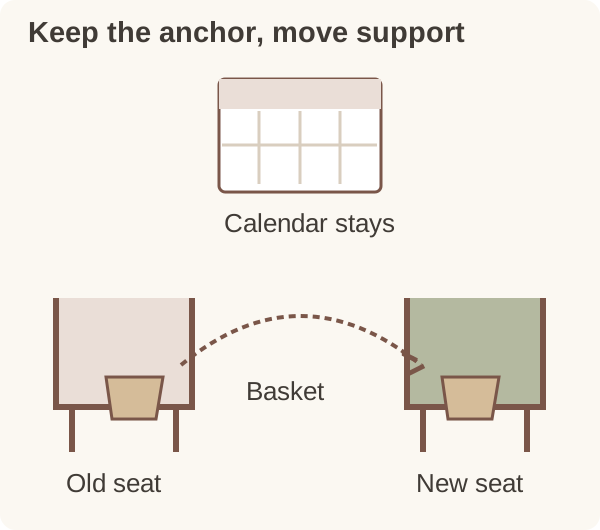
Sometimes a routine fails because the necessary object is in the wrong place for the new season. A reading basket may need to move when the room’s usual seat is occupied, or a returning-home bag may need a more reachable landing spot.
Try one small physical adjustment that matches the actual obstacle. You could place the shared calendar where you discuss it, move a frequently used basket, or clear the surface needed for tomorrow’s task.
Check that the move works for the other people using the space. A helpful new location for your supplies should not quietly take over someone else’s work area or private storage.
Give the new location a short, agreed name when you share it. A routine is easier to hand off when beside the chair or on the entry shelf means the same place to everyone involved.
Ask which part of a tradition matters
A seasonal tradition may contain several different things: a date, a meal, a visit, a shared activity, or time for reflection. Ask which part carries the meaning for the people who take part.
You may be able to preserve that meaning while changing its practical form. A conversation around a simple meal could fit a crowded week more easily than preparing the elaborate gathering you managed in a different season of life.
University of Minnesota Extension discusses communicating expectations and allowing flexibility when families negotiate traditions. Its context is new family arrangements; use that limited principle here without treating one household exercise as a universal rule.
Leave room for a person to value something you did not expect. A familiar song, a visit at a different time, or a quiet moment may matter more to them than the part you had assumed everyone wanted to repeat.
Let your beliefs inform your own choices
If faith is part of your household life, you can include the practices that matter to you in this review. Name the time, objects, or shared understanding that would make a chosen practice possible in the new schedule.
Keep the invitation clear when people share a home but do not share every belief or observance. You can reserve a quiet place or explain an activity without requiring somebody to perform the same response.
A private reflection practice also needs an ordinary physical arrangement. A place to sit, a book you can find, and a clear stopping point may be more useful than adding another item to a crowded weekly chart.
For specific religious guidance, look to the sources and community you personally trust. This household planning exercise does not claim authority to define an observance or speak for a denomination.
Choose a small trial with a clear review
Decide which one change you will try and what would tell you whether it helps. You might move the planning conversation to a known evening and see whether the people who need to participate can actually be there.
Write the old arrangement and the proposed change separately. That makes it easier to notice whether the issue was timing, access, unclear responsibility, or something the new arrangement did not address.
Set a review point that fits the trial instead of promising a fixed number of days to form a habit. You are checking whether the arrangement supports your present week, not measuring a psychological milestone.
If the change creates a new obstacle, describe it plainly. You can keep part of the adjustment, reverse it, or try a smaller version without deciding that the entire seasonal review failed.
Try a season with later evenings
Imagine your household’s return-home time becomes later on two weekdays. The old plan leaves dinner preparation, a shared room reset, and quiet reading competing for the same short period.
You keep the useful calendar check, choose the meal earlier, and give the room a smaller reset on those evenings. The reading basket moves to an available seat instead of waiting behind another person’s ongoing project.
On the other days, you leave the familiar rhythm alone. A change that affects two evenings does not necessarily require a new plan for the whole week.
At your review, ask whether the decisions were easier to carry out and whether the new location stayed usable. Those observations give you something more concrete than deciding whether the season felt perfectly organized.
Separate a practical seasonal note from private information about why somebody’s capacity changed. You may only need to remember that Tuesday evenings needed a smaller plan, rather than preserving personal details that another household member did not agree to keep in a shared notebook.
Also distinguish a meaningful tradition from the particular purchases that happened to accompany it. You can keep a welcome, a conversation, or time for reflection without automatically replacing every decoration or supply that appeared in the previous year’s version of the occasion.
Keep a note for the next transition
Save a brief description of the change and what helped, with a date and enough context to recognize the situation later. Do not write it as an instruction that next year’s household must obey.
When another transition arrives, read the note as a useful memory and check what is different now. Your home rhythm can hold familiar meaning while its practical details continue to change with your life.
