A plain table runner can give a familiar table a different feeling without covering the whole surface. Before you buy one, decide whether you want a quiet line beneath a small arrangement, a piece of fabric for occasional meals, or a simple way to use a textile you already enjoy seeing.
The useful choice depends on your table’s ordinary jobs, not an image of a room that nobody uses. You may need the same surface for breakfast, homework, sorting groceries, and conversation, so start with the moments when fabric would help and the moments when clearing it away would make life simpler.
Name the job in one sentence
Try a sentence such as, “I want a narrow neutral textile under the flowers when friends come for dinner.” That gives you a location, a use, and a reasonable limit; “make the dining room complete” leaves you with no clear way to judge whether a purchase solves anything.
For a daily table, notice which objects move across the center and how often you wipe the surface. If everyone regularly spreads work into that space, an occasional runner you bring out for meals may fit better than a permanent arrangement that must be moved several times a day.
A runner can also be a meaningful family textile, but you do not have to expose a precious piece to every household task. Choose separately between enjoying a textile’s appearance, using it around meals, and caring for an older or delicate item; one object does not need to perform every role.
Measure the actual table, including its current configuration
Record the table’s usable length and width while it is arranged for the situation you have in mind. If you add a leaf for guests, write a second set of measurements instead of expecting a runner selected for weekday use to create the same proportions on the extended table.
Then decide whether the runner should stop within the tabletop or hang over the ends. Both are design choices, and neither creates a universal rule about how long a runner must be; the important check is whether your preferred placement works around the people and objects using that table.
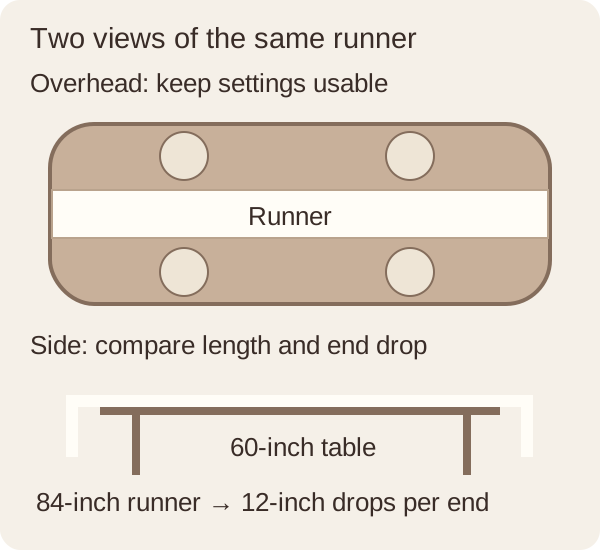
You can calculate a symmetrical end drop by subtracting table length from runner length and dividing the remainder by two. For an illustrative sixty-inch table and eighty-four-inch runner, that is twelve inches at each end, but the arithmetic describes the arrangement rather than recommending that drop for every household.
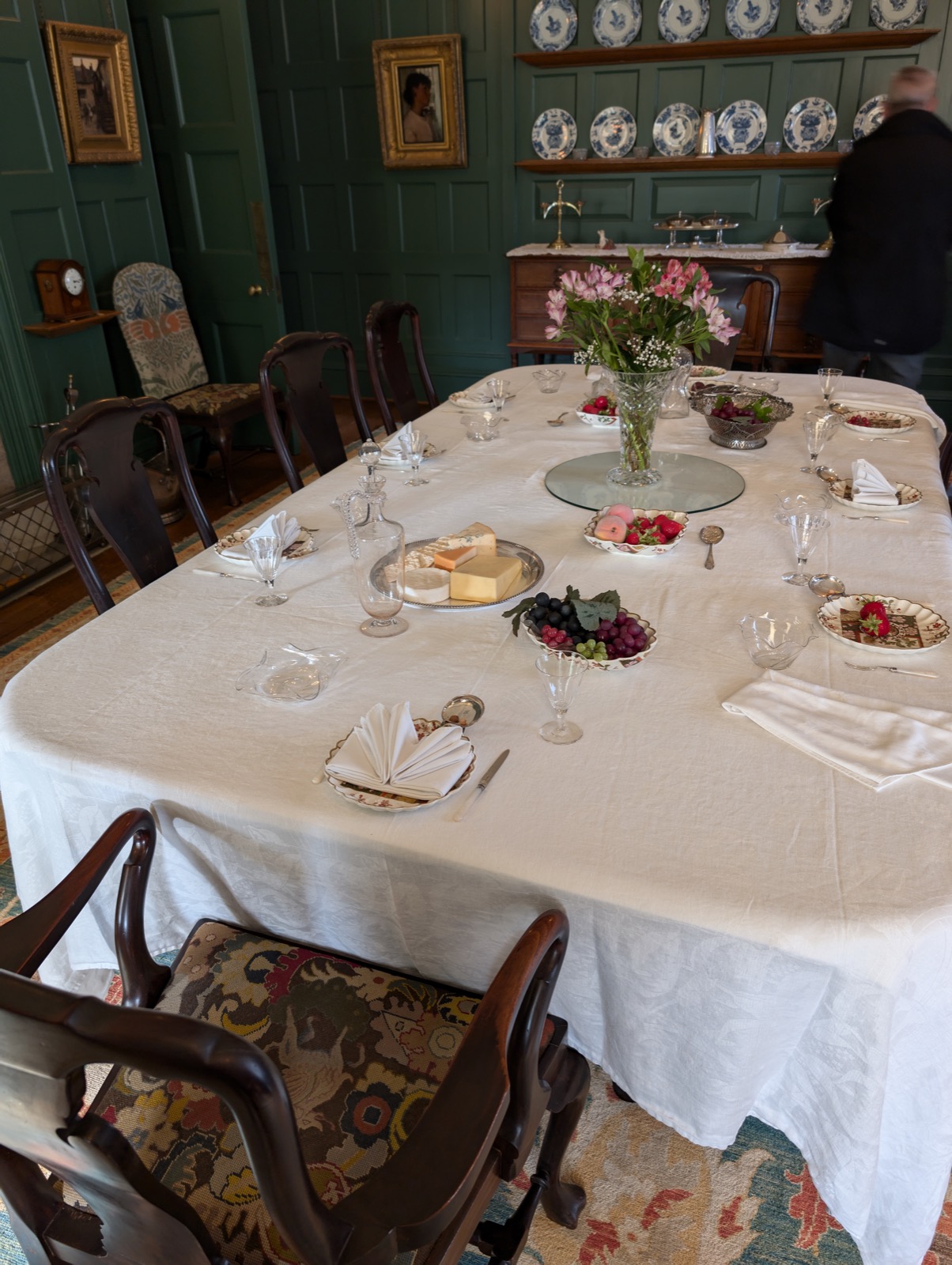
Make a temporary layout before choosing fabric
Use an existing suitable cloth or a few clean paper sheets to mark the approximate footprint on the table. Keep the mockup away from anything that could damage it, and use it to judge space rather than treating it as a substitute protective surface for food, moisture, or hot objects.
Set out the ordinary plates, cups, serving pieces, and the small arrangement you expect to use. Look for the moment when an object needs to straddle a fabric edge, a person’s reach becomes awkward, or the runner’s hanging end competes with a chair or someone’s lap.
Try the arrangement from every seat rather than judging it only from the room’s doorway. You may discover that a shorter centered textile gives you the visual line you wanted while leaving the ends clear, or that the table looks and works better without extra fabric at all.
Choose width around the things you actually set down
A narrow strip under a small vase creates a different arrangement from fabric extending beneath serving dishes. Decide which objects should sit entirely on one surface, then check that the chosen width leaves enough useful space for the place settings and tasks that surround it.
Draw the arrangement as a simple overhead sketch if the table changes between meals and other work. A rectangle for the runner and circles for plates can reveal the issue more clearly than a list of decorative measurements, especially if your table is unusually narrow or has rounded ends.
For example, you might reserve the center for one removable arrangement while keeping dishes on the bare surface around it. That is an original layout to adapt, not a tested protection method; follow the furniture maker’s guidance and use appropriate protection for the actual objects and table finish.
Read the exact product’s care before you decide
A fiber name alone does not tell you the complete care routine of a finished runner. Weaves, trims, dyes, backing, and construction vary, so read the actual item’s directions and consider whether you have room and patience for the washing, drying, pressing, or professional care it calls for.
As one specific example, Solino Home’s Classic Hemstitch product information identifies pure linen and lists gentle machine washing, no bleach, low tumble drying as needed, and low ironing as needed. Those are instructions for that collection, not a cleaning recipe for every linen, cotton, jute, or inherited table textile.
Ask yourself which appearance you want after care: relaxed texture, a more pressed finish, or something you can put away without another task. It is reasonable to enjoy a more casual look, and equally reasonable to skip a textile whose routine would create work you do not want.
Look at edges, seams, and what is included
“Plain” can still include hemstitching, fringe, a ribbed weave, a contrasting edge, or a visibly irregular surface. Zoom in on the actual selected item and decide which details feel quiet to you, rather than assuming that a single-color title means a completely smooth rectangle.
Check whether the stated length includes fringe or other projecting trim, especially when the fit is close. Ask the seller when a critical measurement is unclear; a photograph of fabric draped over a styled table cannot resolve exactly how that product’s dimensions were recorded.
Confirm that the package contains the runner alone if the listing photograph also shows matching napkins, placemats, dishes, or flowers. A coordinated collection can be sold in separate pieces, and buying the one textile you need does not require completing the entire arrangement shown in a marketing picture.
Count the care and storage, as well as the purchase
Compare the delivered amount for the exact size and color, plus anything you genuinely need for its intended use. Do not assume a decorative runner replaces a trivet, moisture barrier, or other table protection, and do not buy extra accessories simply because a styled photograph makes them seem like a set.
Include a home for the runner when it is not in use. You might choose an existing clean shelf with room for the folded textile and its care information, while keeping a valuable or unusually delicate piece separate until you have suitable advice for that particular object.
Consider how many occasions you realistically expect to use it before buying several lengths or colors. One versatile piece you like bringing out can serve the purpose better than a collection that consumes a drawer and leaves you feeling that every ordinary meal needs a different presentation.
Try one real occasion, then decide what belongs in the routine
After using the arrangement, note one practical observation: perhaps the runner was easy to remove, the centerpiece occupied too much room, or the fabric suited the shorter table better. Keep that observation with your household notes so the next decision grows from actual use rather than another round of shopping.
Before purchasing, recheck the selected dimensions, finish, care, contents, seller, delivery charge, and return conditions. If the mockup shows no useful role for a runner right now, leave the table as it is; a welcoming place to share a meal does not depend on adding another layer of fabric.
