A paper organizer works best when you know what each sheet needs next. Before choosing trays, upright slots, a carrying file, or a drawer, separate the papers that need action from the ones that belong in a different storage or disposal process; otherwise a new organizer simply gives the same mixed pile a more orderly outline.
You can make the decision with the paper you actually handle in an ordinary week. This is a practical household workflow, not a document-retention schedule, a legal filing system, or a promise that a particular container protects sensitive information; those needs require their own decisions before you arrange a visible work area.
Start with three possible jobs
Give each current sheet a next step such as read, respond, or put in its proper home. These are examples to adapt rather than categories you must maintain, and you can use fewer if most of your household information already arrives through a digital system you manage appropriately.
A school permission slip might need a response from a particular adult, while an appliance instruction sheet may need to join the existing manual folder. Keeping those two papers together because both arrived today hides the different actions and makes the organizer work harder than necessary.
Write down who needs to see a paper before it moves, especially when several adults share responsibilities. The useful label may be a person’s agreed next action rather than a broad topic such as “family,” which can gather many unrelated tasks without making anyone’s next step clearer.
Decide what should never sit in the open tray
Look at the information on a sheet before deciding that visibility is convenient. A public household surface can be useful for a general event flyer, but personal identifiers, financial details, and another person’s private information need a more appropriate arrangement than an open slot beside the calendar.
The FTC’s document guidance distinguishes records to keep and secure from papers to shred when disposal is appropriate. It also notes that some tax-related retention situations differ, so use the relevant authority for your records instead of applying one convenient discard date to every document in a household tray.
A lid, a decorative box, or a folder turned backward is not by itself a security guarantee. Decide on suitable access and storage for the specific records, and keep that process separate from the small collection of ordinary working papers you want easy to reach during the week.
Gather a realistic sample before measuring a container
Collect only the current, non-sensitive papers you expect the organizer to hold and sort them by next action. Include the actual envelopes, folders, or larger sheets that need to remain with them, rather than measuring a single standard sheet and assuming every household paper will fit the same way.
Notice which papers must remain flat, which can appropriately stand in a folder, and which need a protective enclosure of their own. If you are unsure about a valuable or fragile item, do not turn the organizer trial into an experiment with its physical condition.
The Library of Congress’s paper-preservation guidance emphasizes supportive enclosures and stable storage, with important qualifications for different media. That supports separating preservation needs from quick-access working papers; it does not certify an ordinary desktop tray or establish that every plastic sleeve suits every letter, drawing, or document.
Use a tray when flat access is the main advantage
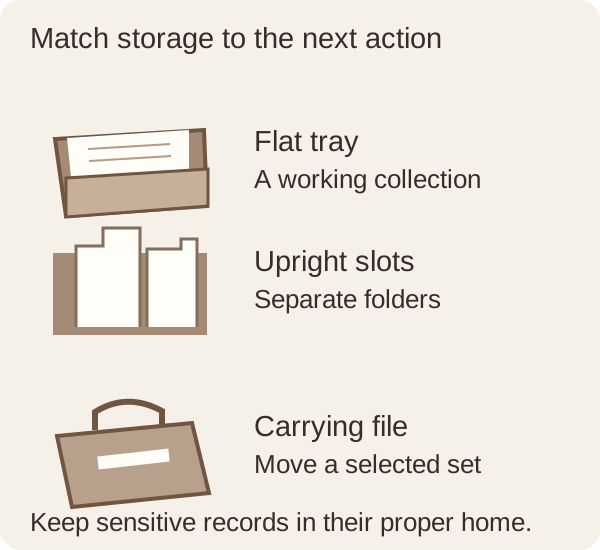
A flat tray may fit the job when you want to see and lift a small current collection without bending it into a slot. Check the actual usable interior and the opening through which your hand will retrieve papers, including the room above a lower tray if you are considering a stack.
Its tradeoff is overlap: sheets underneath are not visible just because the top is open. If your next action depends on seeing every deadline at once, a mixed flat stack may hide information even when the tray is attractive and the total pile looks fairly small.
Try one existing suitable tray with a clearly named job before buying a tower of matching ones. If one collection repeatedly grows beyond the useful space, revisit the decisions and review point rather than assuming the immediate answer is to add another identical level.
Use upright slots when separate folders make the next action clearer
An upright organizer can make sense when labeled folders need their own visible positions and the papers can be stored appropriately that way. Measure the folder including tabs, the usable slot width, and the space needed to remove it without catching it on a shelf above.
Compared with a flat tray, the advantage is a visible folder label rather than a view of each sheet. That distinction matters if several people use the same station: a clear, agreed label may help, but a row of unfamiliar abbreviations can make an organized-looking shelf difficult to understand.
Skip the slot arrangement for an item that needs different physical support, or when the folders would be packed so tightly that returning one takes effort. You are selecting a retrieval method for a defined sample, not proving that upright storage is best for every kind of household paper.
Use a carrying file when the work actually moves
A portable file may help when you need to bring a selected group of current papers from a shelf to the table and return it afterward. Choose for the documents, handles, closure, and route you will use, while keeping appropriate control of any information that travels with you.
Its tradeoff is that portability creates another place a paper can remain after the task ends. Agree on a home position and a return step, rather than adding a carrying file to an existing drawer system without deciding which one contains the current version of the work.
Test the movement with an existing folder and your actual work spot. If papers never leave the desk, a handle and closure may add complexity without solving a real problem; if the table must clear after every meal, the ability to return the collection in one move may matter much more.
Choose a reachable station with a clear review point
Place the ordinary working collection where the responsible people can use it without displacing another necessary activity. That might be a small shelf near a desk rather than the busiest kitchen counter, especially if meals, deliveries, and personal items already compete for that surface.
Attach a realistic review point to the station: for example, check the current response folder when you already review the coming week. This is an original coordination suggestion, not a validated habit intervention, and you can move or simplify it if the chosen moment does not suit the people using it.
During that review, move finished papers to their proper next destination instead of leaving them as proof that you completed a task. An action tray remains understandable when it represents current work, while permanent records, reference information, and appropriate disposal follow the separate processes you selected for them.
Check the complete setup before buying hardware
Compare the organizer’s delivered cost with the folders, labels, or suitable enclosures you actually need to make the arrangement work. Check the selected size and package contents carefully, since a photograph may show several units or accessories that are sold separately, and a multi-tier title does not describe usable interior clearance.
After a week of ordinary use, note one thing that slowed you down and change that part before buying more storage. You may need a clearer label, fewer categories, or a different review moment; the most useful paper organizer can be a simple container you already own with a better-defined job.
