Best Tool for Measuring Thickness: Top Digital Calipers and Gauges for Precision
Measuring thickness accurately is essential for DIY projects, craftwork, leather and fabric inspections, and metalworking. The following selection highlights digital calipers and thickness gauges designed for quick, precise readings, durable construction, and easy unit switching between inches and millimeters. Each product below offers reliable performance for home workshops and professional settings alike.
Summary of Selected Products:
| Product | Brand | Key Features |
|---|---|---|
| Digital Caliper, Adoric 0-6″ | Adoric | 0-150 mm range, 0.01″ resolution, auto-off, inside/outside/depth/step modes, IN/MM conversion |
| Digital Caliper Measuring Tool, Jiavarry | Jiavarry | Stainless steel, accurate to ±0.001″, 0-6″ range, 4 measurement modes, IN/MM/Fraction |
| Digital Caliper, LOUISWARE | LOUISWARE | Stainless steel, 0-6″ range, 0.01 mm resolution, large LCD, IN/MM conversion |
| Neoteck Digital Thickness Gauge 0.5″ | Neoteck | 0-0.5″ range, 0.01 mm resolution, quick one-hand operation, aluminum anvil |
| Kynup Digital Caliper | Kynup | 0-6″ range, 0.01 mm accuracy, IN/MM/Fraction, IP54 splash proof, three unit modes |
This article presents five carefully chosen measuring tools, focusing on accuracy, durability, and ease of use. Each entry includes a direct product link and an image to help you compare at a glance.
Adoric Digital Caliper 0-6″ Tool

The Adoric digital caliper offers a 0-6 inch (0-150 mm) measuring range with a 0.01 inch (0.1 mm) resolution and ±0.2 mm/±0.01″ accuracy. It supports inside, outside, depth, and step measurements using two sets of jaws plus a probe. Quick inch/mm conversion is enabled by a single button. The rugged plastic-carbon fiber construction aims for portability and durability in household and DIY tasks. A practical auto-off feature helps conserve battery life during extended use.
Jiavarry Digital Caliper with Stainless Steel
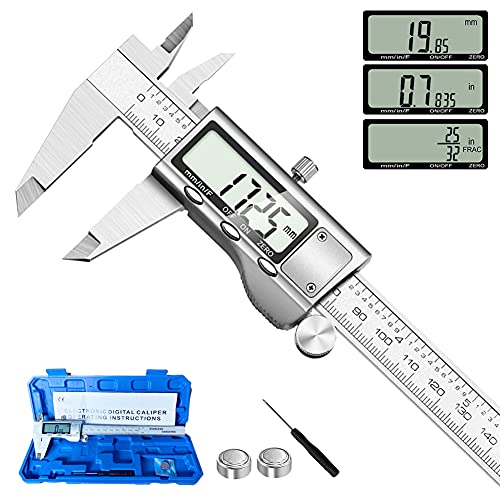
Jiavarry’s stainless steel vernier caliper emphasizes durability with water- and dirt-resistance. It measures 0-6″ (0-150 mm) with an accuracy of ±0.001″ (±0.02 mm) and a 0.0005″/0.01 mm resolution. The device allows easy zero-setting for differential measurements and provides four measurement modes for inside/outside diameter, depth, and step measurements. The combination of stainless steel and precise calibration supports repeated use across various materials, from metals to plastics.
LOUISWARE Digital Caliper, Stainless Steel

LOUISWARE’s digital caliper uses high-strength stainless steel to deliver reliable measurements with a 0-6″ (0-150 mm) range and 0.01 mm resolution. Its large LCD screen provides clear readings, while a thumb wheel and locking screw help secure precise positioning. The device offers inch and millimeter conversion for convenience across different measurement conventions, and its waterproof and oil-proof design makes it suitable for workshop environments where exposure to moisture or oils is common.
Neoteck Digital Thickness Gauge 0.5″
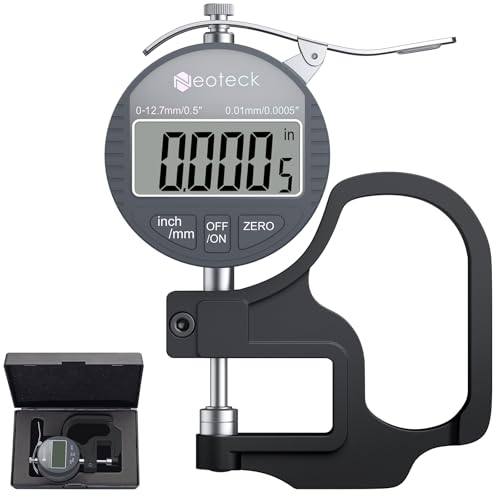
Neoteck’s thickness gauge provides precise 0.0005″ (0.01 mm) readings over a 0-0.5″ (0-12.7 mm) range, with a quick-response time designed for rapid measurements. It features a 10 mm aluminum alloy measuring surface for durability and wear resistance. The one-handed operation enables efficient throughput in high-volume or awkward positioning tasks. The device’s compact form factor and aluminum construction balance accuracy with portability for leather, paper, fabric, film, and similar materials.
Kynup Digital Caliper, 6 Inch

Kynup’s digital caliper covers 0-6″ (0-150 mm) with accuracy of ±0.001″ (±0.02 mm) and a 0.0005″/0.01 mm resolution. It supports inch, millimeter, and fraction conversions via a single button, making it versatile for different measurement conventions. The caliper includes three batteries and an IP54 splash-proof rating, which helps maintain performance in environments with dust or light moisture. Its dual jaws and a probe enable versatile measurements of external, internal, depth, and step dimensions.
Buying Guide: Key Purchase Considerations
- Accuracy and Resolution: Look for calipers with at least ±0.02 mm (±0.001″) accuracy and a 0.01 mm (0.0005″) or finer resolution to ensure precise readings for small parts.
- Measurement Modes: Choose devices that support inside/outside diameter, depth, and step measurements. Jaws and probes paired with multiple measurement modes increase versatility across materials.
- Materials and Durability: Stainless steel bodies resist corrosion, wear, and chemical exposure—important in workshop environments. Consider splash-proof IP ratings if you expect moisture or oils.
- Display and Readability: A large, clear LCD improves reading accuracy, especially in dim or cluttered workspaces. A thumb wheel and locking screw aid stable positioning.
- Units and Conversion: Fast, reliable switching among inches, millimeters, and fractions reduces errors when working with parts sourced from different standards.
- Power and Maintenance: Rechargeable or replaceable batteries, and auto-off features help extend use between charges. Regular calibration checks maintain measurement integrity over time.
- Portability and Ergonomics: Ergonomic grips, light weight, and compact form factor enhance one-handed operation, especially for on-site tasks or quick inspections.
- Value and Support: Consider brands with solid customer support, clear warranties, and readily available spare parts or batteries.
When selecting a thickness measuring tool, balance precision needs with the typical materials you work with, whether metal, leather, fabric, or plastics. For high-volume environments, prioritize speed, durability, and easy zeroing. For hobby projects, a cost-effective digital caliper with four measurement modes may be sufficient. Always verify that the tool provides robust unit conversion and reliable zero-setting to minimize repeated re-measurements.