Best Table Saw Straight Edge Jig Guide for Precise Ripping
Finding a reliable straight edge jig for a table saw can dramatically improve accuracy in ripping, tapering, and dimensioning stock. This guide highlights five top-ready options, spanning taper jigs, straight edge guides, and track-style aids. Each product is selected for stable clamping, easy setup, and compatibility with common miter slots. Use the buying guide at the end to compare features, materials, and intended tasks to choose the best jig for your workshop needs.
| Product | Primary Use | Key Benefit |
|---|---|---|
| POWERTEC 71395 Taper/Straight Line Jig | Tapering and straight-line ripping | Wide MDF base with melamine coating for smooth operation |
| POWERTEC 24 Inch Straight Edge Guide (71705) | Long straight cuts and routing/grooving | Low-profile clamps for unobstructed work area |
| Peachtree Adjustable Taper/Straight Line Jig | Tapering chair legs and straight-line ripping | Versatile settings for varied taper angles |
| Kreg KMA2700 Accu-Cut Track | Edge-guided straight cuts with circular saw | Portable and compatible with many circular saws |
| Kreg KMA4500 Straight Edge Guide | Straight-edge guidance for assorted saws | Retractable cutline indicator for precise alignment |
These selections cover different workflow needs—from dedicated taper jigs to universal straight-edge guides—ensuring there’s a viable option for most hobbyists and professionals alike. The following sections provide detailed product overviews, with highlights on construction, usability, and setup considerations.
POWERTEC 71395 Taper/Straight Line Jig

The POWERTEC 71395 is designed to function primarily as a taper-cutting jig for table saws, with a secondary role as a stable straight-line ripping guide. The base measures 32” x 7-7/8” x ½” and uses MDF with melamine coating on both sides, offering a durable yet lightweight platform. Assembly includes a 36” miter bar, adjustable fence, hold-down clamps, and an abrasive grip strip to minimize stock shifting. Indexing marks assist in setting common angles, and the ergonomic push knob enhances control during operation. This jig is well-suited for long stock and provides a straightforward pathway to repeatable taper cuts, as well as accurate straight-line passes when needed.
Key considerations: The combination of a taper function with a straight-line option makes this jig versatile in a compact footprint. The ready-to-use components support users who want a single solution rather than multiple specialized tools. For best results, ensure the stock is flat and clean before clamping, and verify alignment against a known reference edge after setup.
POWERTEC 24 Inch Straight Edge Guide (71705)

The POWERTEC 24 Inch Straight Edge Guide provides a space-saving solution for achieving straight cuts on any workpiece with parallel edges. The tool includes a single straight-edge clamp designed to accommodate up to 24 inches of material, and its low-profile jaws allow inversion for unobstructed work areas. The fixed end clamp locks with a lever, while the adjustable end clamp can be drawn into place to secure the workpiece. This jig is particularly approachable for beginners yet robust enough for professional use, offering reliable straight-line cuts for plywood, panels, and stock where precise edge parallelism is essential.
Considerations: The simplicity of this guide is its strength. For large panels, you may want to pair it with a second guide for end-to-end alignment. Regularly check the alignment of clamps and ensure the stock is supported to reduce deflection during cutting.
Peachtree Adjustable Taper/Straight Line Jig

The Peachtree Woodworking Supply adjustable taper/straight line jig focuses on precise taper cuts for long stock, such as chair legs or table legs. It features adjustable clamps and the ability to remove the miter bar to convert the tool into a straight-line ripping jig. Quick adjustments in angles and lengths simplify the process of achieving consistent, accurate taper cuts. A maximum stock height of 2″ supports thinner to mid-thickness workpieces, making it a good choice for fine woodworking projects where precision tapering matters as much as straight-line accuracy.
Performance notes: This jig is designed to balance versatility with ease of use. When switching between tapering and straight-line ripping, confirm the clamping arrangement for each operation to prevent drift. The accessible adjustment mechanism benefits users working on multiple project geometries.
Kreg KMA2700 Accu-Cut Track
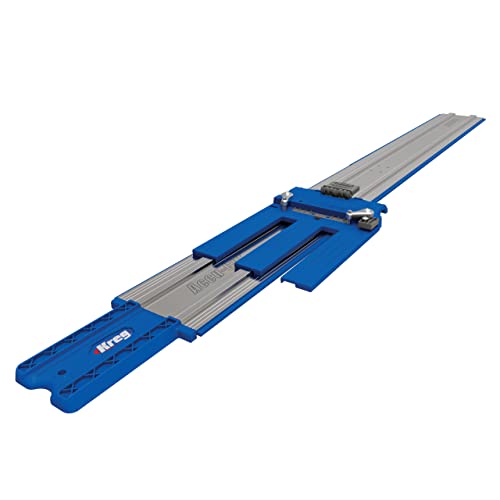
The Kreg KMA2700 Accu-Cut Track turns circular saws into precision edge-guided tools. Its universal sled makes the track compatible with right- or left-handed circular saws, and portability supports use in different locations, from the shop to a job site. The track system supports straight, cross, and angle cuts with improved accuracy. For tasks requiring long, repeatable straight cuts, this track provides a reliable guide that reduces misalignment and blade wander, especially when working with plywood, laminates, or panel stock.
Usage tips: Ensure the track is securely clamped or anchored before cutting. When transporting to job sites, verify that the saw’s base plate and the track align properly to avoid binding. The Accu-Cut system is best used with steady, even feed to maximize cut quality.
Kreg KMA4500 Straight Edge Guide

The Kreg KMA4500 Straight Edge Guide provides a robust edge-guided option for various saws. It features a retractable cutline indicator to simplify alignment and dialing in precise begins and ends of cuts. The guide is designed to work with many circular saws and can be a practical companion for more complex projects that require consistent straight cuts across panels and boards. Its build emphasizes stability and repeatability, helping woodworkers achieve uniform results across multiple pieces.
Practical notes: Use the retractable indicator to verify alignment before each cut. If working with thin materials, drape stock with support to minimize sag and ensure the guide remains flush against the reference edge during the cut.
Buying Guide: Key Purchase Considerations
Think about the tasks you perform most often when choosing a table saw straight edge jig or tapering jig. Consider these factors to select a solution that fits your workshop needs:
- Stock size and material: Larger panels benefit from longer straight-edge guides; thinner stock may require more precise clamps and anti-slip features.
- Primary use: If you mainly taper legs or uprights, prioritize a jig with dedicated taper functionality. For general straight cuts, a robust straight-edge guide may suffice.
- Clamping stability: Look for devices with hold-down clamps, anti-slip strips, and low-profile jaws to reduce drift and kickback risks.
- Ease of setup and adjustments: Indexing marks, adjustable fences, and clear instructions help achieve repeatable results with less setup time.
- Compatibility: Verify miter slot sizing and saw compatibility (e.g., 3/4″ x 3/8″ T-slot or standard slots) to ensure a proper fit.
- Portability and storage: If you move between sites or space-constrained workshops, consider tracks or jigs that are easy to transport and assemble.
- Material quality: MDF bases with melamine coatings can provide smooth movement and durability, while aluminum builds offer rigidity and lighter weight.
- Safety features: Ergonomic handles, anti-slip surfaces, and secure locking mechanisms reduce the risk of stock shifting during operation.
In practice, choosing between a dedicated taper jig and a universal straight-edge guide depends on your typical projects. For furniture builders focusing on tapered legs, a combined taper/straight-line jig can save time and improve accuracy. For general shop tasks such as ripping sheets or trimming panels, a long straight-edge guide or a track system can deliver consistent results with minimal setup.
When evaluating multiple options, compare setup times, part availability, and the ability to customize for specific projects. A flexible toolset that can accommodate both tapering and straight-line cuts tends to offer the most value in a busy shop, especially if you frequently switch between different materials and stock thicknesses.