Best Table Saw Miter Gauge Fence: Top Picks for Precision Cutting
When accuracy and repeatability matter in woodworking, a reliable miter gauge fence can be a workflow game changer. The following selections cover a range of budgets and setups, from adjustable aluminum heads to telescoping fences and extended extensions. Each product is chosen for compatibility with common table saw slots and its ability to deliver precise angle stops, stable fences, and user-friendly setup.
| Product | Brand | Slot Compatibility | Notable Feature |
|---|---|---|---|
| VEVOR Precision Miter Gauge | VEVOR | 3/4″ x 3/8″ | 15 positive angle stops, removable disc |
| Fulton Precision Miter Gauge | Fulton | 3/4″ x 3/8″ | Aluminum fence with 45° ends, extra stops |
| DuBois 51007 Table Saw Miter Gauge Fence | DuBois | 3/4″ x 3/8″ | T-track fence, 13 angle stops |
| INCRA MITER1000SE | INCRA | 3/4″ x 3/8″ | Telescoping fence, 41 laser stops |
| Kreg KMS7102 Table Saw Miter Gauge System | Kreg | 3/4″ x 3/8″ | Factory calibrated, 5 positive stops |
VEVOR Precision Miter Gauge and Fence

The VEVOR miter gauge is designed to fit most standard 3/4″ x 3/8″ table saw slots, with a detachable disc enabling compatibility with both T-shaped and U-shaped slots. The aluminum head provides rigidity for repeatable angle cuts, and 15 positive stop holes cover common woodworking angles from 0 to 67.5 degrees on each side, plus a 90-degree stop. This arrangement supports quick, precise crosscuts and angled cuts for cabinet making, trim work, and furniture components. The gauge arrives partially assembled, reducing setup time and ensuring accuracy remains intact during final assembly. If you rely on frequent angle changes or extended cuts, this gauge offers a robust balance of light weight and rigidity for everyday shop work.
Fulton Precision Miter Gauge with Aluminum Fence

Fulton combines an aluminum miter head with a 45-degree angled fence ends that enhance support for stock during crosscuts and angles. The gauge includes a .200″ thick adjustable aluminum head with 13 positive stops, including 90 degrees and a progression through 22.5°, 30°, 45°, 60°, 67.5°. The accompanying steel miter bar measures 17″ long and matches standard 3/4″ x 3/8″ slots, though tolerances can vary by brand. This setup emphasizes sturdy alignment and repeatable stops, making it a strong option for woodworkers who frequently cut crown molding, picture frames, or casework components that demand stable indexing.
DuBois 51007 Table Saw Miter Gauge Fence System

DuBois’ system pairs an aluminum miter gauge with a T-track fence, a T-track flip stop, and an SEA/Metric scale. It provides 13 precise angle stops and a spring-loaded pin for secure positioning. The miter head is protractor-style, enabling both fixed and custom stops, while the flip stop supports quick repetitive cuts. This combination suits shop setups that prioritize economical upgrades without sacrificing alignment accuracy, making it a practical option for hobbyists expanding beyond a basic gauge.
INCRA MITERV27 Miter V27 Miter Gauge

INCRA’s MITERV27 Miter V27 focuses on precision with 27 angle stops and a compact, no-nonsense design. It features a specialized miter gauge that emphasizes accuracy across a range of standard and non-standard angles, delivering consistent results for cabinetry, trim, and detailed woodworking. The gauge is designed to be compact yet precise, with straightforward adjustments that support repeatable cuts in a busy shop environment. The V27 is well-suited for users who value high-precision tooling without excess complexity in setup or operation.
Kreg KMS7102 Table Saw Precision Miter Gauge System
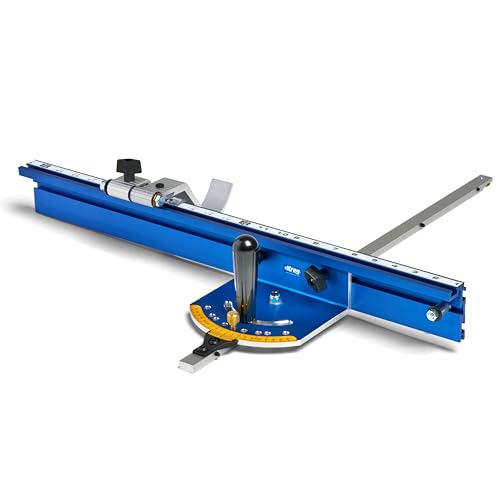
Kreg’s KMS7102 combines a precision miter gauge with a fence and bar, offering factory calibration and five positive stops. The vernier scale aids adjustments to a tenth of a degree, which is beneficial for fine-tuned tasks such as drawer box joints or precise miters in picture frames. The system emphasizes repeatability and simplicity, enabling users to quickly switch between common angles while maintaining alignment along the fence for long crosscuts or repeated identical cuts.
Buying Guide: Key Considerations for a Table Saw Miter Gauge Fence
Choosing the right miter gauge fence depends on your work type, saw model, and preferred workflow. Here are important factors to weigh when evaluating options:
- Slot compatibility: Most tables use 3/4″ x 3/8″ slots with possible variations. Verify your saw’s slot dimensions and consider gauges with detachable discs or adaptable heads to fit both T-slots and U-slots.
- Angle stops and scale: Positive stops reduce setup time and improve repeatability. Look for gauges offering multiple stops (15–41) and a clear, easy-to-read scale. A vernier or laser-etched scale enhances precision for fine adjustments.
- Fence quality and extensibility: A sturdy fence reduces deflection during cuts. Extendable fences improve support for long workpieces. Check for telescoping features and secure clamping for stable positions.
- Construction material: Aluminum heads and fences offer light weight and rigidity, while steel components can add durability. Consider whether you need corrosion resistance for your shop environment.
- Ease of assembly and compatibility: Some gauges arrive partially assembled or require minimal assembly. If you frequently switch between saw models, look for universal or versatile designs with simple alignment.
- Repeatability: A flip stop, adjustable stops, and locking mechanisms help maintain consistent cuts across batches, especially for cabinetry or furniture parts.
- Brand ecosystem and accessories: Some brands provide cohesive accessory ecosystems (fences, bars, and stops) that simplify upgrades and replacements over time.
In selecting a table saw miter gauge fence, balance precision with practicality. For hobbyists, a gauge with straightforward setup and robust stops may suffice. For professional cabinetry or furniture work, a gauge with numerous stops, a precise vernier scale, and a telescoping fence may deliver the most value over time. Always ensure compatibility with your saw’s slot system and confirm measurements with a quick test cut to verify accuracy before committing to a long project.