Best Table Saw Measuring Gauges for Precision and Quick Alignments
Choosing the right measuring gauge for a table saw can improve accuracy, reduce setup time, and ensure repeatable cuts. This guide reviews top-rated options designed to align blades, fences, and dado setups with confidence. Below is a quick table of the five highlighted products to help you compare at a glance.
| Product | Brand | Key Benefit |
|---|---|---|
| Kreg KMS7102 Table Saw Precision Miter Gauge System | Kreg | 5 positive stops and vernier scale for precise 1/10° adjustments |
| Neoteck 0-1” Digital Dial Indicator Table Saw Gauge | Neoteck | Digital readout with mm/inch switch and zero setting |
| ALLmeter Digital Table Saw Gauge with Dial Indicator | ALLmeter | High-precision dial indicator with CNC aluminum bar and multiple holes |
| POWERTEC 71391 Table Saw Precision Miter Gauge System | POWERTEC | 27 angle stops and multi-track fence for versatile cuts |
| VEVOR Precision Miter Gauge | VEVOR | 15 positive stops and compatible with most standard slots |
Kreg KMS7102 Table Saw Precision Miter Gauge System
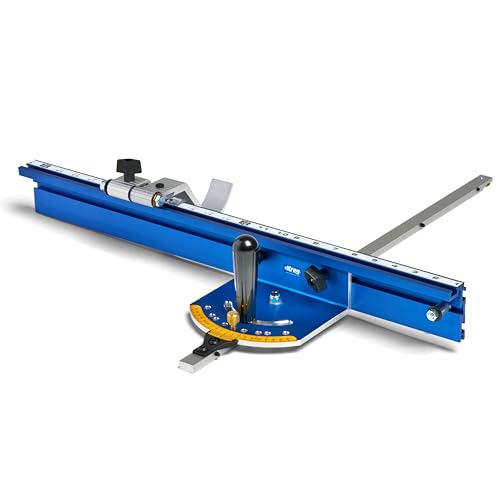
The Kreg miter gauge system is designed for repeatable, accurate angle cuts on a table saw. It includes a miter gauge with five positive stops and a vernier scale that enables precise adjustments to 1/10 of a degree. A brass pin facilitates quick changes between stop angles, and the gauge is factory calibrated for dependable accuracy right out of the box. This setup is suited for woodworkers who value consistent repeatability in crosscuts and angled profiles.
Neoteck 0-1” Digital Dial Indicator Table Saw Gauge

Neoteck offers a digital dial indicator gauge designed to assess blade-to-fence alignment, arbor run-out, and miter-slot squareness. It formats to standard miter grooves (3/8″ x 3/4″), with a 0-1 inch range and high resolution up to 0.0005 inch. The unit emphasizes precise alignment across diverse shop machines and supports quick setup by switching between metric and imperial units. It’s a practical choice for shops needing instant, digital readouts during calibration tasks.
ALLmeter Digital Table Saw Gauge with Dial Indicator
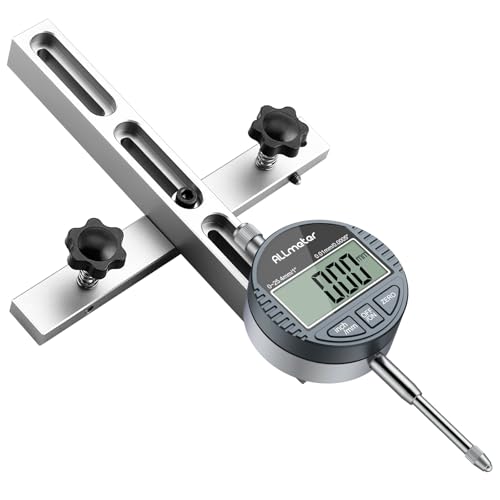
ALLmeter’s gauge focuses on high-precision alignment with a dial indicator rated at 0.01 mm (0.0005 in). The CNC-machined 3.2-inch aluminum bar features three chutes for stability and six holes to accommodate different indicator positions. It’s compatible with 3/4″ x 3/8″ slots and is designed for extended use with a robust build. A detachable dial setup helps users calibrate fences and blades for complex cuts with confidence.
POWERTEC 71391 Table Saw Precision Miter Gauge System

POWERTEC’s bundle combines a precise miter gauge with a 24″ x 3″ multi-T track fence and a removable T-slot plate. It features 27 angle stops with 1-degree increments, including common angles such as 0°, 10°, 22.5°, 30°, and 45°, with additional presets on both sides. The system is designed to work in standard 3/4″ x 3/8″ slots, offering versatility for crosscuts, dado setups, and intricate miters. It’s a cost-effective option for users needing a comprehensive cast-iron-ready setup.
VEVOR Precision Miter Gauge

VEVOR’s precision miter gauge is designed to fit most 3/4″ x 3/8″ slots with a detachable disc enabling compatibility with both T-shaped and U-shaped slots. It offers 15 positive stop positions with a robust aluminum head and a grating for stable mounting. The gauge is shipped partially assembled to simplify setup and reduce the typical fiddling associated with new shop jigs. This option suits users who want solid performance with straightforward assembly.
Buying Guide: Key Considerations for Table Saw Gauges
- Slot compatibility: Verify your saw’s miter slot dimensions (most common are 3/4″ x 3/8″). Some gauges also fit U-shaped slots or T-slots, so confirm compatibility before purchasing.
- Stop versatility: Check the number and spacing of angle stops. Higher-end gauges often offer 1-degree or even 0.5-degree increments for fine-tuning bevels and miters.
- Readout type: Digital dial indicators provide immediate numeric feedback, while traditional vernier scales depend on manual interpretation. Choose based on your workflow and accuracy needs.
- Ease of setup: Some gauges arrive partially assembled or with quick-install fences. Consider how much setup time you’re willing to invest and whether you prefer modular fences for cross-cutting.
- Build material and durability: CNC-machined aluminum bars and robust levers reduce wear and provide consistent measurements in busy workshops.
- Compatibility with accessories: Some systems include or support additional accessories such as T-track fences, flip stops, or extension bars. This can boost versatility for dadoing and riving tasks.
- Calibration stability: Look for gauges with features that reduce drift during use, such as locking mechanisms, repeatable stops, and rigid alignment surfaces.
- Value and completeness: A kit including a miter gauge, fence, stop, and alignment accessories may offer better long-term value than a single gauge piece.
When selecting a table saw measuring gauge, balance your need for precision with the time you’re willing to spend on setup. For frequent repeat cuts and complex joinery, gauges with multiple stops and a reliable digital readout often deliver the best efficiency. For simpler tasks, a sturdy miter gauge with a solid fence may suffice. Always verify compatibility with your saw model and slot style to ensure seamless operation.