Best Table Saw Alignment Tools for Precise Cuts and Setup
Achieving perfect blade, fence, and miter slot alignment is essential for accurate, safe woodworking. The following five table saw alignment tools deliver high-precision dial indicators, smart bar technology, and robust build quality to help you set up and maintain your saw with confidence. Each option fits standard 3/4″ miter slots and works across table saws, bandsaws, and jigs. Use this guide to compare features, accuracy, and ease of use for dependable alignment results.
| Product | Brand | Key Benefit |
|---|---|---|
| Woodpeckers Table Saw Gauge | Woodpeckers | Auto-adjusts to miter slot; includes dial indicator & storage |
| ALLmeter Digital Table Saw Gauge | ALLmeter | High-precision digital readout; CNC aluminum bar |
| AltitudeCraft Precision Table Saw Gauge | AltitudeCraft | 0.001″ dial indicator; rugged aluminum construction |
| XUNTOP Digital Table Saw Gauge | XUNTOP | 0.0005″ resolution; adaptable for 3/4″ grooves |
| Rockler Table Saw Alignment Gauge | ROCKLER | Dial indicator with safety-focused fence alignment |
These tools are designed to minimize runout, improve fence parallelism, and ensure blade-to-slot alignment. Whether you’re a hobbyist or a professional, selecting the right gauge depends on the level of precision you need, the slot width you work with, and how much automation you want in setup and ongoing maintenance.
Woodpeckers Table Saw Gauge and Alignment Tool

The Woodpeckers SG-WP aligns directly to the miter slot and automatically adjusts to the slot width. It includes a dial indicator and a fitted storage case for portable setups. This tool is widely praised for its smooth operation and reliable automatic adjustment, reducing the need for constant re-tightening as you reference blade and fence parallelism. Use it to check blade runout and fence-to-slot alignment for consistent, accurate cuts across rip and cross-cut operations.
ALLmeter Digital Table Saw Gauge
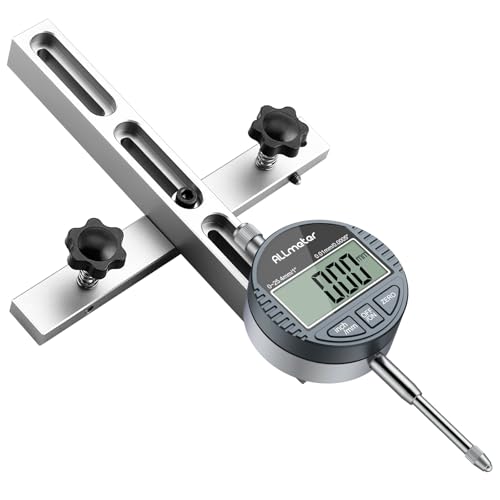
The ALLmeter gauge uses a high-precision digital dial indicator with a 0.01 mm (0.0005 inch) accuracy. The CNC-machined aluminum bar features multiple chutes for additional rigidity, plus six dial indicator adjustment holes for flexible setup. Its digital readout provides quick, repeatable measurements when aligning the fence, blade, and miter slot. It’s designed for durability in daily shop use and supports long-term consistency in alignment tasks across different tools.
AltitudeCraft Precision Table Saw Gauge

The AltitudeCraft gauge features a 0.001″ dial indicator with rugged CNC-machined 6061 aluminum construction and a hard anodized finish. It’s designed to fit standard 3/4″ miter slots and includes adjustable ball screws to eliminate play, providing zero-wobble alignment for blade-to-fence adjustments. This tool suits professional shops where repeatability and accuracy under demanding use are priorities for cabinetmaking and fine woodworking.
XUNTOP Digital Table Saw Alignment Gauge

The XUNTOP gauge offers a 0.0005″ resolution across a 0-1″ (25.4 mm) range, with a digital indicator and a CNC-anodized aluminum bar. Its single 3/4″ groove design ensures compatibility with many mainstream table saws and broader systems. Anti-corrosion copper sleeves and a rigid shaft help maintain stable readings, making it suitable for frequent adjustments to blade parallelism, fence alignment, and sled setup in woodworking shops and fabrication environments.
Rockler Table Saw Alignment Gauge

Rockler’s gauge focuses on precision alignment with a dial indicator to highlight even minute deviations in parallelism, a critical feature for high-quality crosscuts. The accompanying aluminum miter bar includes molded finger grips and hang holes for convenient storage. This tool also serves as a safety adjuster by helping reduce blade binding and ensuring consistent, clean cuts across different board widths and materials.
Buying Guide: Key Purchase Considerations
When choosing a table saw alignment tool, consider accuracy, compatibility, and workflow features. Here are essential purchase considerations from multiple perspectives:
- Accuracy and resolution: For most hobbyists, 0.001″ to 0.01 mm precision is adequate. Professionals may prefer digital readouts to minimize interpretation errors during setup.
- Slot compatibility: Confirm the tool supports standard 3/4″ miter slots and matches your saw’s slot width to prevent play or slop.
- Auto-adjust vs. manual: Auto-adjust or smart bars save time by maintaining a snug fit in varying slot sizes, while non-auto systems may require more manual tweaking but can be more economical.
- Durability: CNC-machined aluminum or aerospace-grade aluminum with hard anodized finishes provides stability and long-term reliability in busy shops.
- Portability and storage: Look for a case or compact design that makes it easy to carry between job sites or store in a small workshop.
- Cross-tool use: Some gauges are advertised for table saws, band saws, and router tables. If you frequently switch tools, a versatile model can save money and space.
Use of a high-precision alignment gauge should be paired with periodic checks of the blade runout, fence alignment, and miter gauge accuracy. Regular calibration helps sustain repeatable results, especially after blade changes, fence realignments, or table readjustments. For mixed workshop environments, digital gauges may offer faster setup, while traditional dial-indicator systems provide tactile confidence for some users.