Best Spray Foam Insulation for Windows: A Practical Guide
Choosing the right spray foam for windows is essential to stop drafts, improve energy efficiency, and reduce moisture infiltration. This guide highlights five reliable options best suited for window and door openings, explains how to select the right product for your frame material and climate, and compares expansion, cure times, and durability. Learn how to apply these foams effectively, avoid common mistakes, and achieve a tight seal around sills, frames, and rough openings.
| Product | Brand | Best For |
|---|---|---|
| Great Stuff Window & Door Foam Sealant | Great Stuff | Draftproofing around windows and doors |
| Red Devil 0914 Window & Door Foam Sealant | Red Devil | Complete cavity fills with frame protection |
| TYTAN Window & Door Extreme Foam | TYTAN PROFESSIONAL | Low-expansion channeling for frames |
| Stanley F905 Gaps & Cracks Sealant | STANLEY | Versatile gaps around windows and pipes |
| Loctite Tite Foam Gaps & Cracks | Loctite | 1-inch gaps with durable, UV-resistant foam |
Great Stuff Window & Door Foam Sealant

The Great Stuff Window & Door Foam Sealant is a 12-ounce can designed specifically for openings around windows and doors. It emits a distinct yellow foam and is manufactured in the United States, giving many DIY installers familiarity and reliability. This product is aimed at sealing gaps and cavities that contribute to air leakage and moisture infiltration. It’s suitable for typical residential framing materials and can be a rapid solution during retrofits or new installations. The yellow foam helps distinguish it from other sealants during the application process, aiding in coverage verification and cleanup.
As a general-purpose expanding foam, it adheres to a broad range of substrates and expands to fill irregular spaces around frames. The can design and accompanying dispensing straw enable controlled placement in corners and along rough openings. For window projects, this foam offers a straightforward approach to draft sealing without specialized tools. While it provides a solid barrier against drafts, users should plan for trimming once cured to achieve a neat finish and to ensure paint adhesion if you plan to finish over the foam.
Red Devil Window & Door Foam Sealant

The Red Devil 0914 spray foam is a 12-ounce polyurethane sealant designed for use around windows and doors. It fills, insulates, and seals gaps to help reduce energy loss and drafts. A notable feature is its low-pressure formula, which minimizes the risk of bowing or stressing window and door frames while providing a complete cavity fill. The product’s multi-directional dispensing capability allows foam to be applied at various angles, improving accessibility in awkward gaps and behind trim where traditional caulks or tapes fall short.
Red Devil emphasizes performance in enclosed cavities common in residential openings. The foam forms a durable barrier against air leakage and moisture, helping to stabilize interior temperatures and improve comfort. For installers, the ability to apply foam from multiple directions can speed up work on awkward corners or around curved trim. Care should be taken to trim and cure properly to avoid overfill and to achieve a smooth finish that accepts paint or stain if desired.
Loctite Tite Foam Gaps & Cracks Spray Foam Sealant

Loctite Tite Foam Gaps & Cracks is a 12-ounce polyurethane expanding foam designed to fill gaps and cracks up to one inch in size. This formulation emphasizes durability and UV resistance, supporting long-term performance in both indoor and outdoor window and door contexts. The high-density foam structure provides a solid air barrier and helps improve insulation without relying on additional sealants. For those focused on energy efficiency, this option offers a straightforward path to reduce drafts around non-structural gaps in frames and trim.
Key advantages include a robust, uniform cell structure that stands up to UV exposure, making it suitable for exterior use in many climates. The foam’s density supports a lasting seal even as building materials move with temperature and humidity. The product pairs well with typical window and door substrates like wood, vinyl, metal, and composites. As with any expanding foam, practitioners should plan for trimming after curing to achieve the desired aesthetic and paint compatibility, especially for visible exterior edges.
Stanley F905 Gaps & Cracks Sealant
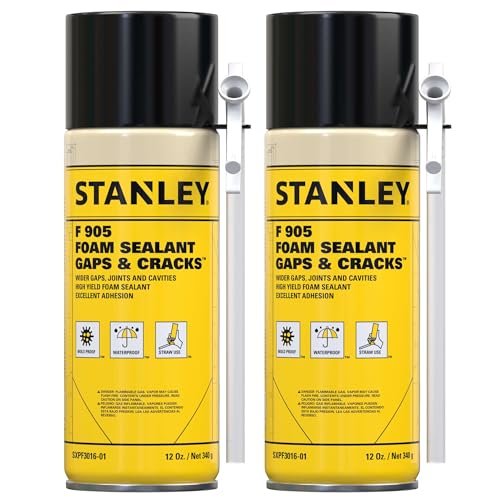
Stanley F905 Gaps & Cracks Sealant is a versatile polyurethane spray foam designed for windows, doors, pipes, and wall penetrations. Packaged as a two-pack of 12-ounce cans, it provides a practical solution for DIYers and professionals tackling multiple openings. The foam is designed for low expansion to help protect frames from distortion while still delivering a complete fill for cavities up to several inches wide. The straw applicator enables precise placement in tight spaces, reducing overspray and cleanup time.
This product is marketed for indoor and outdoor use, offering waterproof properties that help maintain the integrity of sealed openings in varied weather conditions. The combination of low expansion and reliable adhesion makes it a solid choice for sealing around rough openings where a gentle, controlled pour is preferred. After application, trim cured foam to achieve a clean, paintable finish and to integrate with trim carpentry for a seamless installation around windows and doors.
Loctite Tite Foam Big Gaps

Loctite Tite Foam Big Gaps is a high-capacity option designed for larger gaps and structural joints around windows and doors. Each can expands to fill openings up to about three inches, offering substantial insulation in rough openings, sill plates, and larger gaps that would require multiple standard cans. The foam is high-density, providing durability and a uniform cell structure that resists weathering and movement of building materials. It is particularly useful for exterior applications where long-lasting moisture barriers are essential.
The product’s flexibility allows it to tolerate minor fluctuations in temperature and substrate movement without losing its seal. For projects involving seasonal shifting or large gaps, this option reduces the need for frequent rework. As with other foams, curing and trimming are important steps to ensure a neat finish and compatibility with exterior finishes or interior trim work.
Buying Guide for Window Spray Foams
Choosing the right spray foam for windows depends on several factors. The goal is to create a durable air and moisture barrier without compromising the integrity of frames or trim. Here are key considerations and how different products address them.
- Expansion Rate and Frame Safety – Windows and doors require controlled expansion to prevent bowing or distortion. Low-expansion foams are preferred for new openings and retrofits with delicate frames, while regular-expansion foams are suitable for larger cavities where edge support is less critical.
- Cure Time and Work Temperature – Consider cure time and the temperature range in which you’ll apply the foam. Some foams cure quickly in warm environments, while others perform better in cool conditions. Outdoor projects may require products with broader temperature tolerance and UV resistance.
- Adhesion and Substrate Compatibility – Most foams bond well to wood, metal, vinyl, and masonry, but substrate type can influence long-term performance. If you are sealing around painted trim or delicate surfaces, verify compatibility and plan for surface preparation.
- UV Resistance and Exterior Durability – Exterior exposure can degrade foam over time if not UV-stable or protected with paint. For outdoor window frames, opt for formulations marketed as UV-resistant or be prepared to paint the foam after cure.
- Density, Sound, and Thermal Performance – Higher density foams generally provide stronger barriers and better sound dampening, but may be stiffer to apply. Open-cell foams are less dense but insulate differently than closed-cell foams. Closed-cell foams typically offer higher R-values per inch and moisture resistance.
- Dispensing Method and Accessibility – Straw dispensers, directional nozzles, and multi-angle application features help reach tight spaces around sills, casings, and corner joints. For long runs or awkward openings, a product with flexible dispensing is advantageous.
- Coverage and Job Size – Large projects benefit from mega-size kits or multiple cans packaged with applicator tools. For small drafts or single openings, standard 12-ounce cans are often sufficient and easier to manage.
- Finish and Trim – Most foams require trimming and finishing, especially for visible exterior edges or interior trim. If you plan to paint or stain, ensure the foam accepts coatings and that cleanup materials are compatible with the foam chemistry.
In practice, the five products reviewed here each address common window and door sealing needs with distinct strengths. For quick, reliable draft control around standard openings, Great Stuff Window & Door and Red Devil Window & Door foam offer straightforward, user-friendly options. If you’re prioritizing minimized frame distortion, TYTAN Extreme and the Stanley F905 line emphasize low-expansion and precise placement. For larger gaps or exterior applications, Loctite’s Big Gaps solution provides high-density insulation with weather resilience. Your final choice should align with your frame material, climate, and whether you expect to trim and finish the foam after cure.