Best Smart Hose Timers for Automated Yard Watering
For American homes, a smart hose timer can turn a simple yard into a water-saving, convenient landscape. With WiFi-connected models you can start, pause, or adjust watering from your phone, even while away from home. This guide compares top-rated options and explains which features matter most for efficiency and reliability.
Below are five strong choices, covering single- and multi-valve systems, Bluetooth and WiFi hubs, and compatibility with voice assistants. The quick-reference table summarizes each model at a glance.
| Product | Brand | Key Benefit |
|---|---|---|
| Rachio Smart Hose Timer (1 Valve + 1 Hub) | Rachio | App control; expandable up to 8 valves |
| Orbit B-hyve XD 2-Port Hose Timer | Orbit | Weather-based watering; Wi‑Fi or Bluetooth |
| Insoma Smart Hose Timer With Wi‑Fi Hub (2‑Outlet) | Insoma | Brass inlet; 120 psi; rain delay; 2 outlets |
| Smartale WiFi Sprinkler Timer | Smartale | 2.4 GHz WiFi; long-range via hub; rain delay |
| Rachio Smart Hose Timer (2 Valves + 1 Hub) | Rachio | App control; expandable up to 8 valves per hub |
Rachio Smart Hose Timer (1 Valve + 1 Hub)

The Rachio model with one valve and a dedicated WiFi hub replaces traditional dial-based irrigation with app-driven control. Users can schedule watering, pause zones, and monitor run times from a smartphone, turning lawn care into a streamlined process. The system emphasizes quick installation, letting homeowners get practical use in minutes rather than hours.
One of the standout features is expandability. The hub supports additional valves, enabling a broader watering strategy across multiple zones. This makes it a strong match for yards with complex landscaping or separate flower beds. The app interface highlights automation options, with intuitive scheduling, routine adjustments, and status notifications to keep you informed without manual checks.
Orbit B-hyve XD 2-Port Hose Timer

Orbit’s B-hyve XD 2-Port timer puts smart watering at two outlets, combining convenience with adaptive scheduling. The timer incorporates a weather-based approach, adjusting irrigation based on local conditions so plant roots receive the right amount of moisture. This helps reduce water waste while keeping lawns and beds healthy through seasonal changes.
Control is flexible, with options to manage the timer via Wi‑Fi or locally through Bluetooth. This dual-connectivity setup ensures you can configure settings from nearby or remotely, depending on network availability. The XD model is designed to adapt to drought conditions by tweaking schedules, and it also lets you apply local watering restrictions with ease, which is useful in regions with conservation rules.
Insoma Smart Hose Timer With Wi‑Fi Hub (2‑Outlet)
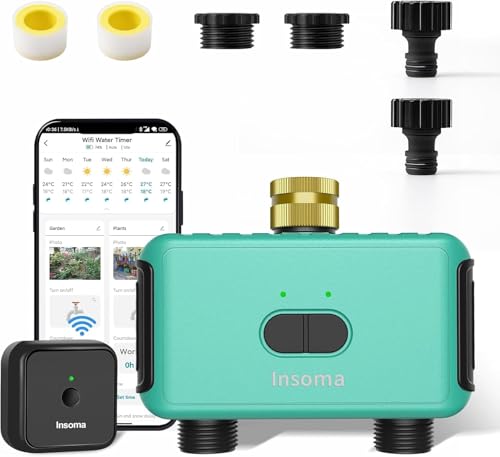
The Insoma timer emphasizes reliability with a pure brass inlet that resists leaks and can withstand pressures up to 120 psi. This build quality helps protect against common outdoor watering issues. The included Wi‑Fi hub connects to the Smart Life app on 2.4 GHz networks, allowing convenient program management from anywhere and anytime.
Designed as a two-outlet unit, this model supports simultaneous watering in two zones, which can improve efficiency for larger landscapes. Notable features include rain delay and manual watering options, enabling you to pause schedules for 1–7 days or run a temporary irrigation session without altering planned programs. The combination of hardware durability and flexible software makes it a practical choice for medium-sized yards.
Smartale WiFi Sprinkler Timer

Smartale blends WiFi and Bluetooth connectivity to extend control range and reliability. A bundled hub enables stable communication with the network, ensuring you can schedule and monitor irrigation from a distance. The app-centric design allows you to tailor daily watering and even set up cycle/soak modes for deeper soil penetration in beds and lawns.
Key features include rain delay and manual watering, so a sudden weather change or a need for a quick watering session won’t disrupt your overall plan. The device supports voice assistants via smart home ecosystems, making it convenient to integrate with Alexa or Google Assistant for hands-free control. Its range and multi-mode connectivity are especially useful for larger properties with uneven signal coverage.
Rachio Smart Hose Timer (2 Valves + 1 Hub)

This two-valve model expands the simple timer concept to a broader irrigation strategy. By pairing with a single WiFi hub, it enables more rapid zoning and automation across larger yards or gardens with multiple planting zones. The Rachio app provides centralized control, letting you program schedules, fine-tune watering durations, and enable smart watering routines for different areas of your landscape.
Like other Rachio timers, setup is designed to be quick and straightforward, with a focus on minimizing the time between unboxing and automated irrigation. The system’s expandability to additional valves without replacing the hub makes it a scalable option for growing outdoor spaces. For households planning to scale their irrigation, this model balances ease of use with future-proof flexibility.
Buying Guide
Key purchase considerations
- Valves and expandability: Decide whether you need a single-valve unit or a multi-valve system. Some hubs support multiple valves (up to eight per hub in certain models), enabling zone-based watering across larger landscapes.
- Connectivity: Choose between WiFi-only, Bluetooth plus WiFi, or hub-based systems. WiFi hubs often provide broader remote access, while Bluetooth can be sufficient for local control.
- Weather awareness: Models with weather-based or drought-aware programming adjust irrigation automatically. This can save water during dry spells and help maintain plant health.
- Durability and inlet design: Outdoor timers should feature weather-resistant enclosures and durable inlet threads. Brass inlets generally offer better sealing and longevity under pressure (important for 120 psi and higher).
- Manual and rain-delay options: A good timer should include manual watering modes and a rain-delay feature to pause schedules during precipitation or forecasted rain.
- App usability: Look for intuitive apps with clear scheduling tools, history logs, and remote monitoring. Cloud reliability and updates can affect long-term performance.
- Voice assistant compatibility: If you use Alexa or Google Assistant, confirm compatibility for hands-free operation and routine integration.
- Ease of installation: Quick-start setups that require minimal wiring or tools are ideal for most homeowners and reduce the need for professional installation.
- Reliability and customer support: Consider models from brands with a track record of responsive support, firmware updates, and widely available replacement parts.
Comparative considerations
- Single vs. multi-valve configurations: If you have multiple zones, a model supporting additional valves and hubs is beneficial for future-proofing.
- Remote access vs. local control: For remote management, prioritize devices with robust cloud connectivity and smartphone apps. Local control suffices for smaller, near-home installations.
- Automation sophistication: Some models offer more advanced scheduling options, such as cycle/soak modes or dynamic drought responses, which can improve water efficiency for containers and lawn alike.
- Price vs. value: Higher upfront cost may be offset by reduced water waste, easier maintenance, and scalability over time.