Best Sliding Table Saw Blades for Precision and Finish
Sliding table saw blades are specialized tools designed to deliver clean, accurate cuts on large panels and delicate laminates. The right blade for a sliding table setup minimizes tear-out, reduces vibration, and extends your blade life, especially on veneer plywood, melamine, and hardwood panels. Below are five top options commonly used with sliding table saws, covering Hi-ATB and crosscut-focused designs. Each blade section includes a brief profile, key features, and practical cutting considerations to help you choose.
Product Overview
- Freud LU3A03: 300mm x 96T Panel Sizing for Sliding Table Saws
- Freud LU3F03: 300mm x 96T Panel Sizing for Sliding Table Saws
- DEWALT Table Saw Blade, 10 inch, 80 Tooth, Fine Finish
- Freud LU91R010: 10″ Thin Kerf Sliding Compound Miter Saw Blade
- Amana Tool DT12961-30 Carbide Tipped Sliding Table Saw Blade
Freud LU3A03 Panel Sizing Blade for Sliding Tables
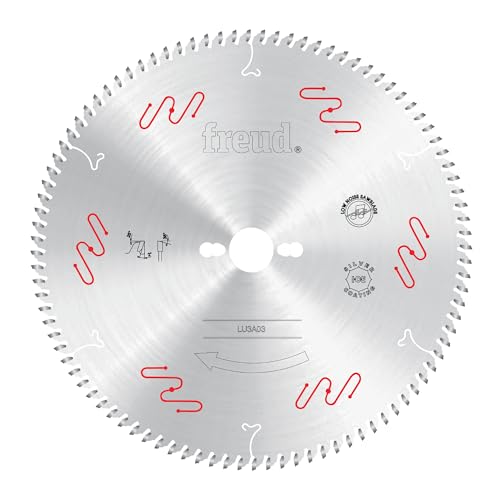
The Freud LU3A03 is designed for panel sizing on sliding table saws, featuring a 300 mm diameter and 96 teeth with a 30 mm arbor. Its Hi-ATB (Hi Alternate Top Bevel) edge at a 38-degree angle targets veneer plywood and melamine-coated panels, delivering precise, chip-free cuts. The blade’s TiCo Hi-Density Carbide blend enhances lifespan under frequent use, while the 3.2 mm kerf maintains efficient material removal. Pinholes are provided for stable seating and alignment, supporting consistent performance on panel operations. This blade suits cabinets, furniture panels, and large veneer sheets.
Key considerations: optimized for crosscuts and panel sizing, excellent finish on laminated surfaces, and reduced chipping on delicate face veneers. For sliding table use, ensure your saw’s arbor and protection plates accommodate the 30 mm bore and 2.2 mm plate thickness. Regular checks of tooth wear help sustain finish quality over long sessions.
Freud LU3F03 Panel Sizing Blade for Sliding Tables

The LU3F03 mirrors the LU3A03 with precise panel sizing for sliding table saws, sharing a 300 mm diameter and 96 teeth but featuring a Flat-triple chip tooth with a negative cutting angle. The TCG grind and negative hook help reduce tear-out in coated and laminated panels, while still delivering clean edges on hardwoods. The blade’s high-quality TiCo carbide maintains edge retention when cutting hard laminates and plywood, making it a reliable option for furniture production and cabinet shop use. The 2.7–3.2 mm kerf range balances speed and accuracy across panel volumes.
Important notes: verify compatibility with your sliding table’s arbor and plate dimensions, and align with the blade’s tooth geometry to optimize cut quality. The negative hook angle reduces climb and improves control when handling long panel runs, contributing to safer, more predictable results in a factory or shop setting.
DEWALT 10-Inch Fine Finish Table Saw Blade

The DEWALT DWA11080 blade emphasizes extended life and superior finish quality, with up to three times longer life in certain situations. Its patented body slot design helps dampen vibration, which is particularly beneficial when cutting large panels on sliding table setups. The 80-tooth configuration provides a fine finish suitable for cabinetry, veneers, and UV-coated laminates. The blade geometry is engineered to optimize accuracy and minimize burn marks on dense woods. Users should expect smooth, consistent cuts when aligning with a sliding table’s fence and miter stops.
Considerations include ensuring proper alignment and runout control, as well as checking the blade’s compatibility with your saw’s arbor size and plate clearance. For sheet goods, this blade offers clean crosscuts and narrow kerf losses that keep material waste low while preserving surface quality.
Freud LU91R010: Thin Kerf Sliding Miter Blade

The LU91R010 is a 10-inch, 60-tooth blade designed for sliding miter saws and related applications. It uses a thin kerf (.090 inches) and a slightly thinner plate (.071 inches) to reduce resistance and deliver smoother crosscuts with high precision. The negative hook angle minimizes climbing, aiding control when performing long, accurate cuts on panel stock. This blade’s TiCo HI-Density Carbide blend is built for performance over extended use, making it suitable for fine joinery and finish work on sliding tables where consistent edge quality is critical.
Practical notes: the 5/8-inch arbor and 10-inch diameter fit most standard sliding saws. For panel work, pairing this blade with a precise fence and careful feed rates yields exceptional edge integrity and finish consistency across repeated passes.
CMT ITK Industrial Finish Sliding Blade

The CMT ITK 10-Inch blade specializes in an industrial finish for sliding compound miter saws, offering a 0.098 kerf and a 0.071 plate thickness. With a 7° hook angle and a combination of 1 Flat + 2/15° alternate teeth, this blade targets glass-smooth finishes across soft and hardwoods, plywood, and laminates. Its 5/8-inch bore matches many sliding saw systems, supporting precise alignment and stable operation. While marketed for miter and solid panel tasks, it remains a solid choice for sliding table configurations requiring fine finish work and consistent edge quality across complex cuts.
Limitations to consider include the need for proper clearance around large panels and ensuring the blade clearance is adequate for your sliding table’s cut depth. Its finish-oriented tooth configuration makes it ideal for cabinetry faces and panels where surface quality matters most.
Buying Guide: Key Purchase Considerations
- Tooth geometry and finish: For paneling and melamine, hi-ATB or negative hook angles reduce tear-out. For crosscuts and fine finishes, consider blades with finer tooth counts (60-80T) and TCG or ATB grind.
- Blade material and carbide: TiCo or similar carbide blends extend life in laminated and hardwood materials. Ensure compatibility with your saw’s arbor and plate thickness (commonly 5/8″ or 30 mm bore).
- Kerf width and plate thickness: Thin kerf blades reduce material waste and motor load on sliding tables, while thicker plates offer durability for heavy-duty jobs.
- Arbor size and compatibility: Verify bore size (5/8″ vs 30 mm) and hub alignment with your sliding table saw to prevent vibration and runout.
- Vibration and stability: Vibration reduction features, such as body slot design and balanced teeth, contribute to smoother operation on large panel cuts.
- Intended use: Distinguish between blades optimized for panel sizing, crosscuts, and mitering. Some blades excel at veneer finishes, while others prioritize speed and lifespan on dense woods.
When evaluating blades for sliding table applications, consider your typical material mix, finish requirements, and repeatability needs. A balanced blade portfolio—one optimized for panels with a high-quality finish and another optimized for crosscuts—helps maintain efficiency in shop workflows while preserving material integrity and blade life.