Best Sliding Miter Saw Blade for Clean, Accurate Crosscuts
Choosing the right sliding miter saw blade can dramatically improve cut quality, reduce tear-out, and speed up project timelines. This guide highlights five top-performing blades that pair well with sliding miter saws, with attention to kerf, hook angle, tooth design, and carbide quality. Each option is evaluated for finish quality, ease of use, and suitability for common hardwoods, softwoods, and laminates. Whether you’re framing, cabinetry, or trim work, these blades offer reliable performance across a variety of materials.
| Product | Brand | Key Benefit |
|---|---|---|
| Freud LU91R010 | Freud | Premium TiCo carbide and negative hook reduce climbing for control |
| OSHLUN SBW-100060N | OSHLUN | Negative hook with thin kerf for fast, precise cuts |
| CMT 253.060.08 ITK | CMT ORANGE TOOLS | Fine finish with 7° hook and smooth crosscuts |
| Diablo D1280X | Diablo | Hi-Density Carbide for precise, clean crosscuts |
| Makita A-93681 | Makita | ATAF tooth design for ultra-precision cuts |
Across these selections, you’ll see a common emphasis on thin kerf construction to minimize burden on the saw, alternate or negative hook angles to prevent drift or climbing, and high-density carbide blends designed for long life and consistent finishes. The following sections provide detailed product breakdowns to help you compare at a glance and choose the blade that best fits your saw and material needs.
Freud LU91R010: 10″ Thin Kerf Sliding Blade

The Freud LU91R010 uses a 10-inch, 60-tooth configuration with a .090″ kerf and a premium TiCo HI-Density carbide blend. Its negative hook angle minimizes climbing, enabling stable control during sliding cuts. The 5/8″ arbor matches many common miter saws, and the 0.071″ plate thickness provides durability for finishing tasks. This blade is designed for crosscuts and finish work on hardwoods and laminates, delivering a clean, glass-like edge with reduced burning in dense stock.
OSHLUN SBW-100060N 10-Inch 60-Tooth Negative Hook
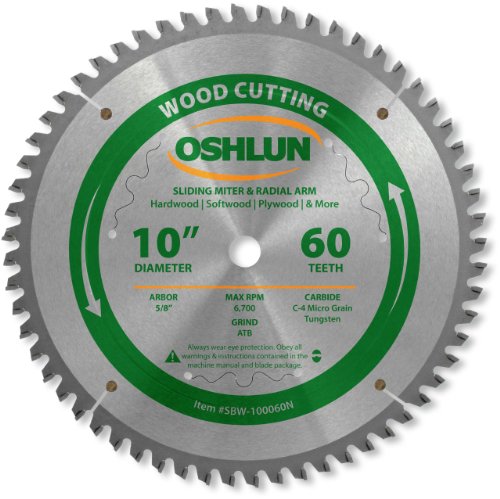
This finishing blade from OSHLUN features a 60-tooth design with a negative hook angle and a 5/8″ arbor. The thin kerf enables faster cuts with less resistance, helping maintain accurate miters on sliding saws. The combination of professional-grade C-4 carbide and a refined grind supports smooth finishes and minimal chipping on both softwoods and hardwoods. It’s well-suited for trim work, cabinetry components, and detailed cut scenes where finish detail matters.
CMT ITK Industrial Finish Miter Blade 8-1/2″ x 60T

The CMT ITK blade is designed for fine finishes on crosscuts, featuring a 0.087″ kerf and 0.055″ plate thickness with a 7° hook and a flat plus two 15°-alternate teeth grind. This arrangement lends itself to glass-smooth cuts on both soft and hard woods, plywood, and laminates used in cabinetry and furniture. The low-resistance grind reduces splintering and tear-out when approaching delicate materials, making it a strong choice for projects where precision is paramount.
DEWALT DWS779 Miter Saw Blade Kit

The DEWALT 12-inch miter saw blade in this kit stands out for its robust 3800 RPM motor compatibility and durable construction. It features a stainless-steel miter detent plate with 10 positive stops, a precise miter system, and cam-lock miter handle for rapid, accurate angle setting. While broader in purpose than a pure finishing blade, it delivers dependable crosscuts and is a versatile option for sliding miter saw setups that require consistent accuracy across varying materials.
Diablo D1280X 12″ Fine Finish Blade
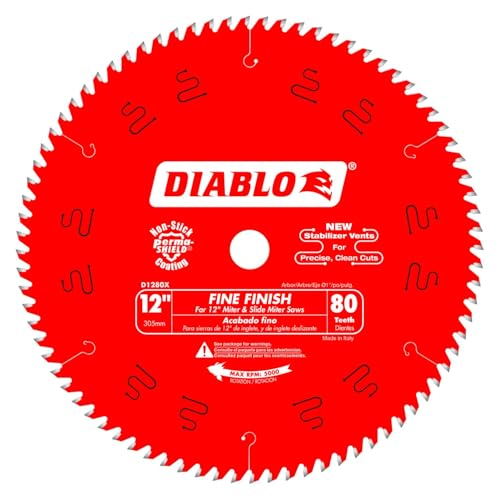
The Diablo D1280X is a 12-inch, 80-tooth blade optimized for fine finishes in both hardwoods and softwoods. Its high-density TiCo carbide and alternating top bevel geometry yield smooth, precise cuts with minimal tear-out. The 1″ arbor matches a wide range of saws, and the blade’s tooth geometry is tailored for refined crosscuts in cabinetry and furniture components where edge quality matters most.
Makita A-93681 10-Inch 80-Tooth

The Makita A-93681 blade employs a precision ATAF tooth design for ultra-precision cuts and an ultra-thin kerf for smoother operation with less motor drag. Fully hardened and hand-tensioned steel plates help ensure true cuts, while the Japanese manufacturing standards contribute to durable performance across finishing tasks and repeated crosscuting in woodworking projects. It’s a reliable option for ensuring clean, square corners on detailed gates, moldings, and trim.
Buying Guide
Key purchase considerations when selecting a sliding miter saw blade include blade width (kerf), tooth count, hook angle, bore size, and carbide grade. Fine-finishing blades typically feature higher tooth counts (60–80) for smoother cuts, while general-purpose or fast-cut blades favor lower tooth counts and thinner kerfs to reduce motor load. Negative hook angles improve stability and reduce climb on sliding cuts, particularly when starting a cut inWarped or dense stock. Hybrids like TiCo carbide blends balance edge durability with long life for busy workshops. Always verify arbor compatibility (commonly 5/8″) and ensure the blade width and thickness won’t interfere with your miter saw’s fence or slide mechanism. For cabinetry and trim, prioritize finish quality; for framing or rough carpentry, kerf and speed may take precedence. Consider blades with anti-vibration coatings or dampening features if your saw experiences chatter. Finally, match blade material to stock: hardwoods and plywood benefit from fine finishes, while laminates require careful edge control to avoid chipping. Assess the balance between price, durability, and cut quality, and factor in your typical project mix to maximize long-term value.