Best Saw Blades for Cutting Hardwood Flooring: Smooth, Precise Cuts
Choosing the right saw blade for hardwood flooring affects the quality of every cut, finish, and installation. For solid, engineered, or laminated floors, you need blades that deliver clean edges, minimize splintering, and resist heat and wear. This guide highlights five top-rated blades tailored for hardwood flooring tasks, focusing on tooth design, durability, vibration reduction, and arbor compatibility. Use these comparisons to match blade performance with your saw type, material, and project needs, ensuring consistent, professional results across installations.
| Product | Brand | Diameter / Teeth | Best For |
|---|---|---|---|
| Norske Tools NCSBP272 8-1/4 Inch 60T | Norske | 8-1/4″ / 60T | Ultra-smooth cutting of melamine, laminates, hardwoods, laminate flooring |
| Diablo PergoBlade D1012LF | Diablo | 10″ / 12T | Laminate and wood flooring |
| COMOWARE 10 Inch 80T ATB | COMOWARE | 10″ / 80T | Wood, laminates, plywood, hardwoods |
| WEN BL1080 10-Inch 80-Tooth | WEN | 10″ / 80T | Finish cuts in hard and softwoods |
| SKIL 3601-02 Flooring Saw | Skil | 4-3/8″ / 36T | Solid and engineered flooring; cross, miter, rip cuts |
Norske Tools NCSBP272 8-1/4 Inch 60T Melamine Plus Saw Blade

The Norske NCSBP272 is built for ultra-smooth finishes when cutting melamine, laminates, hardwoods, and laminate flooring. It features a 35-degree high ATB tooth design for precise edges and reduced chipping on tough materials.
- 60T tooth count for fine, smooth cuts
- 35° high ATB tooth design for clean faces
- C4 micro-grain carbide tips sharpened on all sides
- Laser-cut body with expansion slots to reduce noise
- 5/8″ bore compatibility for common saws
Durability is enhanced by micro-grain carbide tips and a precision-ground body. The blade’s anti-vibration design helps maintain stability during long cuts, making it suitable for accurate flooring work where edge quality matters most.
Diablo PergoBlade Saw Blade for Laminate and Wood Flooring
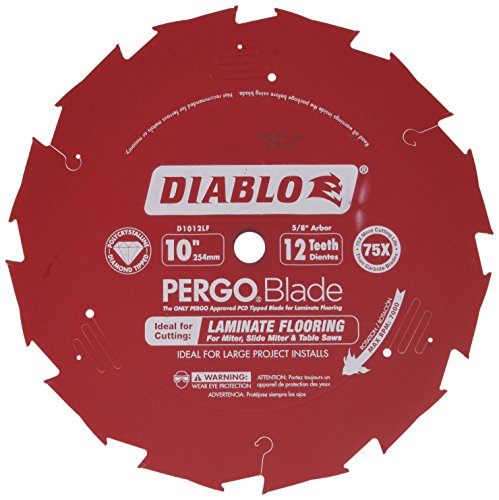
Diablo’s PergoBlade D1012LF is designed for laminate and wood flooring applications, offering durability and long life through specialized tooth geometry.
- 10″ diameter, 12T configuration for specific flooring tasks
- Polycrystalline diamond (PCD) tooth geometry for extended life
- Long-lasting performance—up to many times longer than standard carbide blades
- Anti-kickback design and laser-cut anti-vibration to stabilize cuts
Engineered for flooring work, this blade minimizes edge fraying and delivers consistent cuts across laminate and wood substrates, helping installers achieve uniform flooring gaps and clean transitions.
COMOWARE 10 Inch 80T ATB Saw Blade

The COMOWARE 10″ ATB blade combines a high tooth count with Alternating Top Bevel geometry to deliver clean cuts in wood, laminates, plywood, and hardwoods.
- 80T tungsten carbide teeth for durability
- ATB tooth design for cleaner, splinter-resistant finishes
- 5/8″ arbor for broad compatibility
- Anti-vibration and Teflon anti-stick coating for smoother operation
The blade’s carbide tips resist heat and wear, ensuring sharp cuts over extended use while the anti-stick coating helps reduce friction during long milling tasks.
WEN BL1080 10-Inch 80-Tooth Carbide-Tipped
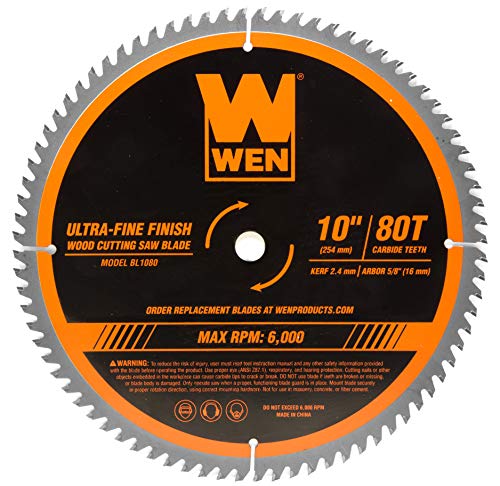
The WEN BL1080 is a professional-grade 10-inch blade optimized for finish work on miter and table saws, featuring a thin kerf and precise cuts.
- 10″ diameter with a 5/8″ arbor
- 80 teeth for ultra-fine finishes
- Ultra-thin 1/10″ kerf for less material waste
- Rated up to 6000 RPM for fast, clean cuts
Designed for hardwoods and other dense materials, this blade reduces tear-out and yields smooth edges, especially on long, straight cuts in flooring projects.
SKIL 3601-02 Flooring Saw with 36T
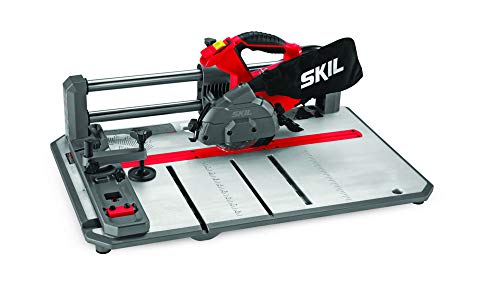
SKIL’s 3601-02 Flooring Saw includes a specialized 36T blade designed for flooring applications, focusing on straight cuts and efficient performance.
- 4-3/8″ diameter with 36T for flooring tasks
- Thin kerf and anti-kickback shoulders for safer cuts
- Expansion slots to reduce vibration and stay true
While smaller, this blade excels for precise starter cuts and detailed flooring work, especially in tight spaces or when making crosscuts on trim and underlayment areas.
Buying Guide
Key purchase considerations
To choose the right blade for hardwood flooring, consider blade diameter, tooth count, and tooth geometry. Higher tooth counts (like 80T) deliver smoother finishes on softwoods and laminates, while mid-range counts around 60T can balance speed and edge quality on hardwoods. ATB (Alternating Top Bevel) teeth tend to produce cleaner cuts with less chipping on patterned or fragile surfaces, whereas RIP blades favor aggressive removal on heavy stock. Blade material (carbide-tipped) and durability features (anti-vibration, anti-kickback, and coatings) extend blade life and reduce wobble during long runs.
Arbor size and compatibility
The most common arbor size for consumer saw blades is 5/8 inch. Always verify your saw’s arbor diameter and the blade’s compatibility before purchasing. Some blades offer universal shanks or adapters, which can save time when you have multiple saws in a shop. A well-matched arbor minimizes runout and ensures truer cuts in hardwood flooring installations.
Kerf and cut quality
Kerf width affects material waste and the force required to push the blade. Thinner kerfs (0.098 inches or less) require less power and leave less waste, but can be more prone to deflection on very hard stock. For hardwood flooring, a balance between kerf width and blade rigidity is important to maintain straight, clean cuts without overheating the teeth.
Durability and coatings
Carbide-tipped teeth resist wear and heat, extending blade life on hardwoods. Some blades feature coatings (like anti-stick or anti-friction coatings) to reduce resin buildup and heat, improving efficiency on dense fibers. anti-vibration and laser-cut bodies help maintain blade stability, reducing gouging and chatter during long runs.
Application versatility vs specialty blades
Specialty blades such as laminate-specific or flooring-specific designs can offer superior results for their intended substrates, but may underperform on other materials. For a balanced hardwood flooring toolkit, select blades with reliable performance across wood, plywood, and laminated substrates, while keeping at least one finishing blade on hand for high-sheen edges and cleanup passes.