Best Saw Blades for Angle Grinders: Top Choices for Fast, Clean Cuts
Choosing the right saw blade for an angle grinder can boost cutting speed, reduce dust, and extend blade life. The following selections cover a range of materials—from masonry to ceramic tile and hardwood—so you can match the blade to your project. Each option emphasizes durability, cut precision, and ease of use, helping you complete tasks more efficiently.
Summary of chosen products:
| Product | Brand | Material Focus | Arbor | Notes |
|---|---|---|---|---|
| DEWALT Diamond Blade for Masonry | DEWALT | Masonry | 7/8″ Arbor | Long life, thin kerf |
| EZARC 4-1/2″ Super Thin Diamond Blade | EZARC | Tile (Tile work) | 7/8″-20mm-5/8 | Clean, precise cuts; reduces chipping |
| MASTER DEPOT 4-1/2″ Segmented Diamond Blade | MASTER DEPOT | Concrete/Masonry | 7/8″-5/8” | Efficient heat dissipation |
| OA-BRES 4-1/2″ 40T TCT Blade | OA-BRES | Wood | 7/8″ | Carbide for robust woodworking cuts |
| ANGELSWORD 4-1/2″ 40T Circular Saw Blade | ANGELSWORD | Wood | 7/8″ | Three-pack value, heat resistant |
Note: The table summarizes the core attributes of each blade to help you compare quickly. Individual blades excel in different materials and cutting scenarios, so choose based on your primary task—masonry, tile, or wood.
DEWALT Diamond Blade for Masonry

The DEWALT DW4725 is designed for dry cutting of masonry materials. Its diamond matrix offers significantly longer life than conventional abrasives, delivering up to 200x the durability under typical grinding conditions. The blade features a thinner kerf to speed up cuts while reducing material dust. This blade is suitable for angle grinders handling concrete, brick, and similar masonry tasks, where fast, steady cuts are essential. The combination of high-performance materials and a slim cut produces efficient performance with less user fatigue.
Key considerations:
– Ideal for dry cutting in masonry projects to maximize blade lifespan.
– Thinner kerf reduces resistance and dust, aiding faster progress.
– Best used on hard, dense materials where traditional blades wear quickly.
EZARC 4-1/2 Inch Super Thin Diamond Blade
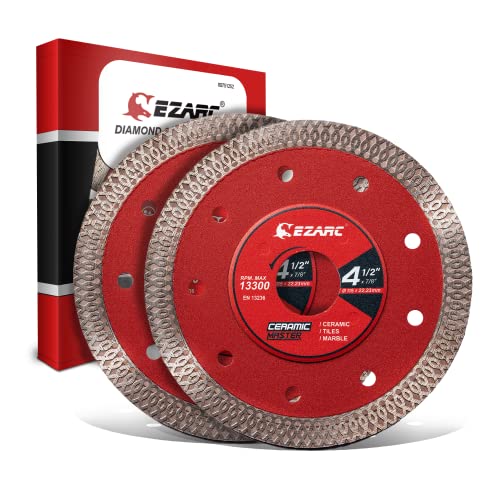
The EZARC blade is designed for tile work and other stone surfaces, featuring a super-thin design and X-teeth turbo mesh rim. This enables clean, precise cuts with minimal chipping, making it a preferred choice for porcelain, ceramic, granite, and marble projects. The blade supports both dry and wet cutting, with wet usage often extending blade life. The reduced cutting force helps prevent tile breakage and decreases tool wear, particularly useful for intricate tile layouts and detailed work.
Key considerations:
– Best for precision tile installations and delicate edges.
– Wet cutting can extend blade life and improve finish quality.
– Thin kerf reduces waste and improves material removal rates.
MASTER DEPOT 4-1/2″ Segmented Diamond Blade

This segmented diamond blade emphasizes effective heat management and dust removal with visible airflow gaps between segments. The 115 mm diameter, 10 mm segment height, and 13300 rpm maximum provide robust performance for dry or wet cutting on concrete, brick, pavers, and terrazzo. The ultra-thin 1.2 mm thickness minimizes cutting resistance for fast, precise results while keeping vibrations lower for a smoother operation. The blade’s design aims to balance speed with durability, reducing the risk of blade wear and breakage during heavy-duty tasks.
Key considerations:
– Great for masonry and concrete cutting tasks.
– Segmented design improves cooling and dust handling.
– Thin profile supports fast cuts with controlled vibration.
OA-BRES 40T 4-1/2″ Carbide Tipped Blade

The OA-BRES 3-pack blends durability and versatility for wood cutting tasks. With a 4.5-inch diameter and 7/8-inch arbor (plus a reduced 5/8-inch ring), these blades use alloy steel and tungsten carbide teeth for precise, clean cuts in hard and soft woods. The 40-tooth configuration supports general-purpose ripping and crosscutting with smooth finishes. Fully polished and chrome-plated surfaces contribute to longer blade life and ease of maintenance, making them suitable for frequent use in home workshops and professional settings.
Key considerations:
– Strong carbide teeth for extended wear resistance.
– Moderate tooth count supports versatile wood cutting.
– Reduced kerf helps minimize waste and boost cutting speed.
ANGELSWORD 4-1/2 Inch 40T Circular Saw Blade

ANGELSWORD offers a 3-pack of 40-tooth blades designed for 4-1/2 inch grinders with a 7/8-inch arbor. The blades emphasize high-quality plate construction and a thin kerf for fast, smooth, and clean cuts. Tungsten carbide teeth deliver excellent wear resistance and heat tolerance, supporting longer blade life even during repeated use on soft and hardwoods. This option suits users who need dependable performance across multiple wood-cutting projects.
Key considerations:
– Carbide teeth provide robust, long-lasting performance.
– Three-pack value is convenient for ongoing projects.
– Thin kerf enables efficient material removal with less resistance.
Buying Guide: Key Purchase Considerations
- Material compatibility: Match blade material to your primary task (concrete, tile, masonry, or wood). Blades designed for masonry and concrete often feature segmented or segmented-diamond rims for heat management, while wood blades focus on carbide teeth for durability.
- Arbor size and compatibility: Most 4-1/2″ blades use a 7/8″ arbor, with some including adapters. Confirm your angle grinder’s arbor compatibility before purchase.
- Kerf thickness: Thinner kerfs cut faster and with less dust but can be less forgiving on rough cuts. Thicker blades offer durability in heavy-duty tasks but may require more effort to push through materials.
- Dry vs. wet cutting: Some blades are designed for both dry and wet use. Wet cutting typically reduces dust and can extend blade life but requires water access and protection from slipping hazards.
- Number of teeth: Fewer teeth (e.g., 24–40T) cut faster and are better for rough cuts in wood, while higher tooth counts produce smoother finishes in wood and tile work and reduce chipping in tile.
- Durability features: Look for carbide teeth, chrome-plated surfaces, and reinforced cores for extended life in demanding tasks. Diamond blades are especially durable for masonry and tile work when used correctly.
- Dust and vibration control: Segmented rims and thin blades can influence dust levels and vibration. A blade with good heat dissipation helps minimize warping and wobble during operation.
- Maintenance and safety: Follow manufacturer guidelines for blade usage, including RPM limits and cooling requirements. Use proper PPE, including eye protection and a dust mask when cutting.