Best Sand Paper for Drywall: Top 5 Sanding Sponges and Blocks
Professional drywall finishing relies on the right sanding tools to achieve smooth, paint-ready surfaces. This guide highlights five top-rated sanding sponges and blocks designed for drywall work, including assorted grit ranges for heavy material removal, smoothing joints, and final finishing. Each product emphasizes durability, washability, and versatility for dry and wet sanding tasks.
| Product | Grit Range | Best For |
|---|---|---|
| MOWPOG 8 Pack Sanding Sponge | 60/80/120/220 | General drywall finish and reach-in areas |
| S&F STEAD & FAST Sanding Blocks | 60/80/120/220 | Rough to fine smoothing and prep |
| Romeda 8-Pack Sanding Sponge | 60/80/120/220 | Multi-surface prep including drywall and metal |
| 3M Pro-Pak Drywall Sanding Paper | 120 | Joint compound smoothing and finish |
| PHICANT 8PCS Sanding Sponge | 60/80/120/220 | Detail sanding and curved surfaces |
MOWPOG 8 Pack Sanding Sponge (60/80/120/220)

The MOWPOG sanding sponge set includes eight blocks in four grits: 60, 80, 120, and 220, with two blocks per grit. Made from a high-elastic sponge and brown corundum abrasive, the blocks are designed for durability and flexible use on drywall, wood, metal, and glass repairs. The sponges are washable and reusable, making them a practical choice for repeated drywall projects where corners and joints require careful material removal without gouging adjacent surfaces. The compact 4″ x 2.75″ x 0.65″ size fits comfortably in hand, enabling precise control in tight spaces.
Features a strong bond with a special glue formula to minimize grain loss during extended use. Ideal for hand sanding in areas where power sanders struggle, this set supports a progressive approach from rough removal to fine finishing, helping to achieve a smooth joint compound surface ready for priming and painting.
S&F STEAD & FAST Sanding Sponge Blocks (60/80/120/220)
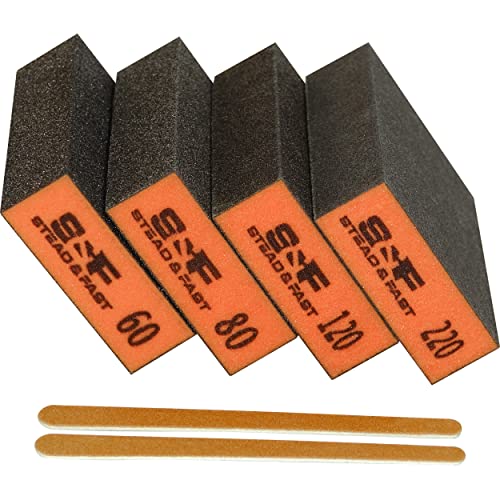
This 4-piece set from S&F STEAD & FAST provides premium European high-density foam with aluminum oxide abrasive. The blocks come in four grits—60, 80, 120, and 220—covering a broad range of tasks from strippable coatings to final smoothing. Designed for wood, metal, drywall, and plaster, these blocks are versatile for preparation work on drywall joints, texturing removal, and pre-paint finishing. The foam construction offers durability and comfort for extended sanding sessions, while the included grits support both heavy material removal and fine finishing as needed.
Romeda 8-Pack Sanding Sponge (60/80/120/220)

Romeda’s 8-pack includes four grits (60, 80, 120, 220) with two sponges per grit in distinct colors for quick identification. Constructed from high-density, flexible sponge material, these sanding blocks resist tearing and hold up through repeated use. The set is marketed for drywall, wood, metal, and glazing projects, making it a versatile choice for prep work around joints, corners, and flat surfaces. Washable and reusable, they accommodate both dry and wet sanding, helping to minimize dust and extend the life of abrasive surfaces.
3M Pro-Pak Drywall Sanding Paper (120 Grit, 25 Sheets)

3M Pro-Pak offers pre-cut drywall sanding sheets in 120 grit, designed for moderate sanding and smoothing of joint compounds. The 4.2 x 11.25 inch sheets fit most drywall sanding tools and feature heavy-duty paper backing to resist tearing and clogging for longer life. While not a sponge, the Pro-Pak sheets are a reliable option for achieving a uniform finish on drywall joints, seams, and patches. They are part of a broader line that provides grits suitable for progressing from rough material removal to fine finishing.
PHICANT 8PCS Sanding Sponge Blocks (60/80/120/220)

PHICANT’s eight-piece set features four grit levels—60, 80, 120, and 220—with two blocks per grit. The sponges are described as washable and reusable, suitable for both dry and wet sanding. The variety pack is designed for detailed sanding on drywall, wood, metal, and glazing projects, and it emphasizes ease of use on flat and curved surfaces. The model numbers printed on the sponges help users quickly identify grit size during a project, supporting a structured approach to surface preparation.
Buying Guide
- Grit progression: For drywall, start with coarser grits (60–80) to remove ridges and compound lumps, then move to finer grits (120–220) to achieve a smooth finish. Some sets include additional ultra-fine grits (over 220) for final polishing.
- Block vs sponge: Sanding blocks provide shape retention and even pressure for flat surfaces, while sponges excel at contoured edges and corners. Wet sanding with sponges can reduce dust and extend abrasive life.
- Material durability: Look for high-density foam or elastomeric cores with strong abrasive bonding. This reduces grain shedding and extends tool life in drywall work.
- Washability and reuse: Reusable sponges reduce waste and cost over time. Ensure the product is explicitly described as washable to maintain performance during multiple projects.
- Size and grip: Consider block dimensions that fit comfortably in your hand and reach tough areas such as corners and around fixtures. Smaller blocks can access tight spots more easily.
- Compatibility: Ensure grit options cover both heavy removal and fine finishing. If you plan wet sanding, verify the sponges are suitable for use with water and minimal clogging.
- Application range: While focused on drywall, many of these products will perform well on wood, metal, and glazing, making them versatile for multi-surface projects in remodeling.