Best Rosin Core Solder Wires for Electronics
Rosin core solder wires are a staple for electronics assembly and repair. The most common alloys used are 60/40 and 63/37 tin–lead, each offering different melting behaviors and wetting characteristics. Rosin core flux helps solder flow smoothly across copper traces and component leads, reducing cold joints. This guide highlights five reliable rosin core solder wires, detailing their diameters, weights, and flux content to help you pick the right option for hobby projects, repairs, and small-scale manufacturing.
| Product | Brand | Diameter | Alloy | Flux Content | Weight |
|---|---|---|---|---|---|
| AUSTOR 60-40 Tin Lead Rosin Core Solder Wire | AUSTOR | 0.8 mm | Sn60/Pb40 | 2.0% | 100 g |
| Kester 44 Solder Wire, 63/37 Rosin Core | Kester | 0.031″ (0.8 mm) | 63/37 | Not stated | 1 oz |
| MAIYUM 63-37 Tin Lead Rosin Core Solder Wire | MAIYUM | 0.6 mm | Sn63/Pb37 | 1.8% | 100 g |
| HGMZZQ 60/40 Rosin Core Solder Wire | HGMZZQ | 0.8 mm | Sn60/Pb40 | 2.2% | 50 g |
| JWOWO Rosin Core Solder Wire | JWOWO | 0.8 mm | Sn63/Pb37 | 2% | 50 g |
These five options were chosen for their balance of usability, reliability, and availability in common electronics work. Each entry uses a standard rosin core formulation, which is widely compatible with through-hole and many surface-mount tasks. The range of diameters and weights also supports both compact repairs and larger projects, letting you tailor your purchase to your typical soldering tasks and tool setup.
AUSTOR 60-40 Rosin Core Solder Wire
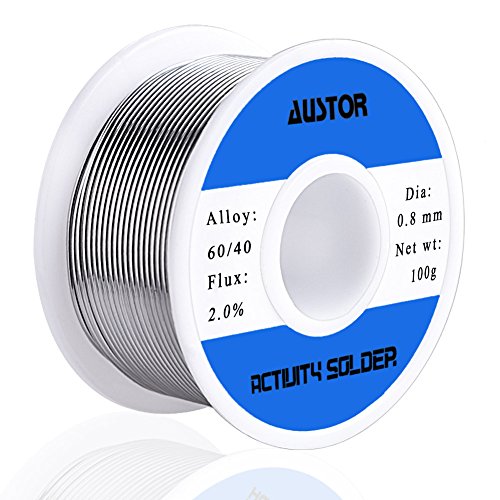
The AUSTOR 60-40 rosin core solder wire uses Sn60/Pb40 with a flux content of 2.0%, designed to flow smoothly and heat evenly. The wire features a 0.8 mm diameter and a 100 g spool, offering a practical balance between precision and amount for hobbyists and professionals alike. Its melting range sits around 185°C to 190°C (365°F to 374°F), which makes it a forgiving option for general circuit board work and leaded components. The combination of robust wetting, reliable heat transfer, and manageable thickness makes it a versatile choice for both board repair and assembly tasks.
Kester 63/37 Rosin Core Solder Wire

The Kester 44 rosin core solder features a 63/37 Sn/Pb alloy and is offered in a compact 1-ounce tube. The product is specially repackaged for portability, with an approx. 27 feet length per tube, making it convenient for on-the-go repairs or small projects. While the packaging note emphasizes portability and standard electronics compatibility, the exact flux content is not stated in the listing. The 0.031″ (about 0.8 mm) diameter suits a wide range of component leads and through-hole joints, providing good balance between control and deposition rate for typical PCB tasks.
MAIYUM 63-37 Tin Lead Rosin Core Solder Wire

MAIYUM’s 63-37 rosin core solder comes in a 0.6 mm diameter with a 1.8% flux core, and a total weight of 100 g. The Sn63/Pb37 alloy is a long-standing standard for electronics work, offering reliable wetting on copper traces and component leads. With a compact 0.6 mm diameter, this wire is well-suited for precise joints on smaller PCBs and dense assemblies. The rosin flux assists flow without excessive spatter while helping to minimize cold joints, making it a solid choice for hobby and professional use where consistent heating and clean joints are desired.
HGMZZQ 60/40 Rosin Core Solder Wire

HGMZZQ offers a 60/40 Sn/Pb rosin core solder wire with a diameter of 0.8 mm and a flux content of 2.2%. Packaged in a 50 g spool, this option emphasizes rapid, strong solder joints and straightforward flow characteristics. A melting point around 183°C (361°F) supports fast work on standard PCBs and electronics assemblies. This wire is suitable for general-purpose soldering, including through-hole components, connectors, and wire-to-board connections, where good wetting and reliable joints are essential.
JWOWO Rosin Core Solder Wire

JWOWO’s rosin core solder wire features Sn63/Pb37 with a diameter of 0.8 mm and a 50 g package. The flux content is listed at 2% continuous rosin core flux, designed to minimize the need for additional flux while providing good wetting and fast soldering speed. The fine 0.8 mm size supports precise joints on smaller pads and dense circuit boards, while maintaining a robust solder joint profile. This option is suitable for a broad range of electronics projects, from hobby boards to more complex assemblies requiring clean, consistent joints.
Buying Guide
Diameter and Joint Type
Smaller diameters (0.6–0.8 mm) are ideal for delicate through-hole work and fine-pitch components, while larger diameters (0.8–1.0 mm) deposit more solder quickly for bigger joints. Match the wire diameter to your tip size and the scale of your PCB. For densely packed boards, a 0.6–0.8 mm wire provides control without sacrificing speed.
Alloy Choice: 60/40 vs 63/37
60/40 (Sn60/Pb40) melts over a broad range, which can be forgiving for beginners but may require careful heat control to avoid bridging. 63/37 (Sn63/Pb37) has a sharper melting transition and can produce crisper joints when used by experienced technicians. Consider your projects: hobby repairs and leaded-through-hole work often benefit from 60/40, while precision joints on dense boards may favor 63/37.
Flux Content and Cleaning
Rosin flux content impacts wetting and residue. Higher flux percentages generally improve solder flow but can leave more residue to clean. Some rosin cores are designed to be low-residue or “no-clean,” while others may require cleaning if cleanliness is critical for the device. For sensitive electronics, choose flux qualities that balance ease of use with the need to minimize post-solder cleaning.
Packaging and Availability
Smaller packages (1 oz or 50 g) are convenient for hobbyists and field work, while larger spools (100 g and up) reduce replacement frequency for professionals. Consider storage, shelf life, and access to spools when planning procurement. Availability across brands helps ensure you can replace a wire quickly if stock runs low.
Brand Reliability and Documentation
Choose reputable brands with documented alloy compositions and flux characteristics. A few listings clearly state the Sn/Pb ratio and flux content, while others may provide broader descriptions. When possible, look for rosin-core wires with consistent diameter tolerance and clear data on melting point ranges to ensure compatibility with your soldering tasks.
Application Considerations
Leaded solders like 60/40 and 63/37 remain popular for through-hole boards and legacy electronics. Be mindful of regulatory restrictions in your region regarding lead use in consumer electronics. For most hobby projects and repair work, leaded rosin-core wires provide predictable behavior and dependable joints, while lead-free alternatives may be preferred for final products destined for customers in regions with strict environmental rules.
Summary of Key Differences
- Alloy: 60/40 offers a broad melt range; 63/37 provides a sharper transition for precise work.
- Diameter: 0.6–0.8 mm balances precision and speed; 0.8–1.0 mm is faster for larger joints.
- Flux: Typical rosin core flux ranges around 1.8–2.2% in these options; flux content influences wetting and cleaning needs.
- Weight: 50 g and 100 g are common small-pack options; 1 oz (28 g) is another standard size for portability.
- Packaging: Pocket tubes and small spools suit field repairs and hobby use, while larger spools support continuous production work.