Best Rope Webbing for Lifting and Lifting Slings
When selecting rope webbing for lifting tasks, durability, load capacity, and adaptability are essential. This guide highlights five reliable options that balance strength and flexibility, drawing on common lifting scenarios—from construction to outdoor recovery. Each product is presented with its key features to help buyers compare performance in real-world settings while ensuring safe operation within stated limits.
| Product | Brand | Approximate Working Load | Material |
|---|---|---|---|
| Kennedy Wire Rope & Sling Company Sling | Kennedy Wire Rope & Sling Company | 6,400–12,800 lbs (Vertical / Basket) | Polyester |
| Rope & Cord Tubular Nylon Webbing | ROPE & CORD | 2,300–4,000 lbs depending on size | Nylon |
| uxcell Lifting Straps | uxcell | 1,760–4,400 lbs depending on orientation | Polyester |
| Trekassy 6′ Lifting Slings | Trekassy | 3,333–9,400 lbs (Vertical / Basket) | Polyester |
| SMARTSTRAPS Nylon Webbing Sling | SMARTSTRAPS | 2,500–6,400 lbs (varies by lift type) | Nylon |
Kennedy Polyester Lifting Sling With Twist Eye

The Kennedy sling features twist eyes set at 90° to the sling body, enabling easier installation and a better fit on hooks. This design reduces snag risk and provides a straightforward connection for vertical, choker, and basket configurations. Manufactured from industrial-grade polyester webbing, it offers a lightweight lifting solution without sacrificing strength. Rated working load limits include 6,400 lbs for vertical lift, 5,100 lbs for choker, and 12,800 lbs in basket configurations, making it suitable for a range of standard lifting tasks where a lighter sling is preferred.
Rope & Cord Tubular Nylon Webbing, Reflective

This tubular nylon webbing from ROPE & CORD emphasizes flexibility and weather resistance. Available in multiple widths, it delivers robust break strengths—4,000 lbs for 1-inch and 2,300 lbs for 5/8-inch variants—while maintaining light weight. Its 100% nylon composition enhances performance across temperature extremes and tough outdoor conditions. The tubular construction offers easier knotting and general adaptability for lifting assistance straps, cargo securing, and other versatile uses beyond traditional slings.
uxcell 3 Feet Lifting Straps, Eye-To-Eye Webbing

uxcell lifting straps are lightweight and highly flexible, constructed from synthetic polyester for durability. They weigh about 0.29 lb per strap, helping with easy storage and handling. Each strap is reinforced with durable stitching and anti-abrasion properties to withstand years of use. Rated for 2,200 lbs vertical, 1,760 lbs choker, and 4,400 lbs basket loads, these lashing options are designed for stable lifts where angles and configurations may vary. Note that lifting under angles greater than 30 degrees is discouraged for safety reasons.
Trekassy 6′ Lifting Slings, 2-Pack
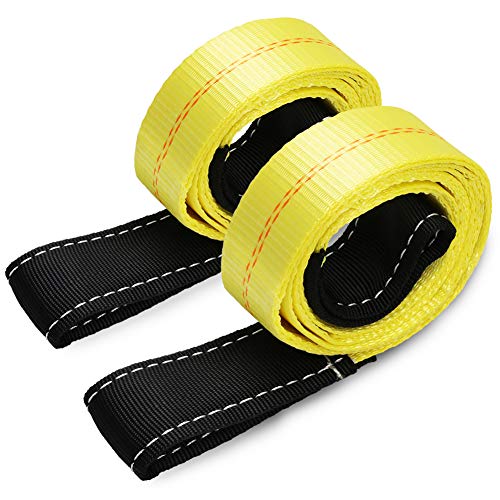
Trekassy offers a 2-pack of 6-foot by 2-inch lifting slings with 9,400 lbs basket capacity and a 3,333 lbs vertical rating. The 2-ply construction and 100% polyester material provide good UV resistance and colorfastness, supporting longer service life in outdoor or workshop environments. The flat-loop eye design enhances loading versatility for various lifting configurations while maintaining a reliable, durable operation for heavy-duty tasks such as furniture relocation or materials handling. This option suits users needing higher basket capacity in a compact, easy-to-transport package.
SMARTSTRAPS 2”x4’ Nylon Webbing Sling

The SMARTSTRAPS nylon webbing sling measures 2 inches by 4 feet and offers versatile lifting configurations, including vertical (3,200 lbs), choker (2,500 lbs), and basket (6,400 lbs) lifts. The product emphasizes reinforced eyes for longevity and loop-ended design for compatibility with a broad range of rigging hardware. Its durable nylon construction supports heavy loads while providing a degree of flexibility essential for complex lifting scenarios, such as uneven loads or irregular shapes, in both construction sites and workshop environments.
Buying Guide: Key Considerations For Rope Webbing Slings
When choosing rope webbing for lifting, consider the following factors to ensure safe and effective use:
- Load rating and configuration: Determine whether you need vertical, basket, or choker lifting, and ensure the sling’s working load limit (WLL) accommodates the heaviest anticipated load with an additional safety factor.
- Material and durability: Polyester offers good UV resistance and low stretch for general lifting, while nylon-based tubular webbing provides flexibility and higher break strength in certain widths. Consider weather exposure and chemical contact in your environment.
- Construction and eye design: Twisted or flat-eye configurations affect ease of installation and hook compatibility. Reinforced stitching increases longevity under repeated use and under heavy loads.
- Weight and handling: Lighter slings improve handling and reduce fatigue on workers, especially for frequent lifts. However, ensure they still meet required load requirements.
- Storage and maintenance: Dry, clean storage extends sling life. Inspect for fraying, cuts, or damaged stitching before each use, and retire any sling showing signs of wear.
- Environment and usage: For outdoor or rugged environments, UV and abrasion resistance matter. In cluttered spaces, consider slings with flexible webbing and versatile eye ends for diverse rigging options.
Usage Perspectives
Industry professionals often balance weight, durability, and ease-of-use. Lighter slings are favored for repetitive tasks where quick setup matters, but more robust slings are preferred for high-load operations or irregular loads. Tubular nylon webbing tends to excel where flexibility and knot retention are key, while polyester slings provide reliable performance with lower stretch. Assess the specific task, hook compatibility, and the lifting method to pick the most appropriate sling configuration.