Best Rip Blade for Table Saw: Top Picks for Clean, Quick Woodcuts
Choosing the right rip blade for your table saw can dramatically improve cutting speed, finish quality, and overall throughput. This guide curates five high-performing options designed for American workshop standards, from underpowered saws to heavy-duty remodeling tasks. Each blade emphasizes carbide durability, refined kerf design, and precision teeth to maximize ripping efficiency across softwood and hardwood applications. Whether you’re building cabinets, framing, or cutting sheet goods, these picks deliver reliable results on modern table saws.
Summary of selected products:
| Product | Brand | Key Benefit | Features Snapshot |
|---|---|---|---|
| Freud Thin Kerf Rip Blade | Freud | Low-power saw optimization and clean rips | 0.098″ kerf, TiCo Hi-Density Carbide, 24T, 10″ diameter |
| Freud Heavy-Duty Rip Blade | Freud | Ripping stability for thick stock | 0.126″ kerf, 30T, 5/8″ arbor, TiCo carbide |
| CMT Orange Tools ITK Ripping Blade | CMT ORANGE TOOLS | Fast cuts on soft/hardwood | 0.102″ kerf, 10″ blade, 24T, 5/8″ arbor |
| Freud Industrial Glue Line Rip Blade | Freud | Glue-line quality finish | 30T, 0.126″ kerf, TiCo carbide |
| FoxBC 10″ Thin Kerf Rip Blade | FOXBC | Thin kerf for less waste | 0.094″ kerf, 24T, 5/8″ arbor |
Freud Thin Kerf Rip Saw Blade With Premium TiCo Carbide

The Freud LU87R010 Thin Kerf Rip Blade is designed for underpowered table saws and radial arm saws, offering a reduced kerf that lowers horsepower requirements. Its premium TiCo carbide blend emphasizes edge retention and cutting efficiency, making it suitable for a range of hardwoods and softwoods. The ultra-thin kerf (approximately 0.098 inches) minimizes material waste and accelerates feed rates, helping craftspeople push through ripping tasks with less bog-down and greater control. The blade’s flat-top grind supports clean, glue-ready edges, reducing post-cut finishing needs.
Engineered specifically for performance in demanding shop environments, this blade balances durability with precision. Users report smoother operation and reliable results when ripping sheet goods or thick planks. As with most high-quality ripping blades, it excels in fast, repeatable cuts that minimize tear-out and misalignment, supporting efficient cabinet building, panel cutting, and framing projects. The LU87R010 stands out for its compatibility with a broad range of table saws while preserving cut quality across varying feed rates.
Freud Heavy-Duty Rip Saw Blade With TiCo Carbide

This Freud LM72M010 blade is built for heavy ripping across hardwoods and softwoods, delivering smooth, fast cuts with a sturdy, flat-top carbide design. Its thicker kerf and reinforced plate enhance stability and flatness, which translates to glue-line ready edges and dependable performance in challenging cutting tasks. The TiCo carbide blend promotes long edge life and consistent results through repeated passes, while oversized flat teeth help produce an ultra-smooth finish that often eliminates sanding or jointing steps after ripping thick stock or plywood sheets.
Designed for professionals who demand repeatable results in demanding environments, this blade maintains rigidity through the cut, reducing vibration and chatter. Its geometry is tuned to resist deflection when cutting dense materials or longer panels, making it a strong choice for cabinet fabrication, shelving, and structural ripping where finish quality matters. The LM72M010 blends durability with finishing capability, ensuring high-quality glue lines and fewer follow-up steps in production work.
CMT ITK Ripping Blade 10″x24x5/8″

The CMT ITK ripping blade is built for fast rip cuts on both softwood and hardwood, with a thin kerf design that reduces waste and improves feed rate. It is designed for use on radial arm saws, miter saws, and table saws when performing heavy ripping tasks, including plywood. The blade features a 0.102″ kerf thickness and 0.071″ plate thickness with a 10° hook angle and alternate teeth grind, offering a balance between aggressive cutting and controlled finishing. This makes it a practical option for volume carpentry and shop-based remodeling projects.
For shops prioritizing speed without sacrificing edge quality, the CMT ITK blade provides dependable results across a range of stock dimensions. The combination of thin kerf and diverse tooth geometry enables efficient sheet stock ripping and cross-cut framing tasks, while maintaining adequate edge integrity for subsequent processing. It is a versatile choice for crews that switch between softwood framing and plywood panel work within the same project.
Freud Industrial Glue Line Ripping Blade
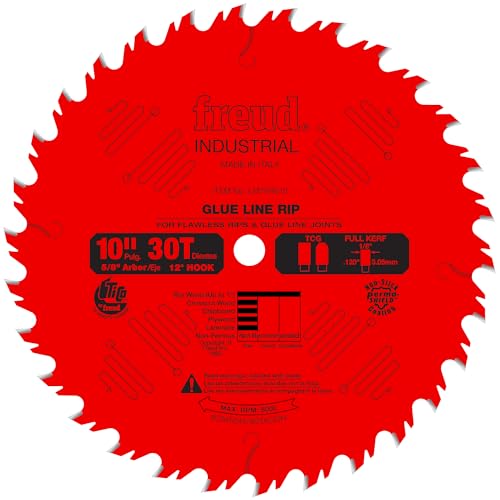
The LM74R010 is a heavy-duty ripping blade designed for glue-line quality work with a thick kerf and reinforced plate. Its three-chip tooth design delivers exceptionally smooth, true-cut surfaces, making it ideal for edge preparation that requires minimal sanding. The TiCo carbide blend enhances cutting performance and durability, enabling consistent results when ripping large stock or finishing panels that will be glued or edge-banded. This blade is intended for demanding applications where precision and edge quality are critical in producing cabinet parts, shelving, and other joinery.
Industrial-level performance emphasizes rigidity and stability, which reduces blade wobble and enhances accuracy across long rips. Operators can rely on consistent sectoral cuts even in glue-ready surfaces, helping to shorten production time in professional shop environments. The combination of material stiffness and advanced carbide chemistry makes this blade suitable for high-volume ripping tasks that demand repeatable, high-quality edges.
Freud Industrial Glue Line Ripping Blade With 30 Teeth

The LM75R010 expands on glue-line performance with a triple chip tooth design to deliver ultra-smooth, true surfaces for finish-ready edges. The blade’s tight tolerances and high-density TiCo carbide enable clean, precise rips and clean edges that reduce sanding and jointing needs. It is well-suited for cabinet making, trim work, and other scenarios where precise rip cuts lead to faster assembly and higher-quality finishes. This blade balances aggressive cutting with finish-oriented results, supporting both rough rips and clean final edges.
FOXBC 10-Inch Thin Kerf Ripping Blade

The FOXBC 10-Inch Thin Kerf Ripping Blade is designed to minimize material waste while maintaining cutting speed. With a 0.094″ kerf and 0.071″ plate, this blade features a 20° hook angle and 24 teeth for balanced performance on wood with a 5/8″ arbor. It emphasizes high-density tungsten carbide construction to resist wear and extend blade life, delivering fast, smooth cuts with reduced noise and vibration. The blade’s thin kerf makes it attractive for general-purpose ripping where precise material usage and finish quality are priorities.
CMT Industrial Ripping Blade 10″x24T FTG

The CMT 201.024.10 blade is engineered for fast, heavy-duty ripping across soft and hardwoods, including plywood. Its PTFE coating helps reduce friction and heat generation during sustained cuts. With a 0.126″ kerf, 0.087″ plate, 20° hook angle, and flat-ground teeth, this blade emphasizes durability and high productivity in tough material scenarios. It is suitable for table saws, radial arm saws, and other big-cut applications where consistent, aggressive ripping is essential for sheet stock and thick stock processing alike.
Buying Guide: Key Considerations For Rip Blades
To select the best rip blade for your setup, consider blade geometry, kerf, carbide quality, and intended stock. Thin-kerf designs reduce resistance and heat buildup on underpowered saws, enabling faster starts and smoother cuts, but they may wear faster in demanding tasks. Thicker kerfs deliver greater rigidity and are often preferred for glue-line and finish work where edge control is critical. A high-density TiCo or similar carbide blend improves edge retention and durability across hardwoods and softwoods.
Important factors include arbor size compatibility (commonly 5/8″ on consumer table saws), tooth geometry (FTG versus flat-top), and hook angle. For cabinet carpentry or thick stock, a blade with more teeth (e.g., 30T) provides smoother finish at the cost of some cutting speed, while fewer teeth (e.g., 24T) cut faster but may require more finishing work. Consider your primary material: plywood and sheet goods benefit from controlled tear-out, while solid stock benefits from fast, straight rasps. Finally, ensure you choose a model with a robust blade body to resist warping under heavy loads.
In practice, assess compatibility with your saw’s horsepower, voltage, and feed rate. A blade optimized for low-power saws can unlock better performance without upgrading equipment. For professional shops, a combination of glue-line capable and standard ripping blades can cover a wider range of projects, from cabinetry to framing. Evaluate warranty and brand support as well, since longer blade life and predictable results directly impact workflow efficiency.