Best Remote Switches for Dust Collectors: Top Picks to Enhance Safety and Efficiency
When dust control is a must in workshops, a reliable remote switch for a dust collector can save time, improve safety, and keep work areas cleaner. The following selections focus on 120V and 220V remote outlets designed to turn dust collection systems on and off from a distance, with features like delay-off timing, wall-through RF signals, and battery-powered remotes. This guide helps readers compare options, from basic instant-on/off units to more advanced delay-control outlets, all suited for American workshops.
Summary of Selected Products
| Product | Brand | Voltage/Power | Remote Range | |
|---|---|---|---|---|
| 120V Automatic Vacuum Switch With Remote | CHAOSEND | 120V | 328 ft | 2 remotes included, RF range through walls, simple ON/OFF operation |
| Remote Automatic Vacuum Switch (5s/10s Delay) | KTNNKG | 120V | Not specified | Time delay off 5s/10s, instant ON/OFF, tool protection |
| 220V Automatic Remote Vacuum Switch (5s/10s Delay) | KTNNKG | 220V | Not specified | High-power support, 5s/10s delay off |
| Automatic Remote Vacuum Switch (Battery Included) | CHAOSEND | 220V | 328 ft | 2 remotes, long-range control, battery included |
| Ortis Dust Collector Remote Switch | Ortis | 220V | 328 ft | Heavy duty, 328 ft wireless range, remote control for safety |
CHAOSEND 120V Automatic Vacuum Switch With Remote

The CHAOSEND 120V system offers remote control for dust collectors via RF signals, useful in busy workshops. It ships with two compact remotes, each powered by a battery and designed for pocket or key-ring carry. The device enables turning the dust collector on or off from up to 328 feet away in open environments, with RF signals capable of passing through walls in many shop layouts. This setup helps minimize travel time between the machine and the vac, supporting safer and cleaner workspaces. The remote’s simple ON/OFF operation makes it accessible for most users.
KTNNKG Remote Automatic Vacuum Switch (120V)

KTNNKG’s 120V wireless dust collector starter outlet supports instant power on/off and includes a remote pair for convenient control. The device emphasizes a straightforward user experience with a dedicated ON/OFF button on the remote. It also features a time-delay off function—press 5s or 10s on the remote to keep the tool running briefly before automatically shutting down. This feature helps prevent accidental shutdowns during debris clearing and ensures continuous operation during longer tasks without constant manual intervention.
KTNNKG 220V Remote Vacuum Switch
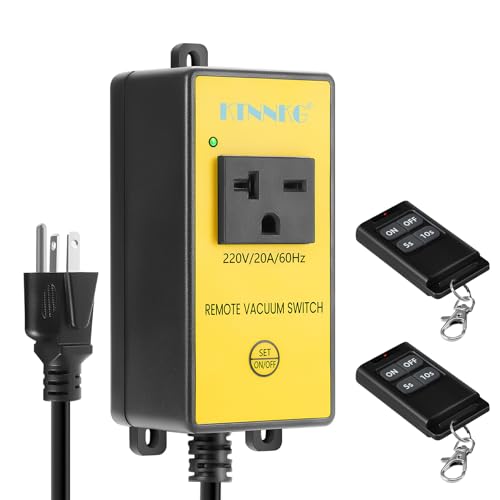
This KTNNKG 220V unit is designed for higher power dust collection tools with a built-in 5s/10s time-delay off function. The remote control turns the switch on and off at the press of a button, and the delay-off option helps maintain debris collection after the user has paused for a moment. The high-power capacity makes it suitable for larger dust collectors or tool setups where sustained operation is beneficial to workflow continuity.
CHAOSEND Automatic Remote Vacuum Switch (220V)
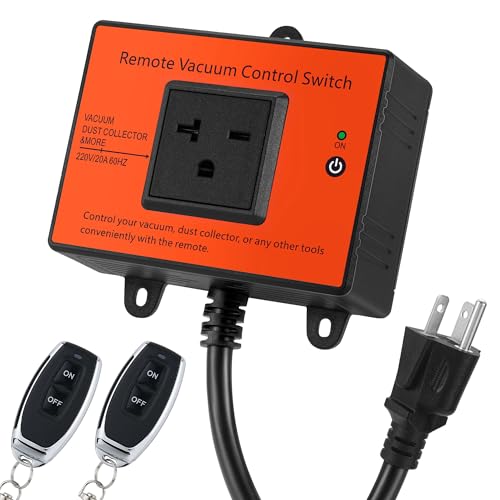
The CHAOSEND 220V model emphasizes long-range remote operation, up to 328 feet, with a battery-included remote unit for immediate use. It supports simple remote control through an ON/OFF button, enabling efficient and safe management of the dust collection process. The design is compatible with multiple workshop setups where a distant control point is advantageous for maintaining airflow and cleanliness during complex tasks.
Ortis Dust Collector Remote Switch

Ortis provides a heavy-duty 328-foot wireless remote switch designed for dust collectors. The remote control is compact and battery-included, enabling easy carriage and setup around a workshop. The device emphasizes safety and convenience by allowing operators to control the vacuum from afar, reducing the need to approach dusty or noisy equipment during the cleanup process. The large range supports workshop layouts with multiple workstations or equipment clusters that require quick, distant access to the dust collector.
Buying Guide: Key Purchase Considerations
- Voltage and amperage: Choose the appropriate voltage (120V vs 220V) and current rating for your dust collector and tools. Ensure the outlet can safely handle the anticipated load, especially for high-power systems.
- Remote range and signal reliability: RF remotes that pass through walls are ideal for open workshops. Consider the maximum range, interference from metal machinery, and whether the system operates on robust frequencies.
- Time-delay/off features: Delay-off timers (5s, 10s) prevent abrupt shutdowns and help ensure debris clearing is completed. Some models also offer instant on/off without delay for urgent stopping needs.
- Remote redundancy: Whether the package includes one or two remotes can affect convenience and backup. Dual remotes reduce the risk of being without control.
- Safety and certifications: Look for UL or equivalent safety certifications and sturdy enclosures or flame-retardant materials to improve reliability in shop environments.
- Durability and fit: Verify whether the switch supports your equipment’s plug configuration and whether the device is designed for continuous operation in a workshop setting.
- Installation and compatibility: Confirm whether the unit requires professional installation or if it’s a plug-and-play inline switch. Check compatibility with existing dust collectors and electrical outlets.
- Battery life and maintenance: For battery-powered remotes, consider the type of battery, expected life, and how easy it is to replace or recharge them in a busy workshop.
Across these options, remote switches provide a practical approach to managing dust collection without constant manual interaction. The choice depends on your workshop size, the power needs of your dust collector, and how freely you want to move around while maintaining clean air and surfaces. End-users should assess whether a basic instantaneous ON/OFF switch meets their workflow or if a timed-delay model offers meaningful benefits during longer cleanup sessions.