Best Plexiglass Table Saw Blades for Clean, Melting-Free Cuts
Choosing the right table saw blade for plexiglass and other plastics minimizes heat buildup, reduces melting, and delivers crisp edges. The following blades are optimized for plastic and acrylic cutting, with features like advanced carbide blends, specialized tooth grinds, and precise kerf control. This guide highlights five top options and compares their strengths to help American DIYers and professionals select the best blade for plastic and plexiglass projects.
| Product | Brand | Key Feature |
|---|---|---|
| Freud LU94M010: 10″ Plastic Blade | Freud | Premium TiCo carbide, MTCG grind for cool cuts |
| IVY Classic 35056 Swift Cut | IVY Classic | High-speed aluminum/plastic cutting, 200 teeth |
| FOXBC 10-Inch 80-Tooth TCG | FOXBC | TCG grind, vibration-reducing stabilizers |
| CMT 222.080.10 MATB | CMT ORANGE TOOLS | Alternate top bevel with chamfer grind for plastics |
| Freud LU94M008 | Freud | Modified Triple Chip Grind, anti-melt properties |
Below are five products chosen for relevance to plexiglass and similar plastics. Each section includes practical details to help compare performance, maintenance, and compatibility with common table saws and miter saws.
Freud LU94M010: 10″ Plastic Blade
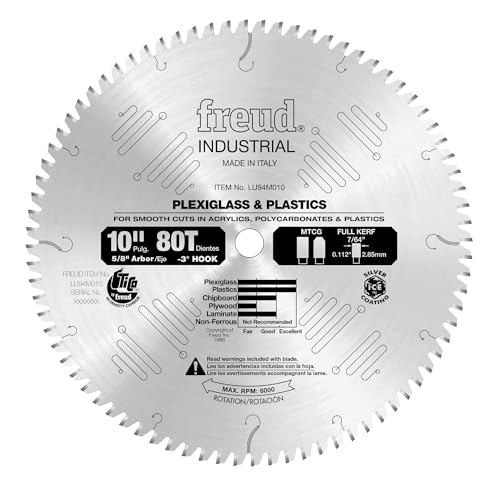
The 10″ Freud LU94M010 is designed for plastic cutting with a 5/8″ arbor, 0.110″ kerf, and a 0.087″ plate. Its 80 teeth and MTCG (Modified Triple Chip Grind) tooth design help keep temperatures down during cutting, reducing the risk of plexiglass melting and maintaining a clean edge. The blade’s premium TiCo Hi-Density carbide blend provides durability and long-term sharpness, making it suitable for repeated use on thinner plastics and acrylics. This blade emphasizes control and smooth cuts, especially when used with circular, miter, or table saws.
IVY Classic 35056 Swift Cut 10″ Blade

The IVY Classic 35056 Swift Cut blade is engineered for light-gauge aluminum, plastic, and vinyl siding up to 1/8″ thick. With a 10″ diameter and 5/8″ arbor, this 200-tooth blade emphasizes precision and smooth edges. For thicker plastics, IVY Classic suggests a different model (36366) to maintain edge quality. The blade’s high-carbon steel construction ensures dependable performance, though users should observe stated rotation directions to prevent uneven cuts. This blade is ideal for fine, controlled finishes on plastic components and trim.
FOXBC 10-Inch 80-Tooth TCG for Plastic

This FOXBC blade uses an 80-tooth TCG (treble chip grind) configuration, optimized for aluminum and non-ferrous metal or plastic cutting with a 5/8″ arbor and 0.094″ kerf. Laser-cut stabilizer vents help trap noise and reduce vibration for improved accuracy and durability. The blade is manufactured with high-density tungsten carbide for toughness and wear resistance, making it a solid choice for consistent, clean cuts in light metal and plastic materials. It is particularly well-suited for miter and table saw applications requiring precise finish cuts.
CMT 222.080.10 MATB Plexiglass Blade

The CMT MATB plexiglass blade is a 10″ blade with 80 teeth, designed specifically for plastics and thin materials. It features a 0.110″ kerf and a 0.087″ plate with a -3° hook angle and an alternate top bevel with chamfer grind. This configuration helps minimize heat buildup and produce smooth finishes on plexiglass, acrylics, and vinyls when used with radial arm saws, miter/crosscut saws, or table saws. The MATB grind supports low-melt performance and clean edge quality for delicate plastic components.
FOXBC 10 Inch 200-Tooth Contractor Blade (3-Pack)

This FOXBC three-pack provides 10″ blades with 200 teeth, 5/8″ arbor, and 0.1″ kerf. It’s designed for smooth, splinter-free cuts in plywood, OSB, plastic panels, and vinyl siding. The high tooth count yields fine finishes ideal for crosscuts and precise sides on plastic sheet materials. The blades are suitable for both contractor and benchtop saws, offering economical, repeatable performance for projects requiring multiple clean passes.
MASTEC 100T Carbide Plexiglass Blade

The MASTEC 10″ blade features 100 carbide teeth and a 5/8″ arbor. Its TC G (Triple Chip Grind) tooth arrangement targets aluminum, plexiglass, and other plastics for smooth cutting with reduced heat buildup. This blade is positioned for durable performance in metal/plastic mixed projects, offering efficient cutting with a focus on clean edges in plastics and non-ferrous materials. Its design emphasizes long blade life and stable operation across common saw configurations.
Buying Guide: Choosing the Right Plexiglass Blade
- Material compatibility: Plastics vary in hardness; look for blades labeled for plastics, acrylics, or polycarbonates. A grind designed to minimize heat buildup reduces melting risk.
- Tooth count and grind: Higher tooth counts produce smoother edges but cut more slowly. MTCG, MATB, and similar formulations help keep temps down while preserving edge quality on plastics.
- Kerf and plate thickness: A thinner kerf (0.094″–0.110″) reduces material removal heat and minimizes stress. Plate thickness influences rigidity; a robust plate supports precise cuts on thin materials.
- Arbor compatibility: Ensure the 5/8″ arbor matches your saw. Some blades offer alternate arbors; adaptor sleeves can extend compatibility but may affect rigidity.
- Cut type and direction: For plastics, follow blade grind directions and use slower feed rates to prevent melting. Some blades require correct rotation direction to optimize performance.
- Durability vs. safety: Carbide-tipped blades provide longevity, but ensure you use proper safety gear and guard settings to avoid splinters and chips.
- Cost vs. value: Higher-quality blades reduce risk of heat-related damage and yield better finishes on plexiglass, potentially saving time and material costs in the long run.
- Saw compatibility and setup: Check your saw’s RPM rating, arbor size, and alignment. For plastic work, use clean, stable cuts with minimal vibration.
When selecting a blade, consider the thickness of plexiglass or acrylic you work with, the required edge quality, and how frequently you cut plastics. Blades with heat-dissipating tooth designs and stable stabilizers generally perform better for plastic cutting. For occasional plastic work, a blade like the Freud LU94M010 or MASTEC options can deliver reliable results, while for more frequent plastic fabrication, blades with high-precision tooth geometries and low-melt properties offer long-term value.