Best Outdoor Motion Sensors for Safer Home Lighting
Outdoor motion sensors enhance security and convenience by activating lighting when movement is detected. Modern sensors offer adjustable sensitivity, timing, and ambient-light controls, plus varying detection ranges and mounting options. Whether you need floodlights that deter intruders, smart integrations for home automation, or solar-powered units for low-maintenance setups, there are options that fit every porch, driveway, and yard. Below we review five top outdoor motion sensors, highlighting what sets each apart and how to choose the best fit for your space.
| Product | Brand | Notable Feature |
|---|---|---|
| LUTEC 72W LED Security Lights with Motion Sensor | LUTEC | 72W, 7500 lm, 180° sensing up to 69 ft, 4 modes |
| Philips Hue Outdoor Motion Sensor | Philips Hue | 160° detection, requires Hue Bridge, smart automations |
| EDISHINE 180-Degree Motion Sensor | EDISHINE | 180° detection, 0–10 min delay, 60 ft range |
| TREEWELL 240-Degree Motion Sensor | treewell | 240° range, adjustable LUX (5–300), 3 modes |
| Tuffenough 3-Head Solar Motion Sensor Lights | Tuffenough | 270° wide angle, 2500 lm, solar power, remote control |
LUTEC 72W LED Security Lights Motion Sensor

The LUTEC LED security light combines high output with practical control options. It delivers 72 watts and about 7500 lumens in a daylight-balanced 5000K color temperature, designed to illuminate broad outdoor areas. The motion sensor covers a wide 180-degree angle and reaches roughly 69 feet, enhancing security without excessive false alarms. It offers four lighting configurations: Test Mode, Security Mode, Dusk to Dawn, and Manual Override. The timer can be set for short or longer durations, helping you tailor when and how long lights stay on after activation. This model emphasizes energy savings and reliable operation in varied weather conditions.
Installation versatility is a key advantage. The sensor’s rotatable head and robust housing suit porches, garages, and walkways. Choosing between Auto, Dusk-to-Dawn, and Manual modes allows users to balance convenience with security needs. While it is not a smart hub device, its brightness and durability make it a strong, straightforward upgrade for traditional floodlight setups. Consider this option if you want a powerful, easy-to-install outdoor light without extra smart-home requirements.
Philips Hue Outdoor Motion Sensor
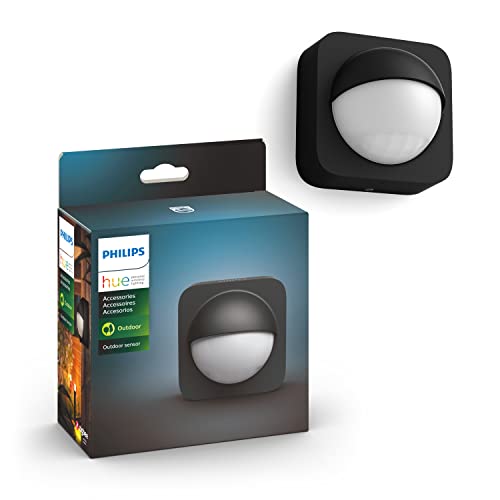
The Philips Hue outdoor motion sensor integrates with the Hue ecosystem to deliver smart lighting automation. It features a broad 160-degree detection area and relies on a Hue Bridge for full functionality, including remote control, automations, and reliable connectivity. When motion is detected, compatible Hue lights can turn on automatically, with options to customize which lights respond and how long they stay illuminated. This setup supports voice assistants (Alexa, Google Assistant, and Apple HomeKit) and supports Matter-enabled future integrations, providing flexible, scalable smart-home control for porches, driveways, and entryways.
Because it requires a Hue Bridge, this option is best for users already invested in Philips Hue or those planning a broader smart lighting upgrade. The sensor itself is weatherproof for outdoor use, and the system supports complex routines, like welcoming lighting scenes when you arrive home or turning lights off automatically at dawn. If you want seamless smart-home integration and scene-based lighting, this is a leading choice, albeit with the need for the additional hub infrastructure.
EDISHINE Motion Sensor

EDISHINE’s motion sensor offers versatile, user-friendly control with three distinct modes. In Auto, lighting activates at night when motion is detected and turns off after a preselected delay. The Dusk to Dawn setting operates only in darkness, keeping the lights off during daytime. Manual Override allows quick on/off control, with devices staying illuminated for up to eight hours before automatically returning to Auto. The sensor supports timely responses with a delay range from 0 to 10 minutes and detects motion up to 60 feet at an angle of 180 degrees. The adjustable neck (180 degrees vertical, 360 degrees horizontal) helps target coverage precisely.
This model suits outdoor lighting upgrades where you want straightforward, reliable automation without a full smart-home ecosystem. It’s compatible with standard 120V circuits and prioritizes predictable behavior and easy installation on walls or eaves. If you need dependable, feature-rich control that doesn’t rely on a separate hub, EDISHINE is a solid pick for porch lighting, garages, and entryways.
TREEWELL 240-Degree Motion Sensor

The TREEWELL 240-Degree motion sensor emphasizes expansive coverage and flexible control. It features three modes: Auto Mode, which turns on the light when it detects movement in darkness and then turns off after a set delay; DTD Mode, which activates at night and remains off during the day; and Manual Override, where you can keep the light on for up to eight hours, with dawn automatically returning to off. The device supports a wide 240-degree detection range and offers an adjustable ambient-light threshold from 5 to 300 LUX, letting you fine-tune when the sensor triggers the light in varying night conditions. A timer and sensitivity can be tuned 10 seconds to 10 minutes for custom delay settings.
Rotable sensor neck provides flexibility for aiming the detection zone toward entryways, walkways, or driveways, making it suitable for porches, backyards, and garages. It’s a strong option for users who want broad, configurable coverage without complex smart-home integration. The unit’s outdoor-rated design ensures durability in various weather conditions while maintaining straightforward installation and operation.
Tuffenough Solar Outdoor Lights With Motion Sensor

This solar-powered solution from Tuffenough features three adjustable heads and a remote for easy operation. With up to 2500 lumens and a 6500K color temperature, these lights provide bright, broad illumination for outdoor spaces. The unit offers three modes: a strong light on sensor, a dim light sensor mode, and a strong long-acting mode, enabling flexible lighting patterns for paths, garages, and yards. The three-head configuration delivers wide coverage, and the motion sensor can detect activity within a 26-foot range. With IP65 waterproof rating, these lights are designed to withstand outdoor weather while remaining maintenance-free due to solar charging and wireless remote control.
Solar-powered lights are ideal for locations without easy electrical access or where mains wiring is undesirable. This set is particularly suitable for driveways, patios, or side entrances that benefit from reliable nighttime lighting during high-traffic periods. The remote control adds convenience for adjusting settings from afar, but keep in mind solar performance can be affected by shading and weather conditions. If you want a bright, wireless solution with broad reach, these three-head solar lights offer a compelling balance of brightness and simplicity.
Buying Guide: Key Considerations For Choosing Outdoor Motion Sensors
When selecting an outdoor motion sensor, consider the following factors to align your choice with your space and goals:
Detection Range And Coverage
Assess the distance at which motion is reliably detected and the width of the sensor’s coverage. A wider angle (e.g., 180–240 degrees) plus a longer reach (50–70 feet) suits large entryways and yards. For narrow approaches, a tighter focus can reduce false alarms caused by pets or nearby traffic.
Lighting Modes And Timing
Look for adjustable delay times (from a few seconds up to several minutes) and multiple modes, such as Auto, Dusk-to-Dawn, or Manual Override. Dusk-to-Dawn ensures lights activate only at night, saving energy. In Auto, the light responds to motion, and in Manual Override you can control lighting when you want it on continuously for a period.
Power Source
Choose between wired connections, solar-powered units, or battery-powered designs. Solar options reduce wiring and maintenance but rely on sun exposure. Wired fixtures generally provide consistent performance, while batteries offer flexibility in remote placements.
Brightness And Energy Efficiency
Consider lumen output and color temperature to ensure adequate lighting without glare. High-lumen fixtures deter intruders but may require more energy or sun exposure in solar models. Energy-efficient LEDs deliver long life with lower running costs.
Environmental Durability
Outdoor fixtures should be rated for weather resistance (IP65 or higher is common). Weatherproof housings protect electronics from rain, dust, and temperature fluctuations, extending lifespan in harsh climates.
Smart Home Integration
If you already use a smart-home hub, verify compatibility with your system (Hue Bridge, Matter support, Alexa, Google Assistant, Apple HomeKit). Some sensors work best as standalone devices, while others enable extensive automations and scenes.
Installation And Mounting
Check mounting options (wall, eave, or pole) and adjustability of the sensor head. Rotatable necks and 180–360-degree adjustments help you target critical zones such as doorways, stairs, and driveways without dead zones.
Security And Reliability
For security-focused lighting, prioritize sensors with consistent triggering in low-light conditions and minimal false positives. A longer warranty and UL or UL-listed certifications add confidence in long-term use.
Cost Of Ownership
Factor in initial price, energy costs (for wired and some LED options), replacement parts, and maintenance. Solar models may have a higher upfront cost but lower ongoing expenses, whereas wired fixtures can offer steady performance without battery concerns.
In practice, your best choice depends on your space, whether you want smart-home features, and how much wiring or sun exposure is feasible. For a high-brightness, easy-install solution on a driveway or garage, a utility-grade LED floodlight with motion sensing can excel. If you want automation and ecosystem compatibility, a Hue-based setup or a Wi-Fi-enabled sensor with smart routines can provide scalable benefits. For low-maintenance, off-grid lighting, solar-powered three-head designs offer broad coverage with minimal wiring. Evaluate these trade-offs against your specific security and convenience goals to determine the best fit.