Best Non Programmable Thermostats for Home Comfort
Choosing a non-programmable thermostat can simplify climate control while keeping your heating and cooling reliable. The following five models are popular for single‑stage systems and straightforward operation. They offer durable displays, easy wiring, and long‑lasting performance. This guide highlights each option with key features and installation notes to help you pick a unit that fits your existing setup and daily comfort needs.
| Product | Brand | Key Benefit |
|---|---|---|
| Suuwer 1H/1C Non-Programmable Thermostat | Suuwer | Blue backlit display; single‑stage compatibility; basic wiring (2–5 wires) |
| Honeywell TH3110D1008 Pro Non-Programmable Thermostat | Honeywell | Digital, reliable control for 1 heat/1 cool; US‑made |
| Honeywell Home RTH5160D1003 Non‑programmable Thermostat | Honeywell Home | Backlit display; simple operation; 1‑degree control steps |
| Honeywell Home X1N Non‑Programmable Thermostat | Honeywell Home | Large screen; easy install with UWP plate; 1 heat/1 cool compatible |
| Emerson 1E78-140 Non-Programmable Heat Only Thermostat | Emerson | Easy‑to‑read display; heat‑only for single‑stage systems |
Suuwer 1H/1C Non-Programmable Thermostat

The Suuwer model is intended for conventional single‑stage systems, supporting up to 1 heat and 1 cool. It features a blue backlight for easy readability in low light and is designed for basic wiring configurations, typically requiring 2–5 wires. It is not compatible with multistage heating/cooling, heat pumps, PTACs, or line‑voltage baseboards. Installation requires confirming the existing base wires and following the provided wiring instructions to ensure proper operation. This unit suits homes seeking a straightforward, affordable control with reliable performance for standard furnaces and cooling units.
Honeywell TH3110D1008 Pro Non-Programmable Thermostat
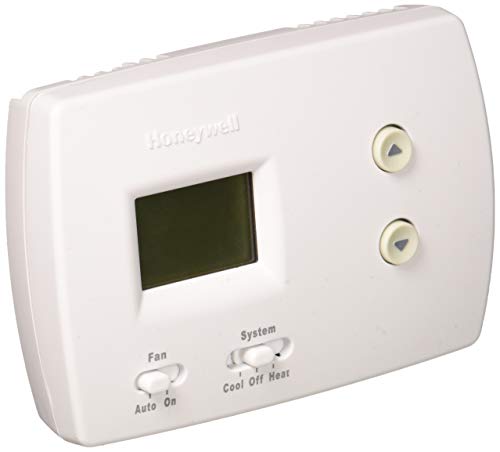
The Honeywell TH3110D1008 Pro Non‑Programmable Thermostat belongs to the Pro 3000 series and supports 1 heat/1 cool in a single‑stage configuration. This white digital thermostat is designed for straightforward operation and is manufactured in the United States. It provides reliable, low‑maintenance control with a simple interface, making it suitable for standard homes and basic HVAC systems where programming is not required.
Honeywell Home RTH5160D1003 Non‑programmable Thermostat
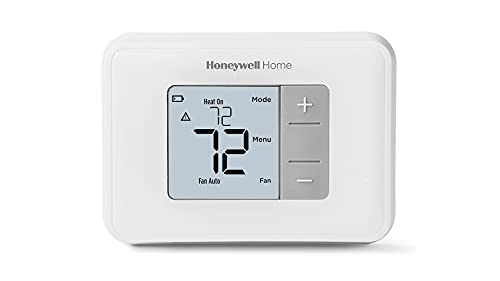
Honeywell Home RTH5160D1003 features a backlit display that shows both the current room temperature and the set point, with simple plus/minus controls and 1‑degree Fahrenheit increments. This model emphasizes a straightforward, no‑frills experience ideal for basic installations where the priority is quick temperature adjustments rather than programmable schedules. Its design supports reliable performance in traditional homes with standard furnaces and cooling equipment.
Honeywell Home X1N Non‑Programmable Thermostat

The Honeywell Home X1N offers a large display and clear font to enhance daily use. It is compatible with single‑stage systems (1 heat/1 cool) and is designed to streamline installation with the UWP wall plate, which can simplify future upgrades. This model balances readability with a quick setup process, making it suitable for homeowners who want a dependable, easy‑to‑read thermostat without programming features.
Emerson 1E78-140 Non-Programmable Heat Only Thermostat

Emerson 1E78-140 is a non‑programmable thermostat designed for single‑stage heat‑only systems. It provides a straightforward, backlit digital display for easy temperature reading and simple controls. This unit is ideal for homes that require reliable heat regulation without additional cooling controls or programmable scheduling, offering a compact, cost‑effective solution for basic heating setups.
Buying Guide
Key purchase considerations help match a non‑programmable thermostat to your home’s HVAC setup. The following factors cover multiple perspectives, from installation basics to long‑term usability.
- System compatibility: Confirm whether your system is single‑stage (1 heat/1 cool) or heat‑only. Do not select a model designed for multi‑stage systems or heat pumps if your equipment is simple directional heating or cooling.
- Wiring and base compatibility: Many non‑programmable units require 2–5 wires and a compatible mounting base. Check the base wiring diagram before buying to prevent incompatibility with your existing wires.
- Display and readability: If you prefer easy visibility, choose models with backlit displays and larger fonts. This is especially helpful for nighttime adjustments or in rooms with ambient lighting challenges.
- Installation ease: Some models include a universal wall plate or simplified installation steps. If you’re upgrading from an older thermostat, a wall plate that matches standard outlets can ease future upgrades.
- Durability and brand reliability: Established brands often provide longer warranties and easier access to support. Consider models from recognized manufacturers with a history of HVAC components.
- Non‑programmable vs programmable value: A non‑programmable thermostat offers immediate, manual control without scheduling. If you eventually want energy‑saving schedules, consider whether a future upgrade to a programmable model is feasible for your home.
- Wiring cautions and compatibility notes: Some units explicitly state limitations (for example, not suitable for 6–8 wire configurations or line‑voltage baseboards). Review these notes to avoid incorrect purchases that could require returning the product.
- Upgrade path and accessories: If you plan to upgrade, verify whether upgrading to a specific Wall Plate or UWP kit is recommended to simplify future device changes.
Overall, choose a model that aligns with your current HVAC setup, wiring capability, and preferred ease of use. All five options here provide reliable, straightforward temperature control for basic single‑stage heating and cooling needs, without the complexities of programmable schedules.