Best Nail Guns for Siding: Top Siding Nailer Picks
Choosing the right nail gun for siding projects affects finish quality, speed, and long-term durability. Siding nails demand reliable firing, precise depth control, and compatibility with coil configurations to prevent wood damage or nail pop. The following five models represent solid options for residential exterior work, blending manageable weight with solid reliability for DIYers and pros alike. Use this guide to compare angles, nail types, and firing modes so you can select the best tool for your siding installation, sheathing, and occasional framing tasks.
| Product | Brand | Highlights |
|---|---|---|
| Bostitch N66C Coil Siding Nailer | Bostitch | Adjustable depth guide; lightweight aluminum body; accepts wire weld and plastic inserted coil nails |
| Metabo HPT NV65AH2 Siding Nailer | Metabo HPT | Dual-angle compatibility; selective actuation; side-load magazine |
| Makita AN613 Siding Coil Nailer | Makita | Efficient motor; tool-less depth adjustment; two-mode operation |
| Metabo HPT NV75A5 Siding/Framing Nailer | Metabo HPT | Wide nail range; lightweight; Pro Preferred recognized |
| Freeman PCN65 Siding Nailer | Freeman | Rapid-fire 10/sec; easy load magazine; adjustable depth |
Bostitch N66C Coil Siding Nailer

The Bostitch N66C Coil Siding Nailer presents a practical blend of maneuverability and build quality for exterior projects. It drives both wire weld and plastic inserted coil nails, enabling use with a range of siding materials from softwood to composites. An adjustable depth guide lets you set nail projection accurately, which helps prevent dimples and ensures a clean finish on various sidings. The tool’s lightweight aluminum construction reduces fatigue during long runs along walls, eaves, and soffits, improving control and accuracy over time.
Load handling and durability are solid with the N66C. The design supports consistent performance across extended sessions, and the tool’s robust drive mechanism resists typical job-site wear. For cedar, fiber cement, or engineered wood siding, this model offers dependable results when paired with appropriate nails. Regular maintenance—checking the depth wheel and applying light lubrication—helps sustain consistent drive depth and jam-free operation.
Metabo HPT NV65AH2 Siding Nailer

The Metabo HPT NV65AH2 offers versatility for siding work with its two-angle capability and selective actuation. It accepts 16-degree wire coil nails from 1-1/2″ to 2-1/2″ and 15-degree plastic coil nails from 1-1/2″ to 2-1/4″, giving you options for different siding substrates and weather conditions. The selectable actuation switch lets you transition between sequential nailing for precision and contact nailing for speed, while the side-load, tilt-bottom magazine makes reloads quick and accessible on ladders or scaffolds. This combination favors both efficiency and control on long exterior runs.
Ergonomics and maintenance considerations are noteworthy. A lighter feel reduces fatigue during extended sessions, particularly when working with cedar shakes or fiber cement. Routine maintenance—keeping the air inlet clean, using proper nails, and storing in dry conditions—helps preserve reliability. While not the cheapest option, its adaptability reduces tool swaps on a project, saving time and space on the truck or in the workshop.
Makita AN613 Siding Coil Nailer

Makita AN613 combines efficiency with precise control for siding jobs through a robust motor and a user-friendly depth system. The tool-less depth adjustment uses nine detents, enabling fine-tuned settings for flush or countersunk nail placements without tools. A two-mode selector allows operators to toggle between contact and sequential nailing, making it adaptable for long, straight runs or delicate corner work near windows and trim. The 2-1/2″ siding nails provide ample reach for common exterior materials, while the trigger design aims to deliver consistent drive depth with each shot.
Balance and reliability are key strengths. The AN613’s compact form and reduced recoil help maintain straight lines on longer siding runs, while straightforward maintenance—such as cleaning the magazine and inspecting seals—supports durable operation. For homeowners upgrading siding or performing light framing, this Makita model offers a dependable, mid-range option with solid performance across tasks.
Metabo HPT NV75A5 Siding/Framing Nailer

The Metabo HPT NV75A5 is built for versatility on siding and light framing tasks. It accepts 16-degree wire coil nails from 1-3/4″ to 3″ and 15-degree plastic coil nails from 1-3/4″ to 2-1/4″, covering a broad spectrum of exterior applications. Weighing roughly 5.7 pounds, it remains maneuverable on large wall runs and overhead installations. This model has earned the Pro Preferred designation for multiple years, signaling professional trust in durability and consistent performance for demanding jobs.
Reloading with its tilt-bottom magazine is straightforward, and the tool’s trigger action supports precise placements under varying conditions. For projects involving siding and sheathing, the NV75A5 provides a balanced blend of power, reach, and control. Regular maintenance—air filter cleaning, lubrication, and drive blade checks—helps sustain long-term performance, especially on sites with dust and debris.
Freeman PCN65 Siding Nailer
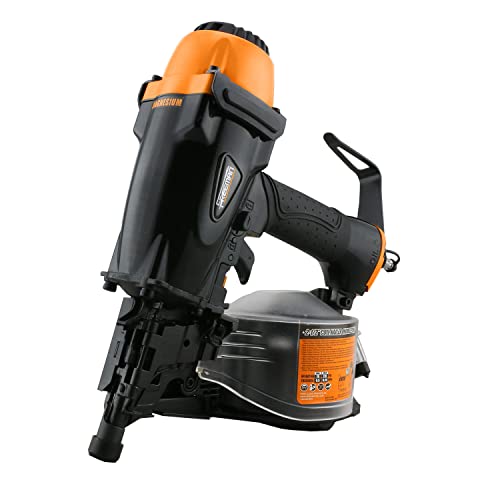
Freeman PCN65 emphasizes speed and durability in tighter exterior spaces. It uses 15-degree plastic coil nails from 1-1/4″–2-1/2″ and 15-degree wire coil nails from 1-3/4″–2-1/2″ (0.09″–0.113″ diameter), providing versatility across common siding materials. A notable feature is the 10-times-per-second rapid-fire capability, which helps cover long runs quickly. The depth adjustment wheel enables precise nail depth control to protect soft sidings and avoid over-penetration. A hardened steel drive blade and anodized aluminum cylinder contribute to robust, long-lasting performance in harsh job-site conditions.
The PCN65 also offers a quick-loading magazine and a well-balanced grip for overhead or vertical work. This model suits homeowners and contractors tackling fencing, sheathing, or exterior renovations where speed and reliability are priorities. Regular inspection of the jam clearance area and routine lubrication will help maintain smooth operation over time.
Buying Guide
Key Considerations
- Angle compatibility: Most siding nails come in 15° or 16° coil configurations. Ensure your chosen nailer supports the angles you’ll encounter on your project.
- Firing mode: Select between sequential and contact (bump) firing. Sequential gives precise control, while contact mode speeds large-area installs.
- Weight and balance: Lighter tools reduce fatigue on long runs, especially when working overhead or on ladders.
- Depth adjustment: A reliable depth control prevents overdriving and substrate cracking in soft wood or composite sidings.
- Magazine type: Side-load or bottom-load magazines affect reload speed and accessibility in tight spaces.
- Nail compatibility: Confirm the tool supports the required nail diameter and length for your siding material.
Choosing For Your Siding Type
- Softwood siding: Prioritize depth control to avoid denting; consider sequential mode for precision on long edges.
- Hardie board or fiber cement: Look for longer nails and robust drive mechanisms to prevent jamming and ensure solid set without splitting.
- Composite and engineered wood: Select a tool with a lighter build and corrosion-resistant components to withstand humidity and temperature changes.
- Framing alongside siding: If light framing is required, a versatile model that supports a broader nail range offers value and flexibility.
Operational And Maintenance Tips
- Air supply: Use the recommended compressor capacity and proper hose size to maintain consistent drive depth.
- Nail selection: Choose corrosion-resistant nails suitable for exterior use and the substrate to minimize substrate damage.
- Jams and cleaning: Regularly clear jams, clean the magazine area, and oil the drive blade as per the manufacturer’s guidelines.
- Safety: Always wear eye protection and use a nailer with a dead-man switch or safety lock when not in use.
Comparisons At A Glance
- Best for versatility: Models with dual-angle or mixed-nail compatibility (e.g., NV65AH2, NV75A5) reduce the need for multiple tools.
- Best for speed: Tools with rapid-fire capability (like Freeman PCN65) are efficient on long runs but may require more maintenance.
- Best for finish quality: Depth control and low recoil models (such as Makita AN613) help achieve flush or near-flush results with fewer touch-ups.
- Best for lightweight work: Low-weight options favor overhead work and long sessions without excessive fatigue.