Best Miter Saw Blades for Clean, Precise Crosscuts
Choosing the right miter saw blade is essential for achieving clean, precise crosscuts in woodworking projects. The blades highlighted here balance tooth geometry, kerf width, and carbide durability to deliver finer finishes, smoother cuts, and longer life. The five blades featured cover a range of common uses—from ultra-finish work to robust crosscuts—so you can pick a blade that matches your saw, material, and desired results. The following sections detail each blade, its strengths, and how it compares for typical miter saw tasks.
| Product | Brand | Key Benefit | Teeth | Kerf |
|---|---|---|---|---|
| DEWALT 12-Inch 80-Tooth Fine Finish Blade | DEWALT | Long life, refined finish | 80 | Unknown |
| DEWALT 12-Inch Miter Saw Blade Pack: 80-Tooth & 32-Tooth | DEWALT | Versatile crosscuts and fast work | 80 / 32 | Unknown |
| Freud Thin Kerf 12-Inch Miter Blade | Freud | Thin kerf, high durability | 72 | Thin kerf |
| DEWALT 12-Inch 100-Tooth Fine Finish Blade | DEWALT | Ultra-fine finish, low vibration | 100 | Unknown |
| WEN BL1280 12-Inch 80-Tooth Fine-Finish Blade | WEN | Ultra-fine finish, clean cuts | 80 | Thin kerf |
DEWALT 12-Inch 80-Tooth Fine Finish Blade

Engineered for long blade life, this 12-inch carbide blade delivers up to three times the lifespan of standard blades, reducing replacements on finish work and trim. The 80 teeth produce exceptionally smooth crosscuts with minimal tear-out on both hardwoods and softwoods. A patented body-slot design helps absorb vibration, so feed motion stays steady and cuts stay square against the fence. Optimized tooth geometry improves accuracy across repeated passes, making it well-suited for cabinet doors, face frames, and fine trim where a pristine edge matters.
Because of its fine finish, this blade excels in tasks where clean edges and a quiet cut are essential. Use it on compatible miter saws or circular saws and pair with a steady feed for the best edge quality. While ideal for finish work, it handles moderate hardwoods and softwoods with consistent results, enabling professional-looking results without extra sanding.
DEWALT 12-Inch Miter Saw Blade Pack: 80-Tooth And 32-Tooth
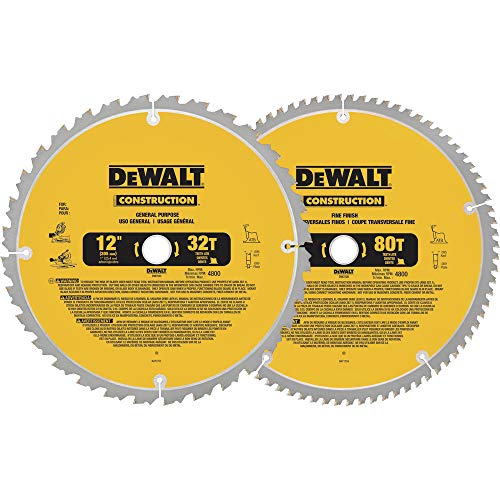
This two-blade set from DEWALT covers crosscutting versatility with two carbide blades: an 80-tooth blade designed for ultra-clean finishes and a 32-tooth blade intended for quicker, less delicate passes. The blades are built for durability and easy use, aligning with standard 12-inch saws. They are manufactured in China, reflecting a balance of cost and performance. The 80T blade excels on cabinet faces, furniture components, and trim where surface quality matters. The 32T blade is suitable for faster cuts in framing and dimensional lumber while preserving acceptable edge quality.
Use this pair when you need a quick swap between ultra-finish work and faster crosscuts in a project. Ensure your saw’s arbor and diameter are compatible with the blades for best results, and maintain steady feeds to maximize blade life and cut quality.
Freud Thin Kerf 12-Inch Miter Blade

Freud LU91R012 uses a thin kerf and a negative hook angle of 5°, which helps control aggressiveness and reduces blowout when cutting near the fence. The premium TiCo carbide blend delivers high-density hardness, edge retention, and long blade life, enabling consistent, clean crosscuts through hard and soft woods. The thin kerf design removes less material, reducing horsepower requirements and improving overall efficiency, especially on mid- to heavy-duty crosscuts.
With 72 teeth and an ATB grinding pattern, this blade balances smooth finish with efficient cutting across typical framing, cabinetry, and furniture components. It is particularly well-suited for precise crosscuts in medium- to dense-wood applications where finish quality and cut accuracy are both critical.
DEWALT 12-Inch 100-Tooth Fine Finish Blade

This blade features 100 teeth for ultra-fine finishes on cabinetry, trim, and paneling. The high tooth count enables exceptionally smooth surfaces and minimizes tear-out, making it ideal for premium finish work. Carbide teeth provide long life and reliable performance across hard and soft woods, while a body-slot design helps dampen vibration for repeatable cuts. The tooth geometry is optimized to maintain precision across repeated passes, which is essential for alignment-sensitive trim work and cabinet components.
Pair this blade with a quality miter saw for bevels and miters that demand tight tolerances and clean edges. It shines on cabinet faces, molding returns, and veneered panels where a flawless edge is essential and sanding time is minimized.
WEN BL1280 12-Inch 80-Tooth Fine-Finish Blade
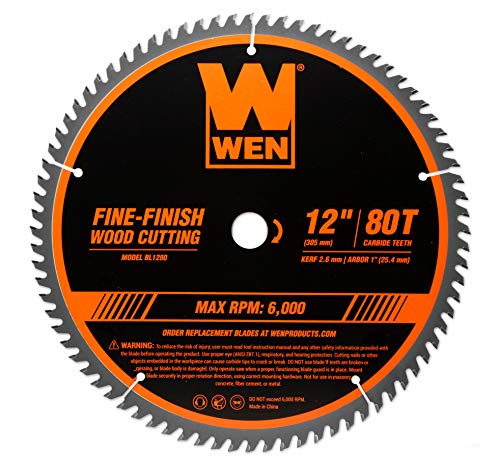
This WEN blade delivers a fine finish with an 80-tooth count on a 12-inch diameter, making it well-suited for cabinet work, trim, and veneered surfaces. It is carbide-tipped and rated for up to 6000 RPM, designed for compatibility with most 12-inch miter saws. The blade uses an ultra-thin kerf (about 0.1 inch or 2.4 mm) to reduce waste and horsepower demand, enabling smoother starts and cleaner cuts. The 1-inch arbor fits many saws, though confirmation of compatibility is advised.
This blade excels in controlled crosscuts on hardwoods and softwoods alike, where clean edges and reduced sanding are desirable. It pairs effectively with finish carpentry tasks such as door and window trim, paneling joints, and furniture components requiring meticulous edge quality.
Buying Guide
Key Considerations When Picking a Miter Saw Blade
Choosing the right blade depends on the type of cuts you perform most and the materials you work with. A higher tooth count yields a finer finish but can slow cutting, while a lower count increases speed at the expense of edge quality. Thin kerf blades reduce horsepower demands and material waste, but require precise saw setup. Carbide teeth provide longevity across a range of woods, and the blade’s diameter and arbor size must match your saw. Consider vibration management features, such as body-slot designs, for smoother, more accurate cuts.
Blade Types Versus Typical Tasks
- Fine-finish blades (80–100 teeth): best for cabinetry, trim, veneers, and laminated materials.
- Crosscut or general-purpose blades (60–80 teeth): versatile for framing and general finishing tasks.
- Ultra-finish blades (100+ teeth): ideal for impeccable surfaces on plywood, melamine, and veneers.
- Thin-kerf blades: save power and produce less waste; require precise alignment and stable feeds.
- Durability and life: carbide-tipped blades extend life on hardwoods and softwoods alike.
Quick Blade Comparisons For Quick Decisions
Reviewing the blades in this guide shows a spectrum of options. For ultra-smooth cabinetry work, the 100T and 80T blades are strong candidates. For flexible crosscut tasks, the 80T/32T DEWALT pack provides range and value. The Freud LU91R012 adds a thin kerf and TiCo carbide blend for balance between finish and speed. The WEN BL1280 offers a budget-friendly, finish-focused option with a thin kerf and a 1-inch arbor. Always verify arbor size and blade diameter before purchasing.