Best Miter Saw Blades for Woodworking: Fine-Finish, Durable, and Precise
Choosing the right miter saw blade can dramatically improve cut quality, reduce tear-out, and speed up projects. For woodworking, fine-finish blades with carbide tips and precise kerf are essential. The five blades below come from a trusted brand and cover a range of sizes and tooth counts, focusing on clean cross-cuts and smooth finishes. Use this guide to compare tooth counts, kerf, and arbor compatibility to fit your 10-inch or 12-inch saws and your project needs.
Below is a quick table of the five selected blades, summarizing key specs to help you compare at a glance.
| Product | Tooth Count | Diameter | Arbor | Finish Type |
|---|---|---|---|---|
| WEN BL1080 | 80T | 10″ | 5/8″ | Ultra-fine finish |
| WEN BL1060 | 60T | 10″ | 5/8″ | Fine finish |
| WEN BL1040 | 40T | 10″ | 5/8″ | Carbide-tipped |
| WEN BL1200 | 100T | 12″ | 1″ | Ultra-fine finish |
| WEN BL1280 | 80T | 12″ | 1″ | Fine finish |
WEN 80-Tooth Ultra-Fine Finish Blade

Designed for precise cross-cuts and clean finishes, the WEN BL1080 features 80 carbide-tipped teeth on a 10-inch blade. The ultra-thin kerf (about 1/10 inch or 2.4 mm) reduces waste and minimizes heat during cutting, helping achieve smoother edges on both hard and soft woods. With a 5/8-inch arbor and a maximum RPM rating of 6,000, this blade is compatible with common 10-inch miter saws and table saws, making it a versatile choice for finish carpentry.
Its 80 teeth strike a balance between fast cutting and a refined surface, which is ideal for cabinetry, trim, and furniture components. The blade’s carbide tips stay sharp longer, and the ultra-thin kerf minimizes waste in denser woods. For best results, pair it with a clean fence, proper blade height, and a steady feed rate.
For users upgrading from standard blades, the 80T delivers a visible improvement in edge quality while preserving reasonable cut speed. When cutting particularly dense woods, use a light touch, slower feed, and allow the blade to do the work to minimize heat buildup.
WEN 60-Tooth Fine-Finish Blade
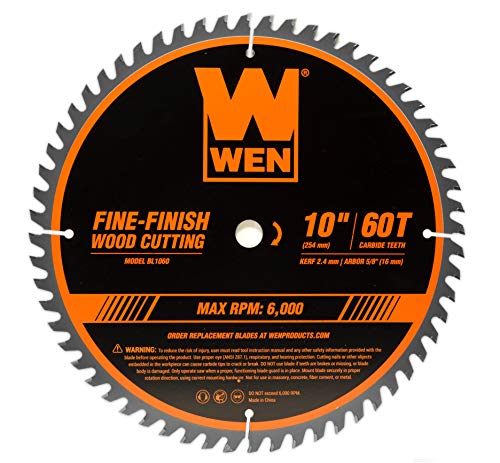
With 60 carbide-tipped teeth on a 10-inch blade, the WEN BL1060 delivers a finer finish than a standard 40-tooth blade while maintaining efficient cutting speed. The ultra-thin kerf and 5/8-inch arbor pair with most 10-inch miter or table saws, and the 6,000 RPM rating supports a wide range of wood types.
Its finish-oriented tooth pattern reduces tear-out on softwoods and hardwoods, making it well suited for cabinet doors, trim, and face frames. For best results, maintain sharp blades and use light to moderate feed pressure. This blade also benefits from consistent cleaning and proper alignment.
If your saw supports quick-change setups, label blades to avoid confusing with the 40T or 80T. Always ensure the blade is installed with the correct rotation direction and guard alignment.
WEN 40-Tooth Carbide-Tipped Blade
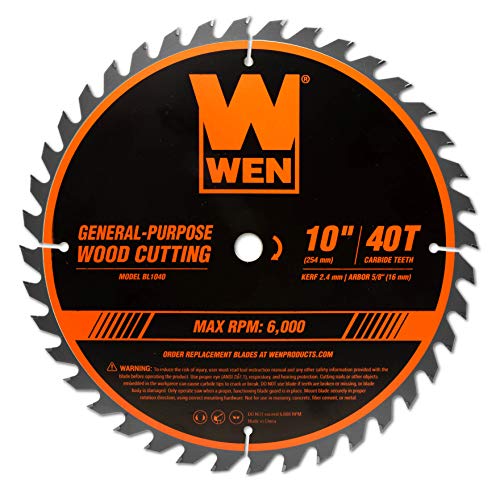
The WEN BL1040 uses a 40-tooth carbide-tipped design for aggressive stock removal while still offering reliable finish performance on larger cross-cuts. The 1/10-inch kerf helps minimize waste, and the 5/8-inch arbor and 6,000 RPM rating ensure compatibility with most 10-inch miter saws.
This blade is well-suited for rapid dimensioning of softwoods and certain hardwoods, especially when you need to square up panels or break down boards before final shaping. For fine cabinetry or face frames, you may prefer higher-tooth blades; rotate blades regularly to maintain sharpness.
This blade excels in stock removal tasks on panels and rough cuts; for best finishes, use it on the initial pass and switch to higher-tooth blades for final passes.
WEN 100-Tooth Ultra-Fine Finish Blade

The WEN BL1200 combines a 12-inch diameter with 100 ultrafine teeth for premium finish work on larger sheets and longer cross-cuts. The 1-inch arbor fits most 12-inch miter and table saws, and the ultra-thin kerf (about 2.8 mm) preserves wood, enabling precise cross-cuts with minimal tear-out.
Its tooth count makes it ideal for furniture components, panels, and architectural millwork where smooth, even surfaces are required. Maintain steady feed pressure and ensure blade alignment for consistent results; the carbide tips help resist wear during dense cuts.
Because it has many teeth, the blade is best used for finishing passes or trimming thin layers; avoid aggressive hogging, and use a consistent feed rate. The 100T blade pairs well with large panels, but consider a sacrificial backing board to minimize tear-out on veneered plywood.
WEN 80-Tooth Fine-Finish 12-Inch Blade
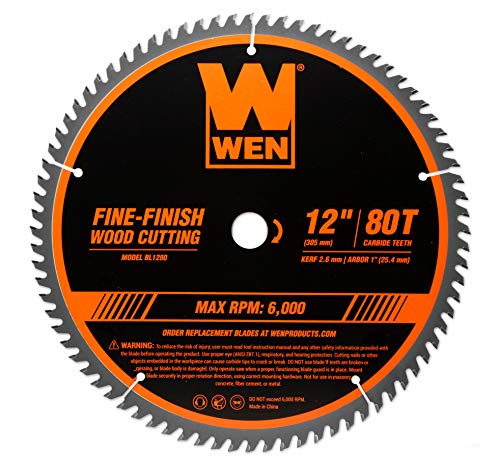
In the 12-inch class, the WEN BL1280 offers an 80-teeth, fine-finish option with a 1-inch arbor for wide boards. The ultra-thin kerf of about 2.6 mm minimizes material loss while delivering precise cross-cuts across soft and hard woods.
This blade suits cabinetry and panel work where clean edges are critical. Pair it with accurate alignment and a slow, controlled feed to preserve finish quality; avoid forcing the blade through dense material to prevent chipping.
The 80-tooth design provides a strong balance of finish quality and cutting efficiency for mid- to large-scale projects. It is well suited for fine furniture, paneling, and door components where a smooth surface is essential.
Inside the 12-inch category, the WEN BL1280 offers an 80-tooth, fine-finish option with a 1-inch arbor for wide boards. The ultra-thin kerf of about 2.6 mm minimizes material loss while delivering precise cross-cuts across soft and hard woods.
This blade suits cabinetry and panel work where clean edges are critical. Pair it with accurate alignment and a slow, controlled feed to preserve finish quality; avoid forcing the blade through dense material to prevent chipping.
The blade’s finish-oriented teeth and carbide tips resist wear, helping maintain a sharp edge across multiple projects. As with all blades, ensure proper storage and safe use to maximize life and performance.
Buying Guide
To pick the right blade, consider the diameter you can fit on your saw, the arbor size, and whether you primarily cut softwoods, hardwoods, or plywood. Ten-inch blades with 40–80 teeth offer different balances of speed and finish, while 12-inch blades with 80–100 teeth prioritize smoother edges on larger boards. Carbide tips provide durability, but the blade’s geometry and kerf determine cut quality.
Teeth count matters: higher tooth counts yield finer finishes at the cost of slower cutting, while lower tooth counts remove material quickly but may leave rougher surfaces. Kerf width affects waste and heat; thinner kerfs save wood but require careful feed control. Arbor compatibility and blade height should match your saw’s specifications.
Practical considerations also include maintenance and safety. Clean blades after use to prevent resin buildup, check for dull or chipped teeth, and store blades properly to extend life. Remember to unplug tools during blade changes, wear safety glasses, and follow the saw manufacturer’s guidelines for maximum RPM and cutting depth.