Best Miter Saw Blades for Hardwood: Clean, Precise Cuts
Selecting the right miter saw blade for hardwood can dramatically improve cut quality, reduce splintering, and extend tool life. This guide highlights five top carbide-tipped blades designed for clean cross-cuts in hard and soft woods alike. Each option balances tooth configuration, kerf, and arbor compatibility to deliver precise finishes on miters, bevels, and edge cuts. The picks below work with 10- and 12-inch miter saws and emphasize ultra-fine finishes for hardwood projects such as trim, cabinetry, and framing. A quick product table follows to compare key specs at a glance.
| Product | Diameter | Teeth | Arbor | Use |
|---|---|---|---|---|
| WEN BL1080 10-Inch 80-Tooth Ultra-Fine Finish | 10″ | 80 | 5/8″ | Hardwood / Finish |
| WEN BL1280 12-Inch 80-Tooth Fine-Finish | 12″ | 80 | 1″ | Hardwood / Finish |
| COMOWARE 10-Inch 80T ATB | 10″ | 80 | 5/8″ | Wood / Hardwood |
| DEWALT 12-Inch 80T & 32T (2-Pack) | 12″ | 80T, 32T | 1″ | Crosscut / Finish |
| DEWALT DWA112100 12-Inch 100-Tooth Fine Finish | 12″ | 100 | 1″ | Hardwood / Fine Finish |
Note: This table summarizes key specs for quick comparison. All blades are carbide-tipped and designed to deliver cleaner, more accurate cuts on hardwood. Individual product pages provide full compatibility details for your saw model and mounting.
WEN 10-Inch 80-Tooth Ultra-Fine Finish Blade

The WEN BL1080 features a 10-inch diameter and a 5/8-inch arbor, with a rapid 6000 RPM rating. Its ultra-thin kerf measures 1/10 inch (2.4 mm), enabling minimal material loss and clean, precise cross-cuts in both hard and soft woods. The blade is carbide-tipped for durability and long life, supporting fine finish work on trim, moldings, and cabinetry. The combination of 80 teeth and ATB-style geometry helps reduce tearing and chipping on hardwood surfaces, delivering flatter, smoother edges with each pass.
Designed for miter and table saw usage, this blade emphasizes finish quality over aggressive removal. The tooth configuration begins with precision-scoring teeth to minimize tear-out, while subsequent teeth remove material efficiently. Maintenance is straightforward: keep the blade clean and free of resin buildup to preserve its edge life and cutting performance. This blade suits projects that require a refined touch on hardwoods, including cabinet face frames and decorative trims.
WEN 12-Inch 80-Tooth Fine-Finish Blade
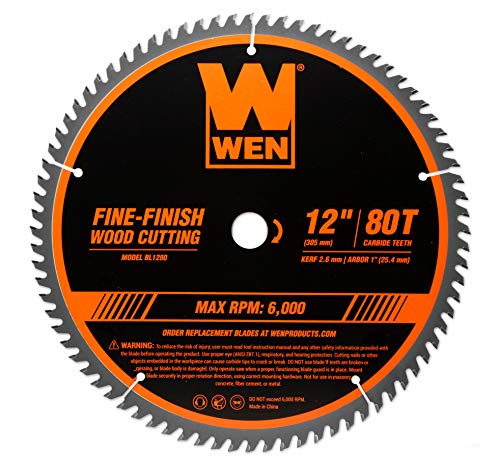
The WEN BL1280 delivers a 12-inch diameter with a 1-inch arbor and a maximum speed handling of up to 6000 RPM. Its 80 teeth and ultra-thin 1/10-inch kerf (2.6 mm) produce clean, accurate cross-cuts in hardwoods and softwoods alike. The blade is designed for fine finishes, helping to minimize splintering on fragile or hardwood veneer surfaces. The larger diameter gives a longer cut length per pass, making it well-suited for wider boards or crown molding work where precision is essential. This blade pairs well with tables and miter saws that require a premium finish cut.
COMOWARE 10-Inch 80T ATB Miter Saw Blade

The COMOWARE blade uses tungsten carbide teeth for enhanced wear resistance and heat tolerance, supporting extended blade life under hardwood cutting. Its ATB (Alternating Top Bevel) tooth design scores wood fibers first, promoting cleaner cuts with less splintering as the subsequent teeth remove material. With a 5/8-inch arbor, this 10-inch blade offers stable performance on most standard miter saws. The combination of ATB geometry and carbide teeth makes it a strong choice for precise finish work across hardwood boards, plywood, and laminated panels, with reduced chipping at the cut edge.
DEWALT 12-Inch 80T & 32T Miter Blade Set (2-Pack)
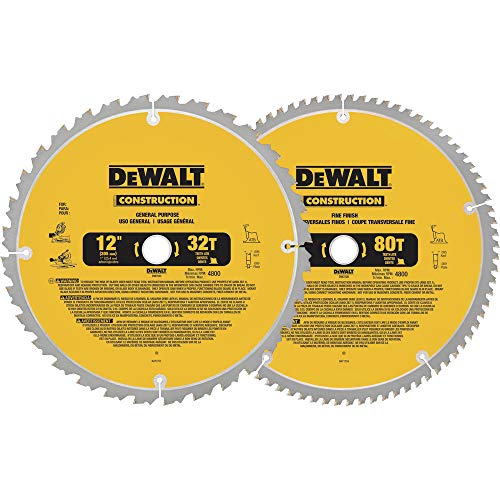
This DEWALT two-pack includes a 12-inch 80-tooth blade and a 12-inch 32-tooth blade, both carbide-tipped for durability and long edge life. The 80T blade excels at fine crosscuts and finishing passes for hardwood, while the 32T blade handles faster, rougher cuts or rips when needed. The dual-pack approach reduces the need for frequent blade changes on wide projects, providing versatility for trim work, panel edges, and cabinetry where both quick material removal and high-quality finishes are required.
DEWALT 12-Inch 100-Tooth Fine Finish Blade

The DEWALT DWA112100 blade runs at 12 inches in diameter with 100 teeth, delivering a superfine finish ideal for hardwoods and fine cabinetry. Its design emphasizes reduced vibration and higher precision thanks to a patented body slot and optimized tooth geometry. This blade is built for clean, smooth surfaces on finished trim, panel edges, and fine joinery, helping to minimize post-cut sanding. The 100-tooth count is a common choice when the goal is to maximize edge quality in hardwood assemblies and premium furniture components.
Buying Guide
Key purchase considerations
- Blade diameter and compatibility: Most 10″ and 12″ blades fit standard miter and table saws. Confirm your saw’s arbor size (commonly 5/8″ or 1″).
- Tooth count and geometry: For hardwood, 80T–100T is typical for fine finishes. ATB teeth slice fibers first for cleaner edges, while smoother finishes benefit from higher tooth counts.
- Arbor and mounting: Ensure the blade’s arbor matches your saw’s arbor bore, and that the flange openings accommodate the blade width without interference.
- Kerf width: Ultra-thin kerfs reduce waste and heat, enabling smoother cuts, but may require steady feed to prevent deflection on larger boards.
- Coatings and anti-sticking: Some blades include coatings to reduce gumming from resins and pitch, which can improve finish quality and lifespan.
Choosing by project needs
- Finish-oriented work: Choose 80T–100T blades with ATB geometry and a thin kerf for pristine edges on furniture, moldings, and trims.
- Depth and board width: For wider boards or bevel cuts, a 12″ blade can offer longer cuts per pass and more stable results, especially with deeper bevels.
- Budget and replacement cycles: Durable carbide-tipped blades last longer under hardwood use. A two-blade set can provide a balance of rough and fine cuts without frequent changes.
Practical comparisons
- 10″ vs 12″ blades: 10″ blades are common for compact saws and lighter cuts; 12″ blades cover larger boards and can deliver smoother finishes on long runs.
- 80T vs 100T: 80T blades favor faster material removal with fine finishes, while 100T blades emphasize ultra-smooth surfaces but remove material more slowly.
- ATB vs other tooth designs: ATB excels at reducing tear-out on hardwoods; FT or U-shaped designs can offer different balances of speed and finish.
What to consider for your setup
- Compatibility with miter vs. table saws: Some blades are optimized for crosscuts; confirm whether the blade is designed for crosscutting or general purpose cutting at high precision.
- vibrations and noise: Blades with anti-vibration features or optimized body slots reduce chatter and noise, improving cut quality on hardwoods.
- Maintenance: Keep blades clean and free of pitch buildup. A light wipe-down after use preserves edge life and prevents pitch from gumming the teeth.
These blades collectively cover common hardwood applications, from cabinetry and trim to fine furniture components. When selecting, balance tooth count, kerf, and arbor compatibility with your saw and project requirements. For finishing-focused work, prioritize blades with ATB teeth and higher tooth counts, paired with a compatible 12-inch diameter for broader cuts, and ensure you have a blade that minimizes tear-out while delivering consistently flat, smooth edges.