Best Large Inverter Generators for Home Backup and RV Use
Large inverter generators provide clean power for home backup, RV trips, and remote job sites without the noise and fuel waste of older open-frame units. Key considerations include peak wattage versus running watts, fuel type, run time, and safety features such as CO sensors and transfer-switch compatibility. The five models below stand out for high output, dual-fuel flexibility, and solid electronics protection, making them reliable options for Americans who need dependable portable power in emergencies, on the road, or at the campsite.
| Product | Brand | Fuel | Running / Peak (Gas) | Notes |
|---|---|---|---|---|
| Westinghouse iGen11000TFc Tri-Fuel Inverter | Westinghouse | Gas/Propane/Natural Gas | 9,000W / 11,000W | Whole-home backup; 50A outlet |
| AIVOLT 8000W Dual Fuel Inverter | AIVOLT | Gas/Propane | 6,100W / 8,000W | Eco-Mode; 62 dBA at 23 ft; 129 lbs |
| WEN DF680iX Dual-Fuel Inverter | WEN | Gas/Propane | 5,100W / 6,800W | Bonded-neutral 240V; CO Watchdog |
| WEN 56477i 4800-Watt Inverter | WEN | Gas/Propane | 4,000W / 4,800W | Clean power; up to 7 hours run time |
| Westinghouse 5000 Peak Watt Dual Fuel | Westinghouse | Gas/Propane | 3,900W / 5,000W | Remote start; CO shutdown |
Westinghouse iGen11000TFc Tri-Fuel Inverter

The Westinghouse iGen11000TFc is a tri-fuel inverter capable of switching among gasoline, propane, and natural gas. Gasoline mode delivers 9,000 running watts and 11,000 peak watts, while propane provides 6,100 running and 10,000 peak, and natural gas provides 7,200 running and 8,800 peak. This flexibility helps during outages or when fuel availability shifts, making it suitable for home backup and large RV setups. Inverter technology ensures clean, stable power for sensitive electronics, supporting reliable operation of appliances and devices during emergencies or outdoor work.
With a 50A outlet and a design focused on portability and resilience, this model is built for extended use in critical situations. It balances high output with a compact footprint relative to its power class, making it a strong option for households seeking substantial backup capacity without sacrificing efficiency or quiet operation.
AIVOLT 8000W Dual Fuel Inverter

The AIVOLT inverter delivers 8,000 watts of surge and 6,100 watts running power, with dual-fuel flexibility to run on gasoline or propane. Eco-Mode helps stretch fuel economy, and the unit operates at about 62 dBA at 23 feet, keeping it friendlier to campers and neighbors. At roughly 129 pounds, it strikes a balance between portability and substantial power, making it a practical choice for RVs, job sites, and emergency backup scenarios.
Its output is designed for electronics safety, featuring a clean sine-wave with low distortion. The model is positioned for home and campsite use, providing reliable heat, cooling, and appliance support while maintaining relatively quiet operation compared with non-inverter counterparts. The dual-fuel capability adds versatility when fuel sources vary.
WEN DF680iX Dual-Fuel Inverter

The WEN DF680iX delivers 6,800 watts surge and 5,100 running watts on gasoline, plus 6,000 surge and 4,500 running on propane. A bonded-neutral 240V configuration supports low-power Level 2 charging for battery and hybrid vehicles, expanding its usefulness beyond basic camping. A CO Watchdog adds an essential safety measure by automatically shutting down the unit if dangerous carbon monoxide is detected, making it suitable for sheltered camping, work sites, and home backup where safety matters.
Powered by a compact 224cc engine, the DF680iX remains relatively portable while still delivering strong output. Its dual-fuel design gives flexibility for longer outages or remote locations, and the CO safety feature provides additional protection for occupants and equipment in smaller spaces or tents.
WEN 56477i 4800-Watt Inverter

The WEN 56477i delivers 4,800 surge watts and 4,000 running watts from a 224cc engine. It produces clean power suitable for sensitive electronics like smartphones, tablets, and laptops, preventing damage from irregular power. The unit also features an efficient 1.9-gallon tank, providing up to seven hours of runtime at half load, reducing refueling interruptions during weekend projects or camping trips.
Designed for portable power without sacrificing performance, this model suits mid-size home backup, RV use, and outdoor activities where quiet operation and dependable electricity are essential. Its compact frame helps with transportation, storage, and quick setup on-site.
Westinghouse 5000 Peak Watt Dual Fuel Inverter
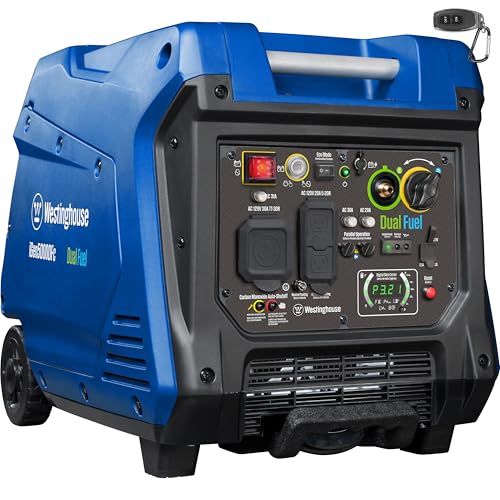
The Westinghouse 5000 Peak Watt Dual Fuel inverter runs on gasoline or propane with 3,900 running watts and 5,000 peak watts. It includes remote start via key fob and both electric and recoil start options, along with a 5–20R 120V duplex outlet and an RV-ready TT-30R 30A outlet. A CO shutdown feature and a floating ground contribute to safety during outages or camping trips, while a digital display shows fuel level, power output, runtime, voltage, and lifetime hours for easy monitoring.
With parallel capability and a durable design, this model supports essential loads for RVs and home use during outages while maintaining quiet operation. It represents a balanced choice for those seeking solid power in a portable form factor, especially when supplemental power is needed alongside other generators.
Buying Guide
- Wattage needs: Calculate running watts for essential loads and peak watts for startup surges. For whole-home backup or high-load RV setups, target models in the 8,000–11,000 watt range on gasoline, with dual-fuel flexibility if available for fuel security during outages.
- Fuel type and runtime: Dual-fuel units offer flexibility, while tri-fuel options provide maximum fuel versatility. Consider fuel availability, storage, and long-run times at your typical load level to maximize efficiency.
- Noise and portability: Inverter generators are quieter than open-frame models. Check the noise rating (dBA at a specified distance) and weigh the unit’s weight and wheels against how you’ll transport and store it.
- Safety features: Look for CO alarms or sensors, automatic low-oil shutdown, and safe grounding options. Transfer-switch readiness or interlock compatibility helps simplify home backup integration without manual rewiring.
- Outlets and compatibility: Ensure the unit supplies the right outlets (120V, 240V, 30A/50A). If you plan to parallel units, verify parallel capability with the selected model family and any required cables or kits.
- Long-term considerations: Warranty length, service availability, and spare-parts supply influence total cost of ownership. Eco-Mode or fuel-saving features can reduce ongoing costs and fuel consumption over time.
- Use-case perspectives: Homeowners may prioritize higher wattage, safety features, and transfer-switch readiness. Campers and RV users often value quiet operation and RV outlets. Contractors may prioritize run time, portability, and robust build for job sites.