Best Jigsaw Blades for Plywood: Clean, Quick Wood Cuts
When cutting plywood, the right jigsaw blade can mean the difference between rough edges and smooth, precise curves. This guide spotlights five blades that balance performance and value for American workshops, from fine-finishing cuts to fast-cutting options. Each blade features details on tooth configuration, material, and compatibility to help you choose the best match for plywood projects. Use the buying guide at the end to compare factors such as blade length, tooth pitch, and shank type.
| Product | Brand | Blade Type | Best For |
|---|---|---|---|
| MRCGTCE Contractor Jigsaw Blades Set | MRCGTCE | Mixed HCS/HSS | General plywood and wood cuts |
| Bosch Pro-Wood T-Shank Set | Bosch | Wood, laminate blades | Smooth top surfaces, clean edges |
| Diablo Fine Finish Jigsaw Blades | Diablo | High-carbon steel, 4″ length | Fine finish wood cuts |
| Bosch Clean For Wood Blades | Bosch | 20 TPI, curved cuts | Clean curved cuts in plywood |
| GINEPAN T Shank Blades Set | GINEPAN | 20 TPI, curved & scrolling | Plywood, laminates, curved cuts |
MRCGTCE Contractor Jigsaw Blades Set
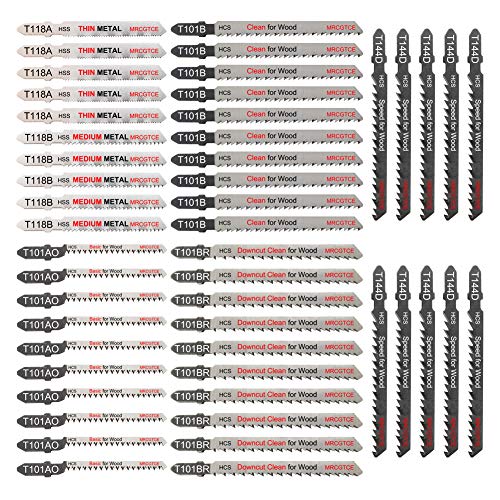
The MRCGTCE 50-piece contractor blade set is designed to cover a broad range of cutting tasks, including plywood. The kit blends HCS-style SK5 high-carbon steel blades with high-speed steel variants for longer blade life and steadier performance. The assortment includes five T118A blades (3″, 21 TPI) for thin metal, five T118B blades (3″, 12 TPI) for medium-metal work, and ten each of T101AO (3″, 21 TPI) for scrollwork in wood, T101B (4″, 10 TPI) for clean wood cuts, T101BR (4″, 10 TPI) for downcut wood cuts, and T144D (4″, 6 TPI) for fast wood cutting. The greater variety supports plywood projects that mix faces, edges, and curved lines. A storage case helps keep blades organized between jobs.
In practice, these blades excel when you need reliable performance across different materials without swapping sets. The SK5 steels provide wear resistance, while the HSS blades deliver efficiency on tougher cuts. The inclusion of downcut and scroll blades helps reduce splintering on plywood surfaces, an important consideration for clean edges on both visible faces and interior cuts. Lubrication is recommended when cutting metal, but for plywood and soft woods the blades typically run smoothly with standard cutting speeds. Overall, this is a value-packed starter kit for plywood work and general-purpose cutting.
Compatibility note: this set uses common T-shank blades, ensuring broad compatibility with many popular jigsaws. While not every blade will be ideal for every plywood task, the diverse mix minimizes the need for frequent blade changes during a project.
Bosch Pro-Wood T-Shank Jigsaw Blade Set

The Bosch TPW005 Pro-Wood set focuses on wood and laminate tasks, delivering clean finishes with its specially engineered blades. The set includes blades designed for laminate surfaces, along with a reverse-pitch or reverse-tooth design that minimizes splintering on top surfaces. This feature makes it particularly well-suited for plywood surfaces with decorative faces or laminates where edge quality matters. The T-shank design ensures secure seating in a wide range of jigsaws and minimizes vibration during cuts. For plywood projects that prioritize edge quality on curved or straight lines, this Bosch kit provides dependable performance and a reputation for consistent results.
What stands out is the attention to laminate-capable blades, which helps when working with plywood that uses veneer layers or decorative surfaces. The reverse-tooth aspect reduces tear-out on delicate edges, a common challenge when finishing plywood edges. If your work involves frequent transitions between plywood sheets and other wood materials, this set offers blades tuned to maintain clean tops and smooth curves. As with most blade sets, match the blade to the cut type and material for optimum results, and confirm your jigsaw’s compatibility with T-shank blades before use.
Overall, Bosch’s Pro-Wood set delivers reliable, consistent performance for common plywood tasks, especially where edge quality and surface finish matter. It’s a practical choice for DIYers and professionals who want dependable results without sifting through a large assortment of blades.
Diablo Fine Finish Jigsaw Blades

Diablo’s DJT101B5 set provides fine-finish, high-carbon steel blades in a compact 5-pack designed to deliver clean bottom finishes and intricate curved cuts. The 4″ length and 10 TPI tooth design are optimized for softwood and plywood, reducing splintering and producing smoother edges with less post-cut sanding. The high-carbon steel edge contributes to faster cutting with less resistance and increased blade life, which is useful when tackling repeated plywood curves or tight interior cuts. The package emphasizes a blade geometry that supports precise, controlled cuts, making it a solid choice for projects that require refined edges on plywood panels.
One practical note is that these blades are well-suited for soft woods and plywood, but users cutting harder hardwoods may want to pair them with a blade rated for denser materials. Overall, they deliver predictable performance for fine finish work on plywood, with the kind of bottom-edge quality that reduces post-cut cleanup and sanding. They’re also compatible with most standard T-shank jigsaws, making them a convenient option for many workshop setups.
Bosch T101AO 5-Piece Clean For Wood Blades

The Bosch T101AO five-piece set is engineered for clean, curved cuts in wood, plywood, laminates, and similar substrates. Featuring a 20 TPI pointed-tooth profile and a narrow blade body, these blades are optimized for precision and controlled turning. The pointed teeth help reduce splintering on both sides of the workpiece, which is particularly beneficial when finishing plywood panels that will be visible. The blades are designed for double-sided laminates and PVC-type substrates as well, offering versatility for mixed-material projects.
In practice, these blades excel on curved scroll cuts and gentle curves in plywood, where tight radii and a smooth bottom edge are desired. If your work involves intricate patterns or decorative edges, this Bosch option provides a dependable balance of speed and finish quality. Remember to check your jigsaw’s shank compatibility with T-shank accessories to ensure a snug fit and reduced vibration during cuts.
GINEPAN T Shank Blades Set

GINEPAN’s Jigsaw Blades T Shank set emphasizes durability and compatibility, using high-carbon steel through processes like quenching and grinding to bolster blade life. The T101AO blades in this set are designed for curved and scrolling cuts in plywood, laminates, and various wood substrates, with 20 TPI providing a balance of speed and precision. The brand highlights compatibility with most current jigsaws—Bosch, DeWalt, Black & Decker, Makita, and others—making these blades a versatile choice for a shop with multiple tools.
For plywood work, the pointed teeth and curved-cut design help minimize splintering on both sides of the workpiece, especially during intricate patterns or beveled edges. The set’s case or packaging keeps the assortment organized for quick blade changes on busy projects. While the blades are marketed for broad compatibility, always confirm your specific jigsaw model’s compatibility and test cuts on scrap plywood to dial in speed and feed before committing to a delicate panel.
Buying Guide
Material and tooth design
Blade material drives wear resistance and lifespan. High-carbon steel blades (HCS) offer fast cutting and cost efficiency for soft woods and plywood, while high-speed steel (HSS) blades resist heat buildup on metal and denser woods. For plywood, look for finer tooth counts (around 20 TPI) for smooth edges on wood and laminates, and consider medium-to-fine blades for curved patterns. Mixed sets provide versatility, but selecting a dedicated wood or plywood blade improves edge quality on specific projects.
Blade length and tooth pitch
Longer blades (3″ to 4″) are common for standard plywood thicknesses and accommodate deeper curves with less blade flex. For tight curves and delicate edges, shorter blades offer more control, though they may require more blade changes. A higher tooth-per-inch (TPI) count generally yields cleaner cuts with less splintering, especially on plywood faces. Coupled with appropriate cutting speed, the right balance of length and TPI reduces sanding time post-cut.
Shank design and compatibility
T-shank blades are the most common and offer a secure fit in many modern jigsaws, reducing blade wobble during aggressive cuts. Ensure the blade’s shank type matches your tool (T-shank versus U-shank or other variants). If your project uses a mix of tools, choosing blades labeled as widely compatible can save time during blade changes. Always verify blade length, shank size, and arbor compatibility with your jigsaw model before purchasing.
Edge quality and finish
For visible plywood faces, edge quality matters. Blades designed for clean top surfaces (often with reverse-tooth designs) reduce tear-out and splintering. Fine-to-medium tooth counts with a narrow blade body help maximize control on curves and scrolling patterns. When possible, test on scrap plywood to observe edge quality, then adjust cutting speed and feed rate to minimize chip-out.
Cost, value, and maintenance
Budget-friendly blade sets offer broad coverage for common plywood tasks, but premium blades can provide longer life and sharper edges for extended jobs. Lubrication is not typically required for plywood cuts, but it’s advisable when cutting metal or tougher materials. Store blades in a case or organizer to minimize dulling and keep blades dry to prevent corrosion. Replacing blades as they dull preserves cut quality and reduces sanding workload.