Best Jigsaw Blades for Cutting Curves: Clean, Precise Curves for Wood and Plastic
Curved cuts demand specialized jigsaw blades that balance speed, precision, and edge quality. The right blade makes the difference when radii matter, delivering smooth edges with minimal chipping. This guide presents five top options optimized for curve cutting, from premium Festool to budget-friendly contractor sets. The quick summary table below helps you compare core strengths at a glance, followed by in-depth notes with practical guidance for selecting the best blade for your project.
| Product | Brand | Best For |
|---|---|---|
| Festool 204267 Jigsaw Blade S 75/1,4 K/5 for Curve Cuts in Wood 5-Pack | Festool | Clean curve cuts in wood |
| 50 Piece Contractor Jigsaw Blades Set | MRCGTCE | Versatile wood/plastic/metal with curve blades |
| Spyder 300004 4-Inch Jigsaw Blade Double Sided | Spyder | Extreme radii, multi-surface cuts |
| LENOX TOOLS 1991404 U-Shank Scroll Blade | Lenox | Tight curves and scroll work |
| Bosch T244D3 4″ Curve-Cutting Blades (5 Piece) | BOSCH | Curved and fast wood cuts |
Festool Curve-Cutting Blade

Festool’s blade is built for precise curve work with conically ground teeth that promote clean, controlled radii. The 5-pack format is ideal for repeat curve work across different projects, maintaining sharpness and consistency. The blades come from a German manufacturing standard, emphasizing wear tolerance and long blade life, which helps when cutting through softwood, hardwood, or composites where clean curves matter most.
- Conically ground teeth for clean curve cuts
- Made in Germany for quality manufacturing
- Designed for smooth curved cutting in wood
50-Piece Jigsaw Blades Set
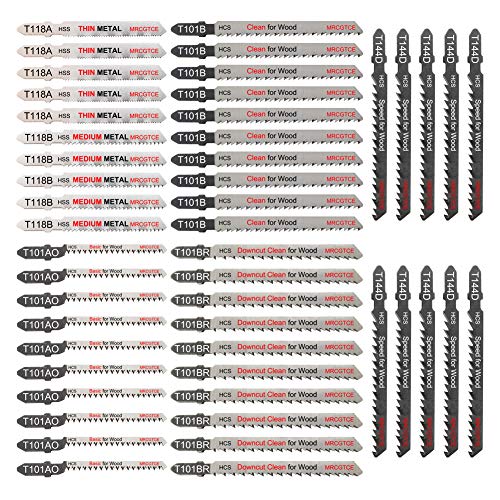
This large contractor set provides a broad range of tooth configurations and blade lengths to cover curves, scrolls, and general cuts. It includes T118A and T118B for metal, plus T101AO, T101B, and T101BR for wood, along with T144D for faster wood cuts. Crafted from high-carbon steel (SK5) and high-speed steel variants, the collection emphasizes durability and wear resistance. It’s a practical choice for shop-wide curve work and mixed-material projects.
- Multiple blade geometries for wood, plastic, and metal
- HCS SK5 steel for durability and wear resistance
- Includes scroll and curve-focused blades for versatile use
Spyder Double-Sided Jigsaw Blade

Spyder’s double-sided design enhances versatility for curved and radius cuts across multiple materials. The blade excels in laminates, fiberboard, plastics, Corian, fiberglass, Formica, and softwoods, enabling tight radii and smoother edges on complex curves. The dual-sided construction helps extend blade life by distributing wear more evenly while maintaining accuracy on challenging curves.
- Double-sided blade for multi-surface flexibility
- Effective on laminates, plastic, composites, and softwoods
- Optimized for extreme radii and clean curves
Lenox U-Shank Scroll Blade

Lenox’s U-shank scroll blade is designed for smooth, burn-free scrolling and is particularly effective for tight curves. Its narrow profile provides extra clearance to navigate tight radii, while precision-ground teeth and optimized tooth angles cut efficiently and reduce heat buildup. This blade is well-suited for flooring patterns and decorative cutouts where controlled curves are essential.
- Narrow profile for tight curves
- 20 TPI teeth with precision grounding
- Reduces burning during scroll cuts
Bosch Curve-Cutting Jig Saw Blades
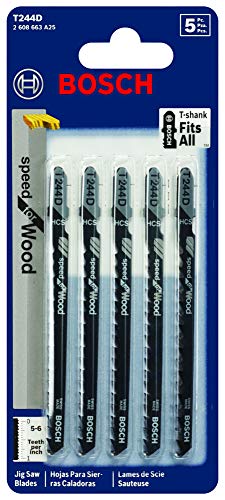
BOSCH T244D3 blades are designed for curved and fast cuts in both hard and soft woods, OSB, and plywood up to 2-3/8 inches thick. The 6 TPI tooth profile paired with a high-carbon steel blade body delivers aggressive cutting performance with extended life. With a 4-inch overall length and 3-inch usable portion, these blades provide a reliable balance of rigidity and maneuverability for curved work.
- Designed for curved and fast wood cuts
- 6 TPI tooth profile; high-carbon steel body
- 4″ length with 3″ usable length for controlled curves
Buying Guide
Key factors to consider when choosing jigsaw blades for curves include blade material, tooth count, shank compatibility, and intended material. Here are practical guidelines to help compare options and pick the right blade for your project:
- Blade material and durability: High-carbon steel (HCS) blades are common and provide strong performance for wood and plastics. For metal and tougher composites, consider blades advertised as high-speed steel (HSS) or composites with robust construction. SK5 is a steel grade often noted for durability in wood-cutting blades.
- Tooth count and geometry: Lower TPI blades (6-12 TPI) cut faster and are better for rough curves in softwood, while higher TPI blades (18-32 TPI) produce finer finishes and smoother edges in hardwoods and plastics. For curves, a blade with a geometry optimized for scrolling and radii is essential.
- Shank type: T-shank blades fit most modern jigsaws with quick-change chucks and provide secure seating. U-shank blades are compatible with older tools or specific models. When purchasing a set, ensure it covers the shank type on your jigsaw.
- Curve capability and radii: Some blades are explicitly designed for tight curves and radiuses, while others excel at smoother, broader curves. Read product descriptions for curve capabilities and radius notes to align with your project’s requirements.
- Material compatibility: For wood, you’ll typically use HCS blades. For plastics, choose blades with wear-resistant teeth. For metal, ensure the blade is rated for metal cutting and consider lubrication to reduce heat buildup.
- Set versus single blades: Sets offer broad coverage for varied tasks and are cost-effective for shop use. If you only need a few specific curves, a few high-quality blades may be sufficient.
- Brand and lifecycle: Premium brands (such as Festool, Lenox, Bosch) tend to deliver longer life and consistent results but at higher upfront cost. Budget sets with a range of blade types can offer excellent value for mixed-material projects.
- Usage tips: When cutting metal or hard materials, apply light lubrication and steady feed to minimize heat and edge chipping. For intricate curves, clamp the workpiece securely and consider making relief cuts to help the blade navigate tight radii safely.