Best Jig for Circular Saw: Top Edge-Guide Tools for Accurate Cuts
Finding the right jig or track system for your circular saw can improve precision, reduce splintering, and speed up repetitive tasks. Below is a curated guide to five standout options that adapt common circular saws into edge-guided cutting tools. Each entry highlights compatibility, key features, and what makes it suitable for different woodworking setups.
| Product | Best For | What It Does |
|---|---|---|
| Kreg KMA2685 Rip-Cut Circular Saw Guide | Regular side-blade saws | Precision edge-guided cuts with universal sled |
| Kreg KMA2700 Accu-Cut | Versatile straight, cross, and angled cuts | Portable saw track for straight-edge routing |
| POWERTEC 36 Inch Circular Saw Guide | Long straight cuts | Space-saving straight edge with adjustable clamps |
| Bora QuickCut Circular Saw Guide | All-in-one guide with rail | Four preset angles and imperial/metric scale |
| POWERTEC Circular Saw Guide Rail System (72093) | Left or right-handed saws | Precision rip cuts with universal sled and scale |
Kreg KMA2685 Rip-Cut Circular Saw Guide

The Kreg KMA2685 Rip-Cut turns a standard circular saw into a precision edge-guided tool, best used with a regular (side-blade) circular saw. It features a universal sled that holds the guide rail and edge guide for portability and consistent alignment. It’s not ideal for saws with plastic upper blade guards, which may interfere with clamping or alignment, and it is not compatible with worm drive saws due to base or motor housing considerations. This jig supports both left- and right-bladed saws, offering flexibility for both-handed users and a range of project setups, from cabinet making to shelving.
Kreg KMA2700 Accu-Cut – Circular Saw Track
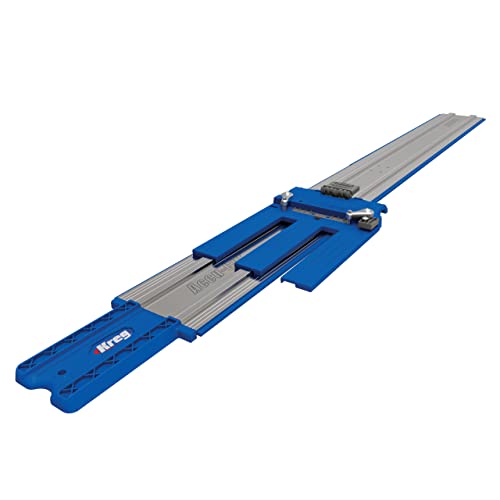
The Kreg Accu-Cut provides a robust track system to make straight, cross, rip, and angled cuts with a circular saw. Its universal sled makes most right- or left-handed circular saws compatible, and the track design is easily portable for on-site or workshop use. The system emphasizes splinter-free cuts and repeatability, making it well-suited for cabinetry, trim work, and furniture projects where consistent results are essential.
POWERTEC 36 Inch Circular Saw Guide/Straight Edge

The POWERTEC 36 Inch Straight Edge Guide is a space-saving solution that enables straight cuts on workpieces up to 36 inches long. It features adjustable clamps with low-profile jaws for unobstructed work areas and a straightforward locking lever. This guide is a practical option for beginners and pros alike, offering reliable alignment without the complexity of more elaborate track systems.
Bora 530416 Quickcut Circular Saw Guide

The Bora QuickCut combines a guide rail and angle assist in one tool, offering four preset angles (22.5°, 45°, 60°, 90°) for quick framing and crown molding work. It also includes an imperial and metric ruler for precise measurement. A large curved handle provides a secure grip to prevent edge guide slippage during cuts, delivering dependable performance for framing, shelving, and trim tasks where consistent angle accuracy matters.
POWERTEC Circular Saw Guide Rail System (72093)

The POWERTEC rail system turns most circular saws into an edge-guided cutting tool with a universal sled design and adjustable base plate clamps. It supports both left- and right-bladed saws and includes an imperial scale for precise, repeatable rip cuts from 1 inch to 22 inches wide. The elongated slot and secure indexing stop help align the blade to the cut edge, ensuring consistent performance across repeated tasks.
Buying Guide: Key Purchase Considerations
When selecting a jig or guide system for your circular saw, consider these factors to match your workflow and materials:
- Compatibility: Verify blade type (left- or right-blade), motor housing, and guard design to ensure the guide clamps securely and sits flat on the base.
- Guide Type: Decide between a standalone straight-edge guide, a full-fledged saw track, or an all-in-one rail system. Track-style guides often provide greater repeatability for long runs, while straight-edge guides offer simplicity for basic tasks.
- Adjustability: Look for adjustable rails, clamps, and stops that allow you to set precise offsets and enable exact repeat cuts with minimal setup time.
- Length and Reach: Longer guides enable cutting longer panels without repositioning. Consider available extensions if working on sheets or cabinetry.
- Angle Capability: If you frequently cut miters or bevels, choose a system with preset angles or easy-angle adjustment. Some options include angle assists and metric/imperial rulers for precise measurement.
- Portability: For on-site work, prioritize lightweight, easily assembled guides with a compact footprint and carry handles.
- Durability and Material: Aluminum guides offer rigidity and longer life under heavy use. Screws, clamps, and anti-slip surfaces affect stability during operation.
- Budget and Skill Level: Beginner setups tend to favor simpler straight-edge guides, while professionals may prefer modular rail systems with fine adjustability and repeatability.
How To Choose For Your Projects
For cabinetry and shelving, prioritize precision and repeatability over rugged versatility. If you frequently work with sheets of plywood or large panels, a longer track or rail system reduces the need for repeated repositioning and helps maintain a straight cut across wide boards. For quick framing or trim work, a compact jig with simple setup and reliable edge guidance may be more efficient. Always test with scrap material to verify alignment before committing to final cuts.
Installation and Safety Tips
- Secure the guide firmly to the workpiece or rail to prevent shift during the cut.
- Verify blade depth and guard clearance when using guides with various saw models.
- Wear appropriate eye and hearing protection; keep hands clear of the cutting path.
- Use clamps or a fixed stop to maintain consistent cut length across multiple pieces.