Best Hobby Air Compressor With Tank for Home Projects
Finding the right hobby air compressor with a tank means balancing portability, quiet operation, and steady airflow for crafts, painting, and DIY projects. The models below are compact enough for home studios yet durable enough for longer sessions, with tanks that help maintain consistent pressure. Each option supports common hobby tasks from model painting to cake decorating, nails art, and light automotive work.
| Product | Brand | Tank Size | Noise Level | Best For |
|---|---|---|---|---|
| Timbertech AS186 / ABPST08 Series | TIMBERTECH | 3L | ~47 dB | Hobby painting, makeup, tattoos |
| Master Airbrush TC-326T | Master Airbrush | 3 L | ~47 dB | Professional airbrushing, art |
| Nessxa 10 Gallon Ultra Quiet | Nessxa | 10 gal | ~70 dB | General workshop, tire inflation, spray painting |
| Airgoo AG-426 | Airgoo | Tank not specified | ~47 dB | Hobby painting, nails, crafts |
| Metabo HPT THE TANK EC914S | Metabo HPT | 6 gal | Low to moderate | Framing, finish work, general construction |
Timbertech Upgraded Airbrush Single-Piston ABPST08
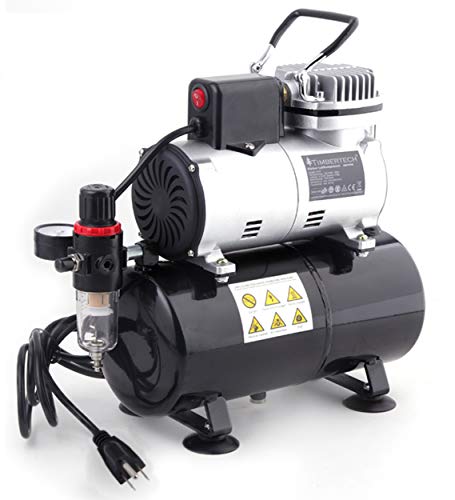
The Timbertech ABPST08 is a compact, oil-free piston compressor designed for hobby painting, body art, and light automotive graphics. It features a built-in cooling fan to reduce temperature and extend lifespan, a 3-liter receiver tank for steady output, and a maintenance-free design. A carry handle enhances portability, making it suitable for small studios or on-the-go projects. This unit delivers a quiet operation level around 47 dB, with a pulse-free output ideal for consistent spray results.
Timbertech Airbrush AS186 Mini Compressor

The AS186 is a high-performance oil-free mini compressor with a 3-liter tank, regulator, and moisture trap. It’s designed for hobbyists using airbrush tools, with an autostart at 3 Bar and autostop at 4 Bar, ensuring a stable air supply from 0.2 to 0.8 mm nozzles. Its compact form, built-in carry handle, and quiet operation around 47 dB make it a reliable choice for cake decorating, makeup, and light automotive graphics.
Master Airbrush TC-326T 1/5 HP Cool Runner II

This professional single-piston compressor features two cooling fans and a large 3-liter storage tank for continuous spraying. It delivers 0.8 CFM at 25 L/min with precise true diaphragm regulation and a water trap filter for clean, dry air. It comes with an airbrush hose and two-holder setup, making it a strong option for serious hobbyists who paint models, nails, or makeup with steady airflow and extended run times.
Nessxa 10 Gallon Ultra Quiet Air Compressor

The Nessxa 10-gallon unit centers on portability and quiet operation. It delivers 8.76 CFM at 115 PSI from a 2 HP motor, with a dual-cylinder setup and oil-free design. The sound level is around 70 dB, making it suitable for hobby workshops, tire inflation, spray painting, and small DIY projects. Its wheels and handle simplify transport between spaces, enhancing usability for home garages and studios.
VEVOR 13-Gallon Tank Air Compressor

The VEVOR 13-gallon unit combines a robust 2 HP motor with an oil-free tank to deliver up to 125 PSI. It is designed for longer operation times with low maintenance and a noise profile around 66 dB. Its large tank allows higher-volume tasks such as spray painting or tire-related work at home, with mobility features like wheels for easier transport indoors and outdoors.
GOYOJO PCP Air Compressor

The GOYOJO 4500 PSI PCP air compressor is a versatile, beginner-friendly option for PCP airguns, paintball gear, and other high-pressure needs. It features an integrated transformer design for simplified power delivery, safe operation, and an automatic stop function at a chosen PSI. The compact build supports easy transport and storage, with dual-power options (12V DC car and 120V AC home use).
Buying Guide: Key Purchase Considerations
- Tank size and duty cycle: Larger tanks stabilize pressure for longer spray sessions, but add weight. For hobby painting and crafts, a 3 to 6-gallon tank is often a sweet spot.
- Noise level: Look for units rated around 47 dB for quiet operation in home studios, and consider models with dual cooling to extend run times without overheating.
- Oil-free vs oil-lubed: Oil-free compressors reduce maintenance and are cleaner for painting and cosmetics, though some professionals prefer oil-lubed for heavy continuous use.
- Portability: Built-in handles, wheels, and compact dimensions matter if you move the unit between spaces or mount it in a small studio.
- Air delivery and pressure: Check CFM and PSI ranges to ensure compatibility with your tools—airbrushes, paint sprayers, or nail guns require specific flow and pressure ranges.
- Moisture and filtration: Moisture traps and gauges help maintain air quality and consistent spray results, especially in humid environments.
- Power options: Some units support 120V AC, while others offer DC or dual-power setups—knowing your workspace power availability helps prevent compatibility issues.
- Warranty and durability: Look for models with robust build quality, service access, and a reliable warranty to protect your investment in a hobby workflow.
Usage Scenarios and Comparisons
For small art projects and makeup work, a compact 3-liter tank with low noise is typically sufficient, offering good portability and quick recovery between bursts. If your hobby includes longer paint sessions or larger crafts, a larger tank (6 to 13 gallons) provides steadier pressure but may reduce mobility. Oil-free compressors are favored for clean, cosmetic-grade spraying, while dual-fan cooling designs help prevent overheating during extended sessions. Weigh the balance of noise, weight, power needs, and tool compatibility when choosing the best model for your workspace.
Maintenance and Safety Tips
Regularly drain the tank to prevent moisture buildup, inspect hoses and fittings for wear, and replace any damaged parts promptly. Use appropriate airbrush or spray tools within the specified nozzle sizes to avoid overloading the compressor. Keep the work area well-ventilated and follow manufacturer guidelines for startup and shutdown procedures to maximize the unit’s lifespan.