Best Heat Resistant Window Film for Cooler, More Comfortable Homes
Living spaces in hot climates often struggle with heat, glare, and fading interiors. The right heat resistant window film can reduce solar load, improve comfort, and protect furnishings without darkening rooms or sacrificing daylight. This guide highlights five top window films that balance temperature control, UV protection, and privacy for American homes. Each option offers a different blend of heat rejection, glare reduction, and style, so you can choose based on your needs—from bright living rooms to private bathrooms. Compare key specs in the summary table to start your selection.
| Product | Brand | UV Blocking | Heat / IR Rejection | Privacy | Size |
|---|---|---|---|---|---|
| Gila 3-in-1 Heat Control Window Film | Gila | 99% | 59% solar energy rejected; glare reduced 72% | Low to moderate daytime privacy | 3 ft x 15 ft |
| Coavas One Way Privacy Window Film | Coavas | 95% | 85% IR reflection; HVAC savings up to 30% | Daytime privacy; see-out, not-in | 17.7 in x 78.7 in |
| Savvy Choice Anti-Glare Window Film | Savvy Choice | 93% | 85% IR blocked | Daytime privacy; requires curtains at night | 17.5 in x 78.7 in |
| KESPEN One Way Daytime Privacy Film | KESPEN WINDOW FILMS | 90% | 82% IR blocked | Daytime privacy; mirror effect by day | 17.5 in x 6.5 ft |
| Winemana Window Insulation Roll | winemana | Not UV-specific; blocks solar radiation | Up to 90% solar radiation blocked | Not a privacy film; clarity depends on application | 48 in x 10 ft |
Gila 3-in-1 Heat Control Window Film

The Gila 3-in-1 Heat Control Window Film is designed for amateur installation on standard residential windows. It rejects up to 59% of total solar energy and cuts glare by as much as 72%, helping interiors stay cooler and more comfortable during sunny days. With UV blocking up to 99%, it protects furnishings from fading and reduces skin exposure to ultraviolet rays. The film is noted for its applicability on curved surfaces, expanding options for uniquely shaped panes often found in modern homes.
Installation considerations include an adhesive backing that forms a seal against the glass, which can be ideal for long-term performance. It can be trimmed to fit irregular window shapes, and buyers report that its 3 ft by 15 ft roll covers multiple standard windows. Homeowners may notice a modest tint that preserves daylight while enhancing comfort. For rooms with strong sun exposure or skylights, this film provides a balanced blend of glare control, UV protection, and energy efficiency without overly darkening interiors.
Coavas One Way Privacy Window Film

Coavas One Way Privacy Film combines heat blocking with daytime privacy. It reflects about 85% of IR rays, helping stabilize indoor temperatures and reduce HVAC workload by up to 30%. The film blocks roughly 95% of UV rays, protecting interiors from color fading and reducing skin exposure to sunlight. Its 13% visible light transmission (VLT) maintains a degree of external visibility, so rooms remain bright while customers enjoy privacy during the day. It is marketed for homes, bathrooms, and offices, making it a flexible choice for multi-room installations.
Light control is a key feature here: the film provides a mirror-like exterior during the day, which helps obscure interior views from outside while still allowing occupants to see out. As with most one-way films, effectiveness varies with lighting conditions. A potential caveat is that the exterior reflectivity can be less pronounced on very bright days, so pairing with blinds or curtains is common for nighttime privacy and glare management.
Savvy Choice Anti-Glare Window Film
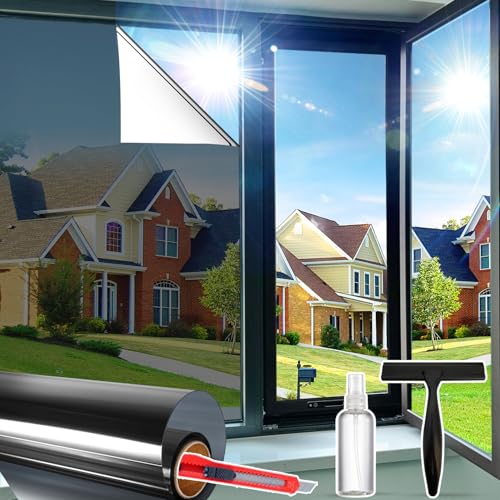
Savvy Choice specializes in reducing heat and glare while maintaining daylight inside. The film blocks about 93% of UV rays and 85% of infrared radiation, contributing to cooler interiors and better protection for furnishings. It supports daytime privacy through its reflective properties, described as a mirror effect when outside lighting is brighter than inside. The product notes that free tools are included, facilitating the installation process for DIY enthusiasts. This option suits living rooms, home offices, and bedrooms where glare reduction and UV protection are priorities.
As with day-to-day privacy films, nighttime use may require curtains or blinds to preserve privacy. The installation is compatible with standard glass surfaces, and the film’s light-blocking balance helps preserve natural daylight while mitigating sun-related drawbacks. For users seeking a cost-effective way to improve comfort without sacrificing visibility, Savvy Choice provides a strong combination of UV protection, heat reduction, and design flexibility.
KESPEN Window Privacy Film One Way Daytime Privacy

KESPEN’s One Way Daytime Privacy film emphasizes UV and infrared light control with a 12% VLT, balancing light entry and privacy. It blocks about 82% of infrared rays and 90% of UV rays, helping reduce heat gain and protect interior surfaces from fading. The daytime privacy feature relies on a mirror-like effect when outside lighting is brighter, but it can become see-through at night, so drawing curtains after sunset is advised if privacy is needed. It is suitable for home offices, living spaces, and bathrooms where privacy and heat control are both important.
This option is marketed as a static cling film, which can simplify removal and reapplication if you’re testing different placements. Surface preparation is key for best performance, with clear glass and a dry, free of dust surface recommended. The film’s blend of heat rejection and UV protection makes it a practical choice for mid- to high-sun exposure rooms.
Winemana Window Insulation Roll

The Winemana Window Insulation Roll is designed for substantial heat shielding with multi-layer reflective aluminum. It blocks up to 90% of solar radiation, helping to maintain cooler interiors in cars, homes, RVs, and even greenhouses. The double-sided reflective foil is tear-resistant and built to endure outdoor exposure, making it a durable option for seasonal use or long-term insulation projects. The product is marketed for a variety of applications, including windows, garage doors, and basements, making it a versatile choice for seasonal temperature management.
Installation is straightforward but flexible: the sheet can be attached with tape, suction cups, clamps, or hooks, accommodating different window sizes and configurations. Because this is insulation rather than a tinted film, it can change the room’s appearance more noticeably than typical window films. Consider this option if you’re prioritizing maximum heat reflection and insulation across multiple panes or areas, such as sun-facing storefronts, patios, or garages.
Buying Guide
- Heat rejection vs. glare reduction: Choose a film that specifically lists IR or total solar energy rejection if you want the strongest cooling effect. UV blocking protects furnishings and skin but doesn’t always correlate with visible light transmission.
- Privacy needs: One-way or two-way films offer daytime privacy but may reveal interiors at night. Plan to pair with curtains or blinds if nighttime privacy is essential.
- Light transmission (VLT): Higher VLT means more visible light; lower VLT increases privacy but darkens rooms. Match VLT to room function and daylight preferences.
- Installation type: Adhesive films tend to be more durable but require careful surface prep; static cling films are easier to reposition but may be less durable in humid climates.
- Surface compatibility: Most films suit standard flat glass; curved surfaces or double-pane windows may demand specialized products or professional application.
- Roll size and coverage: Confirm width and length to ensure you can cover the intended area without seams. For large windows, multiple rolls may be needed.
- Durability and climate suitability: Look for heat resistance claims and weather resistance if applying to exterior or high-UV exposure areas.
- Removability and impact on glazing: Some films are easier to remove without residue, while others may leave marks if removed improperly.
- Maintenance: Clean with non-abrasive cleaners to preserve tint integrity and prevent scratching or fading of the film over time.
- Long-term energy savings: Films that block IR radiation can reduce cooling loads. Consider your climate, insulation levels, and HVAC efficiency when estimating potential savings.