Best Floor Laser Levels for Tile, Flooring, and Room Layout
Selecting the right floor laser level is essential for accurate tile layouts, straight walls, and precise room measurements. This guide highlights five top options that balance reliability, ease of use, and value for American homeowners and professionals. Each entry includes a quick overview of standout features, ideal use cases, and what to consider before purchasing. Whether you’re laying tile, installing a floor, or aligning a ceiling grid, these tools help you achieve professional results with less rework and faster project completion.
Summary Of Selected Products
| Product | Brand | Range (ft) | 360° Coverage | Batteries |
|---|---|---|---|---|
| Huepar FL360G Floor Laser Level | Huepar | 65.6 ft diameter | 360° Horizontal | — |
| PREXISO Square Laser | PREXISO | 30 ft | 90° Square | 2 AA Batteries |
| INSPIRITECH Floor Laser Level | INSPIRITECH | Not specified | 3 x 360° Lines | 2 Li Batteries |
| CIGMAN Self-Leveling Laser Level | CIGMAN | Not specified | Not specified | Battery Included |
| LQHUE 16 Line Laser Level | LQHUE | 100 ft | 4D 4×360° | 2 Rechargeable Batteries |
Huepar FL360G Floor Laser Level For Tile

The Huepar FL360G is designed with an ultra-low laser line positioned just 1/3 inch from the ground, making it ideal for tile work and floor layout. It projects a 360° horizontal green laser line that covers a wide radius, reducing the need to reposition the tool as you tile or align fixtures. Built for indoor use, it carries an IP54 rating for protection against dust and water splashes, ensuring reliability on busy job sites. The combination of a low baseline and full-room coverage supports precise tile layouts, stud placement, window and door alignment, and more.
With its patented 360° design, the FL360G enables continuous leveling without constant tool relocation. The 360° green laser is visible across larger rooms, helping multiple workers tile corners simultaneously. This capability supports faster layout and reduces waiting time on site. While the manual details emphasize indoor use, the tool’s construction focuses on durability and long-term performance for tile installation and floor alignment projects.
PREXISO Square Laser: 30Ft Floor Leveling

The PREXISO Square Laser emphasizes precise 90° tile layout with a built-in square design. It projects a red beam up to 30 feet and includes a square layout guide with two bubble vials for accurate leveling. The magnetic base provides secure attachment to metal surfaces, while the leveling plate supports versatile mounting on walls or other surfaces. This setup is especially useful for tiling and installing floor panels where exact right angles are critical. The device ships with two AA batteries and a layout guide to simplify angle calculations in increments of five degrees.
Two key features—bubble vials for quick reference and a strong magnetic base—help keep lines steady during tile work and flooring projects. The included leveling plate broadens mounting options, enabling precise alignment on walls, floors, or other substrates. While the range is shorter than some full-room lasers, the square layout approach makes it a practical choice for tight spaces or rooms where 90° accuracy is essential.
INSPIRITECH Floor Laser Level Self Leveling
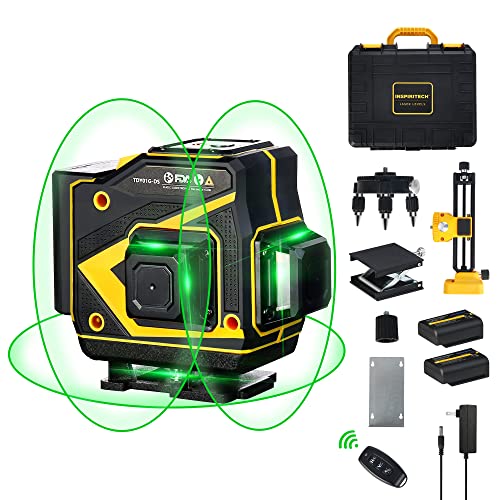
The INSPIRITECH model provides a full 3 x 360° laser layout with green beams for floor, walls, and ceilings. This setup delivers one horizontal line and two vertical lines spaced 90 degrees apart, enabling comprehensive leveling, squaring, and alignment across the entire room. The green beams improve visibility in bright environments, helping workers visualize square layouts quickly. If you need to project a line at any angle rather than level, manual mode can be engaged by turning off self-leveling, offering flexibility for unconventional room shapes or stair layouts.
Mounting flexibility is a core strength, with slotted metal plates and magnetic wall brackets supporting attachment to walls or furniture. A rotary fine-tune base allows precise height and angle adjustments on a telescoping pole or tripod. The device typically supports a two-battery setup for extended use, ensuring you can complete a tile or flooring project without frequent battery changes. This model is well-suited for rooms with multiple tiling walls or ceilings that require consistent line reference across different surfaces.
CIGMAN Self-Leveling Laser Level

The CIGMAN compact laser level is notable for its portability and easy handling. At roughly 0.41 pounds, it suits quick layout tasks for indoor decoration, picture hanging, tiling, and door or window alignment. Self-leveling works within ±4° and provides a green indicator when properly leveled. If the device tilts beyond the threshold, the red indicator flashes and the laser line can be locked for manual mode. This combination makes it a practical choice for small spaces or tasks that demand a quick, hand-held level without bulky equipment.
Manual mode adds versatility for stairs or distinctive layouts where a fixed line is needed at a specific angle. The included battery ensures immediate use out of the box, and the compact size makes it a good companion for contractors who prioritize light equipment for quick measurements and simple tile or trim projects. While it may not match larger machines on range, its portability and straightforward operation provide reliable performance for many DIY scenarios.
LQHUE 16 Line Laser Level

The LQHUE 16 Line Laser Level offers a robust 4D layout with four 360° planes—two horizontal and two vertical—providing comprehensive coverage for tiling, flooring, walls, and ceilings. Its green beam is designed for higher visibility, with brightness adjustable from 1% to 100%. The tool ships with two rechargeable batteries, enabling longer use between charges. An automatic self-leveling feature defaults to a safe level when tilt is within 4°, and a manual mode allows lines to be projected at any angle when needed. This combination supports precise room squaring and flexible layouts for larger projects.
With a maximum working range of up to 100 feet and automatic level detection, this model is ideal for bigger rooms or spaces requiring extensive line references. The inclusion of two batteries ensures ongoing operation, while the adjustable brightness helps tailor visibility to ambient lighting. For professionals and serious DIYers, the LQHUE 16 Line Laser Level delivers reliable performance across tiling, flooring, and grid installations, making it a versatile choice for comprehensive layout tasks.
Buying Guide
Key purchase considerations
- Beam color and visibility: Green beams are typically more visible in bright environments, which is common in American home renovations. Red beams may be adequate for basic tasks but can be harder to see in daylight.
- 360° coverage vs. multi-plane lite: Full 360° horizontal lines provide room-wide references, while 3D or 4D models offer multiple planes (horizontal and vertical) for complete squaring in one setup. Choose based on room size and project type (tiling, flooring, ceilings).
- Self-leveling range and accuracy: Look for automatic leveling within around ±4° or better. Higher accuracy (for example, ±1/10 in at 8 ft) is beneficial for precise tiling and alignment over larger spaces.
- Battery life and power: Li-ion and Type-C charging options offer longer runtimes and easier recharging. If you work on big projects, consider models with two batteries or extended-life options.
- Mounting and portability: Magnetic bases, slotted plates, wall brackets, and compatibility with tripods increase flexibility. Portability matters for quick jobs or on jobsites with uneven floors.
- Durability and indoor/outdoor use: An IP rating (like IP54) helps protect against dust and splashes. Most floor work is indoor, but some models can tolerate light outdoor use if sheltered.
- Ease of use and setup time: Intuitive interfaces, quick setup, and clear indicators reduce learning curves. Manual mode should be easy to engage when needed for angled layouts.
- Included accessories: Batteries, chargers, carrying cases, and mounting adapters add value and convenience, especially for professionals who transport tools between sites.
How to choose for tile, flooring, and room layout
- Tile work: A model with ultra-low lines and 360° horizontal coverage helps you lay tiles consistently across large rooms and multiple corners without constant repositioning.
- Flooring and wall alignment: A 3D or 4D system with multiple planes (horizontal and vertical) makes squaring walls, ceilings, and floors quicker and more accurate.
- Ceiling installation: If you regularly install ceiling tiles or grid patterns, consider a unit with a top 360° line or elevated projection to reach higher areas without repositioning.
- Budget vs. feature set: If you primarily tile small rooms, a compact, budget-friendly model with 2- or 3-line projections may suffice. For larger remodeling projects, investing in a 4D or higher-end model can save time and reduce rework.
Usage tips and best practices
- Calibrate on a flat surface before starting; verify level reference on multiple walls to ensure consistency.
- Use a tripod or mount when possible to maintain stable lines and reduce stray projections during floor tiling or ceiling installs.
- Protect the beam line from ambient reflections by ensuring the workspace is cleared of obstructions that could distort line visibility.
- Recheck alignment after completing critical sections to confirm that subsequent parts of the project line up with the established reference grid.