Best Feeler Gauges for Guitar Setup: Precision Tools for Intonation and Nut Gaps
Guitar setup is a precise task that hinges on accurate measurements. Feeler gauges are essential for assessing string action, truss rod relief, nut slot depth, and overall spacing. This guide highlights top feeler gauge sets tailored for guitarists and luthiers, balancing durability, readability, and value. Each product below is chosen for reliability, ease of use, and compatibility with common guitar setups across electric, acoustic, and bass instruments.
Summary of Selected Products
| Product | Brand | Key Benefit |
|---|---|---|
| Mudder 15 Pieces Guitar Luthier Tools Set | Mudder | Comprehensive starter set with various gauges and radius measurements |
| MusicNomad Precision 6 pc. Guitar Setup Gauge Tool Set | MusicNomad | Accurate gauges with printed instructions and case |
| Spurtar 32 Blades Feeler Gauges (0.0015-0.035″) | Spurtar | Wide range, dual marking, portable and durable |
| OEMTOOLS 25024 22 Blade Go-No-Go | OEMTOOLS | Versatile for engines and guitars with metric/SAE blades |
| Jiayouy 11 Pieces Guitar Luthier Tool Kit | Jiayouy | Understring radius gauge set with dual metric/imperial scales |
Mudder 15 Pieces Guitar Luthier Tools Set

The Mudder gauge set uses stainless steel with rounded edges, offering rust resistance and hand-friendly handling. It includes a foldable feeler gauge that covers a typical guitar spacing range from 0.0015 inch to 0.035 inch (0.038 mm to 0.889 mm). The under-string radius gauge provides nine radii options (7.25–20 inches) to match common guitar neck radii. This combination supports tasks like string height, truss rod relief, and nut slot alignment, making it a versatile entry point for setup work.
MusicNomad Precision 6 Pc. Guitar Setup Gauge Tool Set
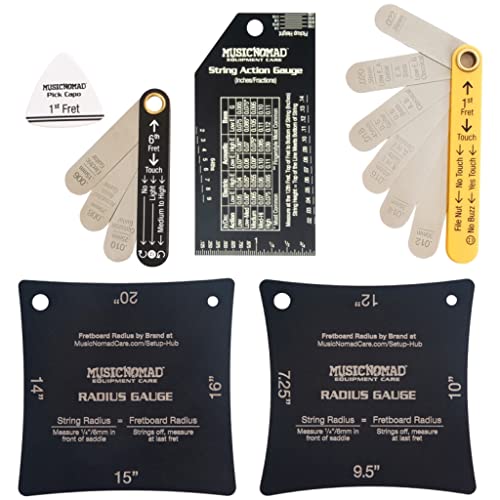
MusicNomad’s set emphasizes accuracy and readability. Each gauge is etched with clear numbers and includes printed instructions on the gauges themselves. The kit also features a dedicated truss rod relief measurement set (0.006″, 0.008″, 0.010″) and a truss rod relief reference, along with a circumferential radius gauge set (7.25”, 9.5”, 10”, 12”, 14”, 15”, 16”, 20”). An innovative pick capo is included to facilitate certain setups, and the durable stainless steel construction avoids messy oils associated with traditional feeler gauges.
Spurtar 32 Blades Feeler Gauges

This Spurtar set includes 32 blades spanning 0.0015” to 0.035” (0.04–0.88 mm). Crafted from #65 manganese steel, the blades are clearly marked for quick identification, and the set is foldable for compact storage. It suits guitarists needing precise spacing measurements and also serves other precision tasks such as spark plugs or piston gaps, making it a versatile tool for workshop drawers and luthier kits alike.
OEMTOOLS 25024 22 Blade Go-No-Go

OEMTOOLS delivers a compact, go-no-go gauge with 22 hardened blades. The blade protector with a thumb notch enables quick blade changes, improving workflow during detailed setup checks. While useful for automotive applications, the stem of the kit includes metric and SAE blades that translate well to guitar setup, especially when calibrating precise gaps in bridges, nut slots, or pickup heights. The dual-system blades broaden compatibility with different measurement standards commonly encountered by hobbyists and professionals.
Jiayouy 11 Pieces Guitar Luthier Tool Kit

Jiayouy’s kit focuses on understring radius gauges and a 32-blade feeler gauge for guitar and bass setups. The set emphasizes anti-rust and scratch-prevent features, with a 9×5.1 cm string action gauge and metric & imperial dual-scale etchings that stay legible over time. The included 32 blades cover typical spacing ranges, making it a practical choice for precise measurements of neck relief, bridge height, and nut slot depth in a single compact kit.
Buying Guide: Key Purchase Considerations
- Measurement range and clarity: Look for blades covering 0.0015” to 0.035” (0.04–0.88 mm) with clear, etched markings. Dual metric/imperial scales improve versatility.
- Durability and comfort: Stainless steel with smooth edges reduces hand fatigue and resists rust. Foldable designs protect blades when not in use.
- Included gauges: Ensure the set includes radius gauges matching common guitar neck radii and a truss rod relief range if your setup requires it.
- Calibration needs: Some sets provide go-no-go features or printed instructions on gauges, which can speed up adjustments and reduce guesswork.
- Storage and portability: A compact case or foldable design helps maintain blade integrity and makes field setups easier.
- Brand reliability: Reputable brands often offer better tolerances and longer blade life, reducing replacement costs over time.
- Use-case versatility: If you also work on other equipment (spark plugs, engines), a set with broad measurements can be more economical.
- Edge care: Avoid oils that can smear or corrode; opt for rust-resistant materials to maintain accuracy long-term.
When selecting a feeler gauge set for guitar setup, balance the breadth of measurements with ease of use and durability. For beginners, a compact kit with clear markings and included radius gauges can cover most common needs. For more advanced setups, look for additional truss rod relief measurements and a robust, readable action gauge. A modular set that combines a foldable feeler gauge with radius gauges and a portable storage option often provides the best value for a dedicated home workshop or professional luthier bench.