Best Dust Collectors for Power Tools: Top Picks for a Cleaner Shop
Finding the right dust collector for power tools can dramatically improve air quality and tool life in a home workshop. This guide highlights five proven options that align with common woodworking setups, from compact tabletop units to larger mobile systems. Each choice balances filtration, portability, and ease of use to help you choose the best fit for your shop size and projects.
Overview of Selected Products
| Product | Brand | Key Benefit |
|---|---|---|
| WEN DC1300 1,300 CFM Dust Collector | WEN | High airflow with dual inlets and a large 50-gallon bag |
| WEN DC3401 Woodworking Dust Collector | WEN | Compact, mobile with a 12-gallon bag; easy mobility |
| ROCKLER 9 Gal HEPA Dust Collector | ROCKLER | Auto-start via power tool, washable HEPA filtration |
| Delta 1-HP Dust Collector | Delta | All-in-one unit with multiple accessories and bags |
| Delmar Tools Low Profile Dust Separator | Delmar Tools | Lifetime warranty with high efficiency and quick attachment |
WEN DC1300 1,300 CFM Dust Collector

The WEN DC1300 delivers robust airflow suitable for larger hobby shops and woodworking setups. With a rated 1,300 CFM and dual 4-inch inlets, it can support multiple tools simultaneously, reducing ducting complexity and minimizing tool downtime. The 50-gallon vertical collection bag provides substantial dust capacity, helping to minimize interruptions during longer projects. A mobile base adds maneuverability, allowing you to reposition the unit as your workflow shifts—an important feature in flexible shop layouts.
Performance wise, the DC1300 balances power and practicality. It handles typical wood dust efficiently, and its filter and collection design help keep downstream tools cleaner. While it’s not the smallest option, its combination of airflow, bag capacity, and mobility makes it a strong candidate for homeowners expanding into more ambitious woodworking projects. If you frequently switch between cutting, sanding, and routing, this model’s dual inlets can simplify setup while maintaining strong suction. Consider pairing with sensitive dust separators if your space requires additional filtration.
WEN Woodworking Dust Collector, 5.7-Amp DC3401
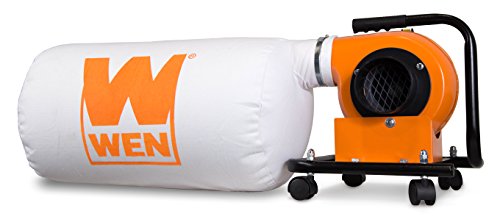
The WEN DC3401 offers a compact, budget-friendly option for small shops or users who value easy storage. Its 5.7-amp motor drives a 12-gallon collection bag and four-inch dust port for straightforward connections to common woodworking tools. The unit sits on a mobile base, enabling simple repositioning around a workspace, and its design emphasizes portability without sacrificing basic dust collection performance. For hobbyists performing occasional routing or sanding, this model provides a reliable, space-conscious solution that’s easy to set up and maintain.
Practical considerations for the DC3401 include its portable footprint and the trade-off of lower airflow compared to larger machines. If your shop runs a mix of light-to-moderate tasks and you don’t require continuous operation on multiple tools, this unit can be a smart, space-efficient pick. It pairs well with smaller dust separators or chip collectors to maximize filtration in tighter spaces.
ROCKLER 9 Gal HEPA Dust Collector

The ROCKLER unit emphasizes filtration and automation. It features HEPA filtration with auto-start tied to your power tools, ensuring dust collection activates as soon as a tool runs. A washable HEPA filter captures particles down to 0.3 microns, which helps maintain a cleaner workspace and reduces secondary dust. The system also includes a disposable filter bag for mess-free emptying and a compact 9-gallon tank with modest noise output, making it suitable for mid-sized shops where cleaner air is a priority and noise levels matter.
With its filter pulse cleaning and integrated storage, this option suits users who want lower maintenance and straightforward operation. It’s a good match for tools that generate fine dust, such as planers and routers, and it scales well for spaces where a larger full-size collector isn’t practical. The built-in auto-start makes it a drop-in upgrade for existing tool setups that already rely on automated dust control.
Delta 1-HP Dust Collector

Delta’s 1-HP model provides a balanced feature set for users wanting a robust stand-alone collector with broad compatibility. It includes a motor, blower, and support frame, plus a complete assortment of bags and a 4-inch intake port. The unit ships with multiple wheels and casters, facilitating movement around a workshop. This is a flexible option for garages where space can be reconfigured as projects change, or for hobbyists who frequently add new tools to their dust collection network.
Prospective buyers should note the included bags and the importance of proper filtration for long-term tool health. The Delta unit is capable of handling a range of tasks—from sanding to planing—without requiring immediate upgrade. It can serve as the core of a mid-sized dust collection system when paired with compatible ducting and tool ports. If you’re seeking a straightforward, reliable option with broad tool compatibility, this Delta model is worth evaluating.
Delmar Tools Low Profile Dust Separator

The Delmar Tools Low Profile Dust Separator emphasizes efficiency and durability with a lifetime warranty and USA-based customer service. It attaches to 5-gallon buckets and delivers high suction performance with a 2.5-inch hose and 90-degree adapter. The design aims for rapid setup and reduced clogging, making it a practical add-on for shops seeking a scalable approach to pre-separation before a larger dust collector or shop vac. This unit is particularly helpful for users who want a simple, reliable pre-separator that minimizes debris reaching the primary filtration system.
From a purchasing perspective, the lifetime warranty provides long-term assurance, while the compact, low-profile footprint supports tight spaces. It’s well-suited for occasional to moderate dust production and can be integrated with other dust collection components to create a layered filtration approach. If you value a durable, straightforward accessory that improves overall suction and reduces maintenance on downstream equipment, the Delmar option is worth considering.
Buying Guide: Key Purchase Considerations For Power Tool Dust Collectors
Choosing the right dust collector for power tools involves balancing airflow, filtration, capacity, and space. Consider these angles to refine your decision:
- Airflow and tool compatibility: Larger shops with planers, saws, and jointers benefit from higher CFM ratings. If your setup uses multiple tools at once, dual inlets or easy expansion paths help sustain suction.
- Filtration quality: HEPA filtration captures finer dust, which is especially important for health and indoor air quality. Decide between bag filtration, cartridge filters, or washable filters based on maintenance tolerance and budget.
- Capacity and disposal: A bigger collection bag reduces downtime for emptying. However, larger units require more space and may be less portable. Consider a separator if you want to pre-separate dust before the main bag.
- Mobility and footprint: Mobile bases and compact designs enable flexible shop layouts. If space is limited, prioritize models with lighter weight and easier maneuverability.
- Noise and energy use: Some units operate quietly, which can be significant in shared spaces or during evening work. Check decibel ratings where available and pair with energy-efficient motors if possible.
- Setup and compatibility: Look for units with standard 4-inch ports and easy-to-connect accessories. Auto-start features that kick in when a tool is powered on can simplify operation and improve consistency.
- Warranty and service: A lifetime warranty or strong customer support can offer peace of mind for long-term use, especially for DIY enthusiasts who rely on their dust collection system for many projects.
Comparison Snapshot: For most home workshops, a mid-to-large unit with at least 1,000 CFM, a sizable bag or tank, and the ability to accept multiple tools is a solid baseline. For spaces with tight footprints, consider compact models paired with effective pre-separators. If air quality is a primary concern, prioritize HEPA filtration and auto-start functionality.
Other considerations include the availability of replacement parts, the ease of maintenance (filters, bags, seals), and whether the system is compatible with existing shop vacs or dust extractors. Evaluate your typical projects, tool lineup, and how often you will move the unit around the shop to determine the best fit.