Best Compound Miter Saw Blades for Precise, Clean Cuts
Choosing the right compound miter saw blade can dramatically improve finish quality, reduce chipping, and extend blade life. This guide highlights five top-performing blades popular among American woodworkers for crosscuts, fine finishes, and durable performance on soft and hard woods. Each option balances kerf width, tooth design, and carbide quality to optimize cutting speed and precision on miters and bevels.
| Product | Brand | Key Benefit |
|---|---|---|
| Freud Thin Kerf Sliding Compound Miter Saw Blade | Freud | Premium TiCo carbide; 5° negative hook for smooth, controlled cuts |
| CMT 253.060.08 ITK Industrial Finish Blade | CMT ORANGE TOOLS | Fine finish crosscuts; ATB+G tooth grind for glass-smooth results |
| WEN BL1080 80-Tooth Ultra-Fine Finish Blade | WEN | Ultra-thin kerf; optimized for clean, precise miters |
| Makita A-93681 80-Tooth Micro Polished Blade | Makita | ATAF tooth design; ultra-smooth, accurate cuts |
| CMT P08060S ITK Plus Finish Blade | CMT ORANGE TOOLS | ATB+Shear grind; fine finish for soft/hardwood and laminates |
The following sections detail each blade’s strengths, ideal applications, and what to consider when buying. The goal is to help readers compare performance characteristics such as kerf width, tooth geometry, and carbide grade to match their project needs.
Freud Thin Kerf Sliding Miter Blade

- Negative Hook Angle: 5° negative hook helps prevent aggressive biting and promotes controlled feeding toward the fence.
- Premium TiCo Carbide Blend: High-density crosscutting carbide for durability, edge retention, and reliable performance on tough woods.
- Thin Kerf Design: Removes less material, requiring less horsepower while delivering clean, precise cuts.
Best use: Fine crosscuts and precise miters on a variety of hardwoods and softwoods. The combination of TiCo carbide and negative hook makes it suitable for clean, repeatable results in cabinetry, trim work, and finish carpentry.
CMT 253.060.08 ITK Industrial Finish Blade

- Fine finish crosscuts with glass-smooth results for miters and bevels.
- Designed for compound miter saws; handles soft/hardwood, plywood, and laminates.
- 0.087 kerf thickness; 7° hook angle; 1 flat + 2/15° alternate teeth grind for precision.
Best use: High-quality finishing work where surface preparation is critical, such as cabinetry and decorative trim that requires minimal touch-up after cutting.
WEN BL1080 80-Tooth Ultra-Fine Finish Blade
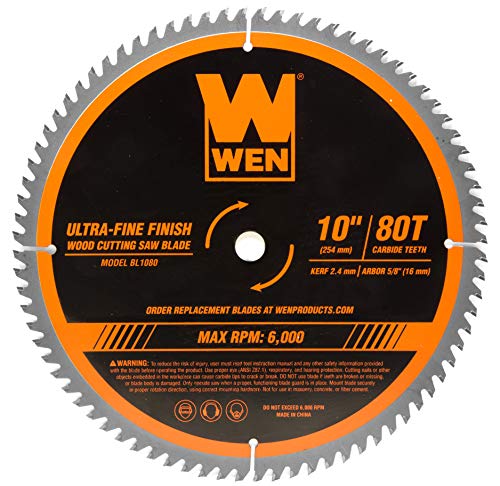
- 10-Inch, 80-tooth carbide-tipped blade with a 5/8-inch arbor; rated up to 6000 RPM.
- Ultra-thin 1/10-inch kerf (2.4 mm) for clean, efficient cuts with minimal waste.
- Optimized for both miter and table saw applications, delivering smooth finishes on soft and hard woods.
Best use: Precision finish work where ultra-smooth surfaces are required, such as cabinet doors, moldings, and fine trim installations.
WEN BL1060 60-Tooth Fine-Finish Blade
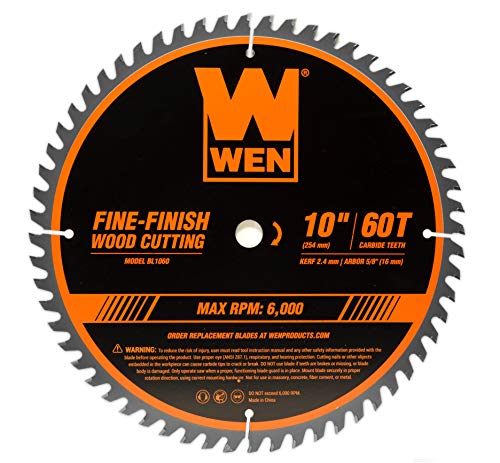
- 10-Inch blade with 60 teeth and a 5/8-inch arbor; crafted for fine finish work.
- Ultra-thin kerf design ensures clean cuts with less motor load.
- Suitable for miter saw and table saw use; balances cutting speed with finish quality.
Best use: Finishing work where a balance of speed and surface quality is needed, including trim and panel edge treatments.
Makita A-93681 Micro Polished Mitersaw Blade

- ATAF tooth design for ultra-precision cutting; micro polished finish for smoother cuts.
- Japanese ultra-thin kerf carbide-tipped design reduces drag and reduces motor load.
- Fully hardened and hand-tensioned steel plates ensure true, accurate results.
Best use: High-precision miter and bevel work where repeatable, square corners are essential, such as picture frames, fine cabinetry, and trim installations.
CMT P08060S ITK Plus Finish Blade

- 8-1/2 inch by 60 teeth; 10° ATB+Shear grind for a refined finish.
- 0.069 kerf thickness; 0.043 plate thickness supports clean, precise cuts.
- Well-suited for softwood, hardwood, plywood, and laminates on compound miter saws.
Best use: Finishing cuts where a glass-smooth surface is desired, especially on delicate or dense laminates and fine plywood sheets.
Buying Guide: Key Purchase Considerations
- Tooth geometry and grind: ATB, ATB+Shear, and TiCo carbide blends impact finish quality and edge longevity. For fine finishing, look for micro-polished edges and smoother tooth patterns.
- Kerf width: Thin kerf blades require less horsepower and reduce wood waste, ideal for portable setups and lower-powered saws.
- Material compatibility: Some blades are optimized for hardwoods, softwoods, laminates, or plywood. Match blade to typical stock types.
- Arbor compatibility: Confirm bore size (commonly 5/8 inch) and compatibility with your saw’s arbor to avoid vibration or misalignment.
- Finish goals: For cabinetry and finish carpentry, prioritize blades advertised as “finish” or “industrial finish” with smooth edge results. For rough cuts, standard crosscut blades may suffice but may require additional sanding later.
- Durability vs. cost: Premium carbide blends and special grindings provide longer life and cleaner cuts under heavy use, but may come at a higher upfront cost. Consider project frequency and material mix to determine value.
The blades listed above cover a range of crosscut and finish needs, from ultra-fine finishes to durable crosscuts on mixed stock. When selecting, consider the typical materials, cut quality desired, and the capacity of your miter saw to ensure optimal results.