Best Circular Saws for Woodworking: Top Picks for 2025
Woodworking requires power, control, and reliability. A circular saw is a workhorse for framing, decking, cabinetry, and finish work. The five saws below balance motor strength, blade availability, depth and bevel capacity, and portability. Each option serves different project scales—from quick trim cuts to thick framing. Use the quick summary table to compare core specs at a glance, then read detailed insights to choose the right saw for your needs and budget.
| Product | Brand | Power (Amps) | Blade Size | Notable Feature |
|---|---|---|---|---|
| Skil 5080-01 | Skil | 13 | 7-1/4″ | Bevel up to 51°; lighter than older SKIL models |
| Enventor 7-1/4″ | Enventor | 10 | 7-1/4″ | Laser guide; adjustable depth |
| Skil 5280-01 | Skil | 15 | 7-1/4″ | Single beam laser; high RPM |
| GALAX PRO 11 Amp | GALAX PRO | 11 | 7-1/4″ | 6000 RPM; depth/bevel adjustment |
| WORKPRO 5.8Amp | WORKPRO | 5.8 | 4-1/2″ | Compact; includes parallel guide |
Skil 5080-01 13-Amp Circular Saw

The Skil 5080-01 pairs a robust 13-amp motor with a lighter frame to reduce user fatigue during extended sessions. Its 7-1/4-inch carbide blade handles common wood cuts with confidence, while the bevel range reaches up to 51 degrees with positive stops for precise angle control. The balance and ergonomics support comfortable gripping and stable tracking on long rips, crosscuts, and bevel cuts. This model is well suited for framing or decking tasks where both speed and consistency matter, and it accepts standard blades found in most wood shops.
Users benefit from a durable chassis that resists common jobsite abuse, plus a straightforward blade-changing process facilitated by a spindle lock. While aimed at serious projects, the saw remains approachable for DIYers thanks to predictable performance and reliable cut quality. The 13-amp power ensures steady performance even when crossing through denser hardwoods. Overall, the Skil 5080-01 is a balanced choice for workshops that value power without excessive weight.
Enventor 7-1/4-Inch Circular Saw

The Enventor model features a 10-amp electric motor designed for fast, clean cuts through wood, laminate, and plastics. It comes with two blades (40T and 24T) to optimize both rough framing and precise finishing tasks. A laser guide and a scale ruler help align cuts, while the adjustable cutting depth and 0°–90° bevel range expands versatility for various angles and thicknesses. The rear axle lock button simplifies blade changes when replacing blades, maintaining workflow efficiency. A 6.56-foot power cord enhances mobility around larger jobsites or workshops.
Bevel and depth adjustments support a wide range of woodworking applications—from simple straight cuts to intricate bevels on cabinetry. The built-in laser acts as a visual alignment aid, improving consistency across cuts. While compact, the tool delivers notable performance, making it a practical option for DIYers seeking accuracy without heavy equipment. The laser, guides, and dual blades collectively extend the saw’s utility for hobbyists and light professionals alike.
GALAX PRO 11 Amp Circular Saw

The GALAX PRO circular saw is built around an 11-amp copper motor delivering strong performance and a 6000 RPM no-load speed. It features a 7-1/4-inch blade and adjustable cutting depth, enabling practical 90° and beveled cuts from 2-1/2″ down to 1-7/8″ as angles shift from 90° to 45°. This combination makes it suitable for framing and carpentry tasks that require steady feed rates and clean edges. A reliable safety design helps mitigate accidental starts, while a robust base plate supports stable tracking during long rip cuts and bevel adjustments.
For projects emphasizing durability and high-speed cutting, the GALAX PRO model provides a good balance of power, depth versatility, and control. It suits hobbyists expanding from basic cuts to more complex bevels, as well as professionals who need a dependable saw without the extra weight of heavier brands. The tool’s balance and power make it a dependable option for mid-scale shop work and on-site jobs.
WORKPRO 5.8Amp Circular Saw

The WORKPRO 5.8-Amp circular saw delivers a compact 5.8-amp motor with 3,500 RPM no-load speed, making it a practical choice for light- to mid-duty woodworking, PVC, tile, and soft masonry tasks. Weighing just over five pounds, it minimizes hand fatigue during extended sessions. It offers adjustable cutting angles from 0° to 45°, with a maximum depth of 1-11/16″ at 90° and 1-1/8″ at 45°, enabling bevel cuts for small framing or trim work. A parallel guide enhances straight-cut accuracy, while the dust hose and vacuum adapter help maintain a cleaner workspace.
This model is well-suited for hobbyists who need a compact, affordable saw for occasional cuts, as well as for workshop corners where space is at a premium. While not as powerful as larger models, its portability and included guides provide solid value for simpler woodworking tasks and DIY repairs.
Skil 5280-01 Circular Saw
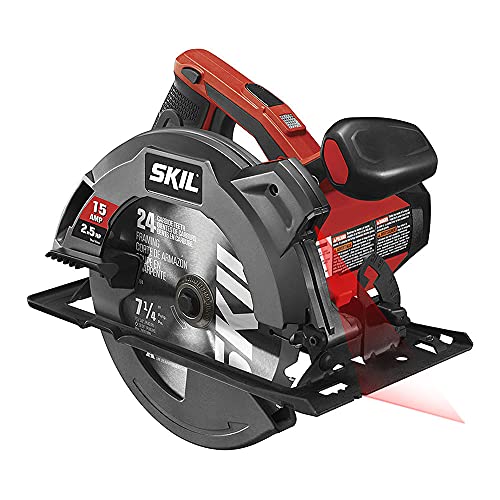
The Skil 5280-01 pushes into higher power territory with a 15-amp motor delivering up to 5,300 RPM for faster, thicker cuts. It includes a 7-1/4-inch carbide-tipped blade and a spindle lock to simplify blade changes when changing blades between different materials. Its bevel capacity reaches up to 51 degrees, with a positive stop at 45°, enabling a broad range of cutting angles for framing, decking, and trim tasks. This model targets users who regularly work with dense hardwoods and require quick, repeatable cuts with reliable accuracy.
Beyond raw power, the Skil 5280-01 emphasizes usability and durability, ensuring steady performance on longer projects. The combination of ample motor, solid cut depth, and familiar blade-change features makes it a versatile option for serious hobbyists and professional carpenters who value speed and consistency in daily tasks.
Buying Guide
Power and performance: For most woodworking tasks, a 10–15 amp saw provides ample torque for dense hardwoods and thick stock. Lighter 5–8 amp tools excel for trim work and soft woods but may stall on heavy cuts. Consider a model with a steady no-load speed (RPM) and a motor designed for sustained use rather than occasional bursts.
Blade size and depth: A 7-1/4-inch blade is the standard for many plywood and framing cuts, offering a good balance between depth and weight. Check the maximum cutting depth at 90° and 45° so you can plan bevel work and nesting cuts. Some compact models use smaller blades (e.g., 4-1/2″), which are great for tight spaces but require more passes for thick stock.
Bevel range and stops: Bevel capacity from 0° to at least 45° is common. Positive stops at familiar angles (e.g., 15°, 22.5°, 33.9°, 45°, 51°) speed setups for common cuts. If you frequently tilt for bevel joinery or mitered frames, a wider range and sturdy stops help maintain accuracy.
Ergonomics and weight: Heavier saws reduce control in long sessions, while lighter models can vibrate more and fatigue the wrist. Look for balanced weight distribution, comfortable handles, and a design that minimizes kickback. A soft-start or vibration-reducing features can also improve comfort during extended use.
Guides, lasers, and dust: A laser guide or line-utility marks improve cutting accuracy on visible stock. A parallel guide or rip fence helps straight cuts, especially when working with long stock. Dust collection compatibility or a rugged dust hose reduces cleanup time and improves visibility on the workpiece.
Durability and maintenance: Spindle locks simplify blade changes, and a robust base plate resists bending during heavy cuts. Check for easy blade replacement, availability of replacement blades, and compatibility with common 7-1/4″ blades. A proven chassis and durable materials extend tool life in workshop or jobsite environments.
Use-case scenarios:
– Framing and decking: Prioritize high amperage, stability, and depth to handle dense stock quickly.
– Cabinetry and trim: Favor models with clean cutting finishes, precision guides, and bevel accuracy.
– DIY and portable work: Choose lighter models with effective guides and comfortable grips for on-site performance.
In summary, pick a saw that aligns with your typical projects. For frequent heavy cuts, a 15–16 amp tool with robust bevel capacity and a reliable guide system offers the best blend of speed and precision. For occasional, lighter DIY tasks, a compact 5–6 amp model with a parallel guide and dust management can be a smarter, more portable choice. Always balance power with ergonomics to sustain performance across long sessions.